A solo creator's AI video editing pipeline from camera to publication

A Solo Creator's AI Video Editing Pipeline That Actually Works

Last winter I ran a very ugly set of numbers. I’d spent an entire afternoon in a café, writing code and shooting footage in between — about forty minutes of material across phone and screen recording. I started editing that evening and exported at 1:30 in the morning. The finished cut was fifty-eight seconds. Forty minutes of footage. Six hours of editing. Fifty-eight seconds of output. And the numbers on it were mediocre. ...

July 19, 2026 · 24 min · 4918 words · Xinwei Xiong, Me
When Anyone Can Build the Thing, "He Built It" Becomes the Signal

When Anyone Can Build the Thing, "He Built It" Becomes the Signal

Same product, different name, different score There’s something I’ve been watching for a long time without finding the right place to write it down. In the same product community, you’ll regularly see two small tools with nearly identical features. One launches and sinks without a trace; the other gets shared repeatedly and draws serious questions. Look at both product pages: similar craftsmanship, similar pricing, landing pages built from the same template, even. The real difference sits in the small line under the maker’s name — “maintainer of such-and-such project,” “has written about xx for three years.” ...

July 19, 2026 · 29 min · 6026 words · Xinwei Xiong
Distribution for solo builders: a durable audience outlasting copied products

Distribution for Solo Builders: Your Readers Can't Be Copied

I wasted years on this one sentence “If the product is good enough, people will come.” I believed that line for years. It fits the engineer’s worldview: code is verifiable, performance is measurable, and there’s an objective difference between good and bad. If the difference is objective, then the good thing winning is just a matter of time — the market is efficient, it just needs a while. That was my logic through my open-source years. Write the project well, keep test coverage high, take the docs seriously, and then wait. Wait for stars, wait for issues, wait for someone to mention it in a blog post somewhere. Sometimes the wait paid off. More often it didn’t. And every time it didn’t, my first reaction was the same one: the thing isn’t good enough yet, go back and keep improving it. ...

July 19, 2026 · 24 min · 5000 words · Xinwei Xiong, Me
AI Writes Requirements for Free, and That's the Most Dangerous Part

AI Writes Requirements for Free, and That's the Most Dangerous Part

One morning, and three things that shouldn’t exist One morning I got up, made coffee, opened my laptop, and found the agents I’d left running overnight all parked at “done”: one had added full multilingual support to a small tool of mine — Chinese, English, Japanese copy, an i18n layer extracted; one had built reading-progress analytics for my blog; one had refactored a CLI I wrote six months ago into a plugin architecture. The code was clean. The tests were green. ...

July 19, 2026 · 32 min · 6720 words · Xinwei Xiong
I Ran Ten Agents Overnight, Woke Up to Ten PRs, and Then I Got Stuck

I Ran Ten Agents Overnight, Woke Up to Ten PRs, and Then I Got Stuck

This is part two of “The Super Individual’s Gear Stack.” If you haven’t read the overview , start there — every judgment in this piece rests on the yardstick that essay proposed: does an advance in a layer of gear help only you, or does it help all of your competitors at the same time? ...

July 19, 2026 · 32 min · 6628 words · Xinwei Xiong
Four-layer stack rising from AI production tools through judgment and distribution to reputation

The Four-Layer AI Stack for Super Individuals: What Actually Compounds

The fifteenth tool list changed the question Over six months, I read roughly twenty or thirty “AI-era super individual” tool lists. Around the fifteenth, the pattern became hard to ignore: the lists differed far less than the competitive advantage each one promised. I use most of the tools they recommend. The problem was not that the recommendations were bad. It was that ten thousand builders could install the same stack in the same week. Their absolute capacity might rise, while the distance between them barely moved. ...

July 19, 2026 · 11 min · 2221 words · Xinwei Xiong, Me
A narrow blue passage beyond a crowded red ocean, representing defensible AI agent businesses

Where AI Agents Still Have a Blue Ocean

Suppose you had to place a bet today on one direction in AI agents. What is the first question you should ask? Most people ask whether the thing can be built. By mid-2026, that is often the least interesting part. The colder question is: why has nobody made this opportunity routine yet? The answer is a useful filter. If nobody has solved it because everyone just noticed it, competition is probably coming. If nobody has solved it because the work is dirty, slow, and carries consequence, there may be something defensible—or there may be no market. The rest of the article is how I try to separate the two. ...

July 15, 2026 · 28 min · 5843 words · Xinwei Xiong, Me
A personal intelligence pipeline connecting monitored sources to evidence, judgment, and action

Build a Personal Intelligence System That Leads to Action

The quiet dashboard can be the dangerous one A morning briefing with no new items may mean that nothing relevant happened. It may also mean an RSS route broke, an API began returning empty pages, or a credential expired during the night. From the reader’s side, those very different states look identical: silence. That is the first lesson of a personal intelligence system. Gathering more information is easy to demonstrate; knowing whether the machine is healthy, whether its summaries are faithful, and whether a signal deserves action is the real work. The system I want is not an account that publishes automatically. It is a pipeline that can show me what changed, why it may matter, what evidence supports the claim, and which decision—if any—should follow. ...

July 15, 2026 · 12 min · 2452 words · Xinwei Xiong, Me
A measured cost test for routing work across an agent fleet

Agent Fleet Economics in 2026: Testing Low-Cost APIs and Open-Weight Options

How many agents can one person afford to keep running? The wrong way to answer is to count agents. An “agent” might classify one paragraph, search for twenty minutes, or refactor a repository through eighty tool calls. The useful unit is not the agent. It is the successful task, with its input tokens, output tokens, tool charges, retries, and human cleanup attached. That distinction changed how I think about two related but different choices: low-cost hosted model APIs and open-weight models that can be self-hosted. Falling API prices matter, but “90% cheaper” is meaningful only when three things are visible: ...

July 15, 2026 · 12 min · 2346 words · Xinwei Xiong, Me
An AI news pipeline reaching the boundary between automation and human judgment

AI News Pipelines: Automation Limits and Human Judgment

Suppose you ask an AI system to track one field — papers, releases, benchmarks, first-party changelogs, and the conversations around them. How far can it get on your behalf? This essay is not a census of every product. It is a field note from the systems I tested between January and June 2026, across AI research and developer-tool sources. In that sample, three patterns kept recurring: subscription aggregation, change monitoring, and agentic search. They were capable, but they shared a boundary: automation can haul information remarkably well; without your goals, context, and feedback, it cannot reliably make the final judgment for you. ...

July 15, 2026 · 17 min · 3431 words · Xinwei Xiong, Me
Knowledge cards moving through an AI-assisted creation pipeline toward an audience, then returning as a measured feedback loop

AI Content Creation Workflow: Turning Knowledge Into Work People Want

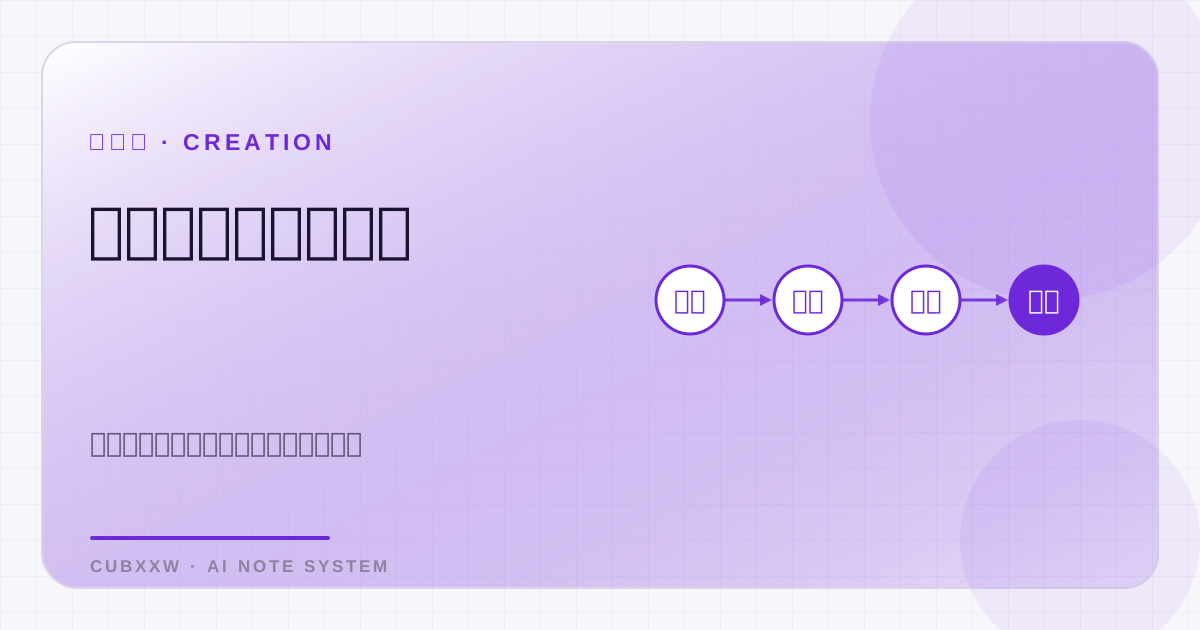
Creation Is the Outward Half We’ve reached the final layer. Information has been denoised, records have been sedimented, knowledge has been structured into repeatedly callable capability — but up to this point, every stage has been solving your own problem. Knowledge makes you stronger, but it doesn’t automatically turn into something others want to read. Creation is the layer that reverses the direction of this pipeline. Knowledge faces inward; creation faces outward. Knowledge asks “can I reuse this”; creation asks “can others receive this.” Creation corresponds to a platform’s recommendation logic, a particular group of users’ reading habits, and the substantial research you did to support this specific piece of expression. It has exactly one goal: have the audience receive it, understand it, and want to connect with you. ...

July 11, 2026 · 12 min · 2476 words · Xinwei Xiong, Me
The Super-Individual Stack: AI-Native Product Directions and Solo Builder Ops in 2026

The Super-Individual Stack: AI-Native Product Directions and Solo Builder Ops in 2026

“Software is eating the world.” — Marc Andreessen, 2011 “Now AI is eating software—and the question for the rest of us is: what’s left for one human, alone, in front of a screen?” — me, asking myself one night in 2026. Prologue: How Big Does One Person Need to Be? In February 2026, I ran my first complete overnight agent. I set a prompt, dropped it into Claude Code in a loop, and went to sleep. At 7 a.m. the next morning, what I saw on the screen was: 6 commits, 4 PRs, 3 auto-rolled-back failures, and a research brief I hadn’t even read myself. ...

June 24, 2026 · 21 min · 4314 words · Xinwei Xiong, Me