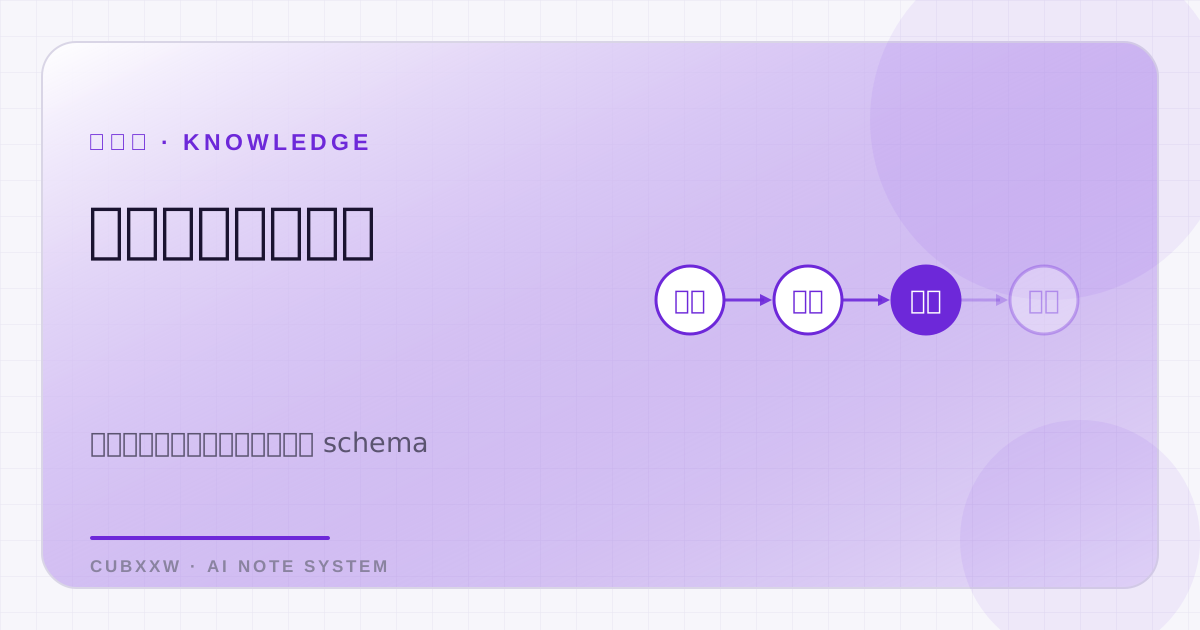
Draft records passing an evidence gate into retrievable knowledge cards, then returning through a review and retirement loop

AI Knowledge Base Workflow: Turn Notes Into Verified, Reusable Capability

Growing Bigger, Getting Less Useful We’ve reached layer three. Information has been captured and denoised; records have been written down and polished into semi-finished products — now the question is: how do you turn these semi-finished products into actual knowledge? Let’s start with a definition. Knowledge is structured, repeatedly reusable material relevant to you: a mental model, a handful of skills, a methodology, along with your judgment, positioning, and values. Its keyword is reusability, and it solves your own problems. ...
July 11, 2026 · 11 min · 2202 words · Xinwei Xiong, Me
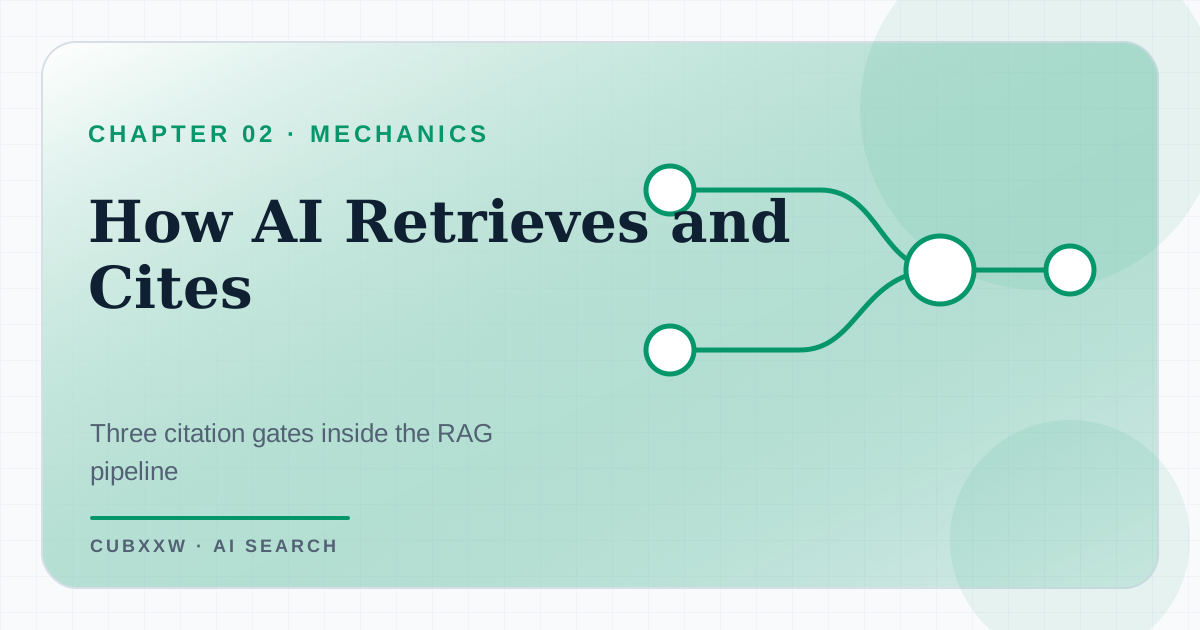
A testable model of AI search retrieval, source selection, answer use, and citations

How AI Search Retrieves and Cites Sources: A Testable GEO Model

The answer first: there is no universal citation algorithm AI search does not expose one shared pipeline that publishers can reverse-engineer into a recipe. Google documents retrieval-augmented generation and query fan-out for AI Overviews and AI Mode. Perplexity documents real-time web search, synthesis, and source links. OpenAI says ChatGPT search uses third-party search providers and content supplied directly by partners. None of those statements proves that the products share the same index, chunker, lexical retriever, vector store, reranker, prompt assembly, or citation policy. ...

July 11, 2026 · 13 min · 2577 words · Xinwei Xiong, Me
A quiet archive of linked memory cards illustrating Mem0 OSS v3 retrieval

Mem0 OSS v3 in Practice: Memory Architecture, Retrieval, and Trade-offs

This project note is part of my attempt to understand open-source AI systems by building with them, reading their migrations, and writing down where the abstraction holds—and where it leaks. Project learning list The problem is not remembering more An LLM can carry a conversation while the relevant messages still fit inside its context window. That is short-term continuity, not memory in the human sense and not durable application state. When the session ends, the model does not naturally retain that a user prefers terse answers, changed jobs last month, or abandoned an earlier plan. ...

May 9, 2025 · 11 min · 2303 words · Xinwei Xiong, Me
Blank cards passing through a wooden ranking staircase toward a reader

LLM Recommendation Systems: Retrieval, Ranking, RAG, and Evaluation

Recommendation systems create a tempting illusion: the newer the model, the more advanced the system. Anyone who has operated one knows that the model is only the part above water. Below it sit exposure bias, latency budgets, feature freshness, inventory constraints, exploration risk, and counterfactual evaluation. Large language models add a useful semantic layer, but they do not make those older problems disappear. They also introduce new ones: higher cost, variable output, and explanations that can sound persuasive without reflecting the reasons an item was ranked. ...

April 23, 2025 · 18 min · 3653 words · Xinwei Xiong, Me
A research notebook connecting source pages, citations, and synthesized outputs

Gemini Notebook (Formerly NotebookLM): A Source-Grounded Research Workflow

On July 16, 2026, Google renamed NotebookLM to Gemini Notebook. The old name will remain in search results, screenshots, and habits for a while, but the product did not disappear. Google describes it as the same standalone research tool, now connected more closely to the Gemini app and, eventually, Google Search. The rename also marks a larger change: notebooks are becoming places where software can not only read sources, but also run analysis against them. ...

April 21, 2025 · 18 min · 3787 words · Xinwei Xiong, Me
Documents flowing through a measured conversion pipeline into structured Markdown

Microsoft MarkItDown 0.1.6: A Practical Document-to-Markdown Guide

A document converter is a bridge, not a source of truth. The important question is not whether the output looks clean at first glance, but whether the bridge preserves the evidence your next system needs. MarkItDown is easy to demonstrate: install a package, pass it a file, receive Markdown. The difficult work begins one minute later. A PDF may contain selectable text, scanned pages, diagrams, tables, or all four. A slide deck may hide essential numbers inside screenshots. A spreadsheet may be understandable only through formulas, merged cells, and spatial relationships. No single conversion mode handles every case equally well. ...

April 21, 2025 · 15 min · 3073 words · Xinwei Xiong, Me
A restrained editorial illustration of connected paths representing models, agents, and graph workflows

LangChain 1.x in Production: Choosing Models, Agents, and LangGraph

LangChain used to be introduced as a box of chains, memory classes, prompt templates, loaders, and integrations. That description is historically accurate and operationally unhelpful. As of July 2026, the useful way to understand LangChain 1.x is much narrower: Call a model directly when the task is one inference with a clear input and output. Use create_agent when a model must choose among tools in a conventional model–tool loop. Use LangGraph when your application has durable state, explicit branches, retries, parallel work, long-running steps, or human decisions that are part of the workflow. This is not merely a taxonomy. It is an engineering rule about where complexity should live. Every framework abstraction creates a second system beside your product: another execution model, another vocabulary, and another place for failure to hide. The abstraction earns its place only when it makes the real system easier to operate. ...

April 16, 2025 · 15 min · 3178 words · Xinwei Xiong, Me
GPT Researcher pipeline from query planning and retrieval to a cited report

GPT Researcher Guide: Python, Docker, MCP, Costs & Limits

A long report can look like certainty while merely arranging uncertainty more elegantly. The useful question is not how many pages an agent writes, but how a claim entered the report and whether a reader can walk back to its source. The short verdict GPT Researcher is a good fit when a team needs a programmable research pipeline, source traceability, and deployment control. It is not a truth machine. It automates planning, retrieval, context assembly, and report writing; it does not make weak pages authoritative or make every citation support the sentence beside it. ...

April 14, 2025 · 10 min · 2024 words · Xinwei Xiong, Me
A layered search system connecting multimodal data, embeddings, reranking, and grounded answers

Jina AI in 2026: Embeddings, Reranking, Reader, and Jina Serve

Jina used to be easiest to explain as a cloud-native neural-search framework. That description is still true, but it is no longer sufficient. In 2026, the name covers two related products: Jina Search Foundation: hosted APIs and model families for embeddings, reranking, web reading, search, and research. Jina Serve: the open-source framework for turning Python AI components into services and composing them into distributed flows. The distinction matters. Search Foundation gives an application retrieval intelligence; Jina Serve gives a team control over how its own services run. One is a set of capabilities, the other an orchestration layer. Treating them as interchangeable usually leads either to unnecessary infrastructure or to a hosted dependency that was never consciously chosen. ...

April 12, 2025 · 12 min · 2381 words · Xinwei Xiong, Me
LangChain 1.x architecture connecting models, agents, memory, retrieval, and observability

LangChain 1.x in Practice: A Developer Guide to Reliable Agents

A framework is most dangerous not when it lacks features, but when its old tutorials still look plausible. Familiar code can cross a version boundary long before it produces an obvious error. This guide follows the current LangChain Python 1.x path: model calls, agents, tools, structured output, middleware, memory, RAG, SQL, Ollama, and LangSmith. It is deliberately different from a framework overview. The aim is to leave you with a compact application architecture, runnable examples, and a way to recognize code that belongs to the 0.x era. ...

May 22, 2024 · 11 min · 2221 words · Xinwei Xiong, Me
From Language Models to RAG: Capabilities, Limits, and Engineering

From Language Models to RAG: Capabilities, Limits, and Engineering

Introduction: Do Not Learn the Model from the Chat Window The first encounter with a large language model creates a powerful illusion. Something on the other side of the screen appears to have read widely, reasoned carefully, and chosen to explain itself. It can write code, summarize papers, preserve a tone across a conversation, and offer a polished rationale for an answer that is completely wrong. The chat window shows behavior, not mechanism. Fluency hides missing evidence. Completeness hides uncertainty. A human voice invites us to overestimate how firmly the model is connected to the world. ...

May 15, 2024 · 20 min · 4118 words · Xinwei Xiong, Me
From 2024 AI field notes to a reliable production RAG system

2024 AI Field Notes, Reassessed: From Emergence to Production RAG

This article began as notes from a large-language-model meetup in January 2024. Back then, the question was what a model could do. Two years later, the harder question is why anyone should trust the system around it. I have not polished the old notes into a story in which every early judgment was right. Mistakes are useful sediment. They remind us that a technical opinion is not a prophecy; it is a bet with an expiry date. Each section therefore keeps the 2024 observation and adds a 2026 reassessment: still true, changed, or wrong at the time. ...

January 14, 2024 · 11 min · 2234 words · Xinwei Xiong, Me