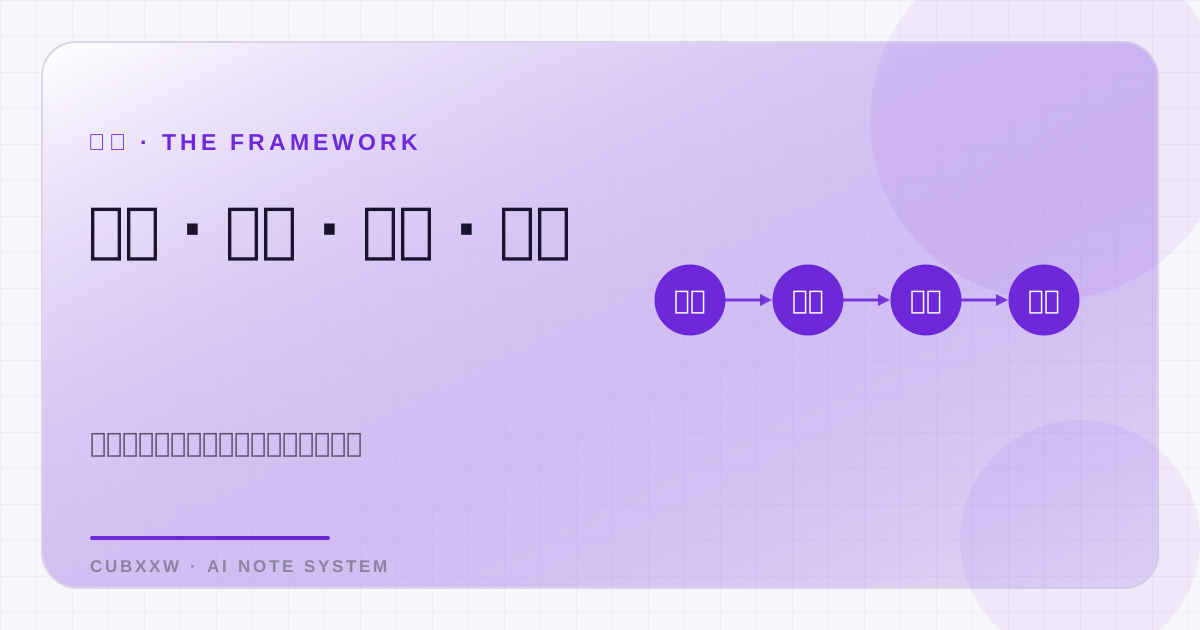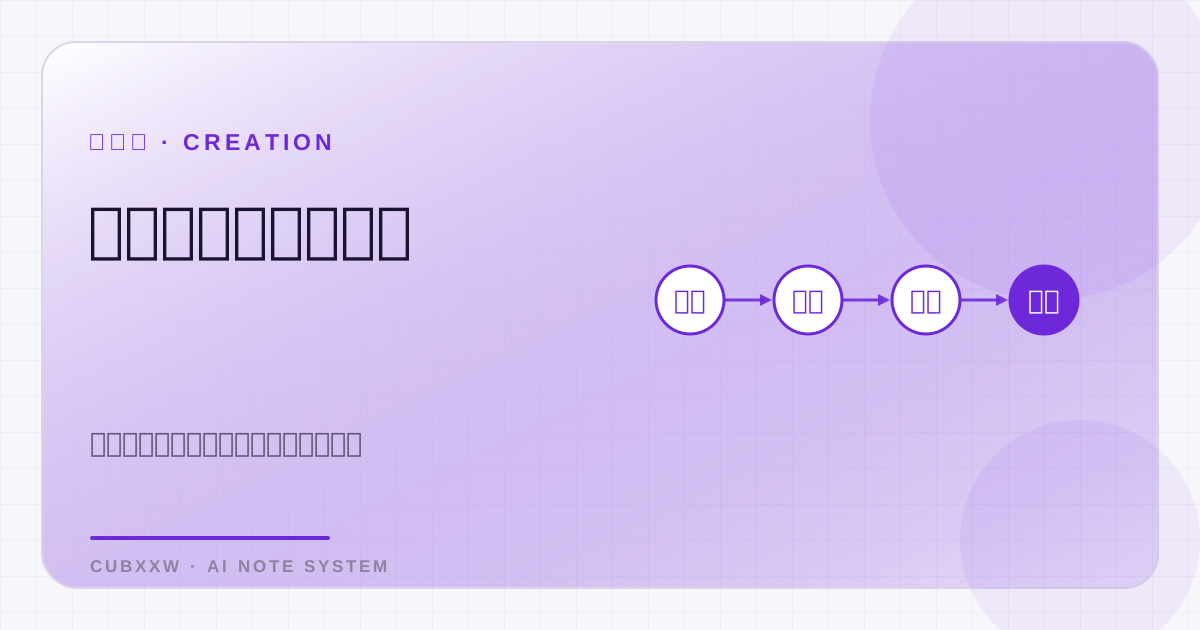
Knowledge cards moving through an AI-assisted creation pipeline toward an audience, then returning as a measured feedback loop

AI Content Creation Workflow: Turning Knowledge Into Work People Want

Creation Is the Outward Half We’ve reached the final layer. Information has been denoised, records have been sedimented, knowledge has been structured into repeatedly callable capability — but up to this point, every stage has been solving your own problem. Knowledge makes you stronger, but it doesn’t automatically turn into something others want to read. Creation is the layer that reverses the direction of this pipeline. Knowledge faces inward; creation faces outward. Knowledge asks “can I reuse this”; creation asks “can others receive this.” Creation corresponds to a platform’s recommendation logic, a particular group of users’ reading habits, and the substantial research you did to support this specific piece of expression. It has exactly one goal: have the audience receive it, understand it, and want to connect with you. ...
July 11, 2026 · 12 min · 2476 words · Xinwei Xiong, Me
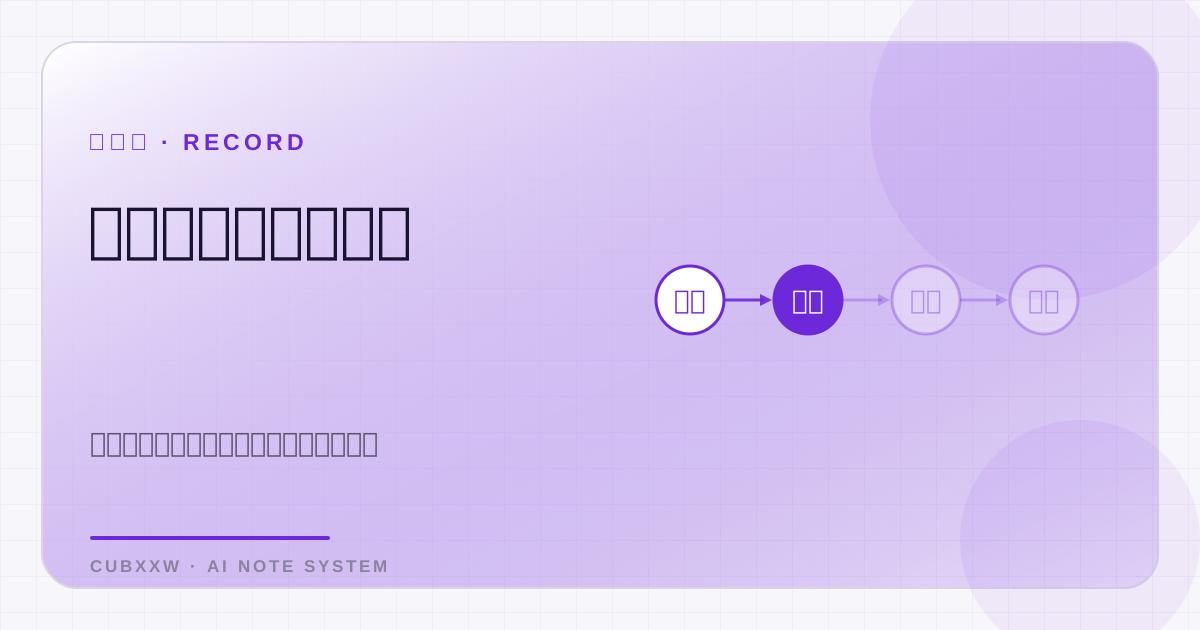
Text, voice, screenshots, code changes, and decisions moving through capture, clarification, and review toward a verified knowledge card

AI Note-Taking Workflow: Turn Fleeting Inputs Into Verifiable Records

The Semi-Finished Product Filed Under “Knowledge” In most people’s mental model, notes only have three tiers: see information → turn it into knowledge → use it to create. The act of “recording” in between gets quietly filed under “knowledge.” But as I said in the overview, records deserve to stand alone as their own layer. Because it’s an independent intermediate form: it’s relevant to you, but not necessarily useful forever; it might just be something you’ll need someday, or something you’re using right now to clarify your own thinking. That kind of thing doesn’t yet qualify as knowledge — only what’s structured for repeated future reuse counts as knowledge. ...

July 11, 2026 · 10 min · 1923 words · Xinwei Xiong, Me
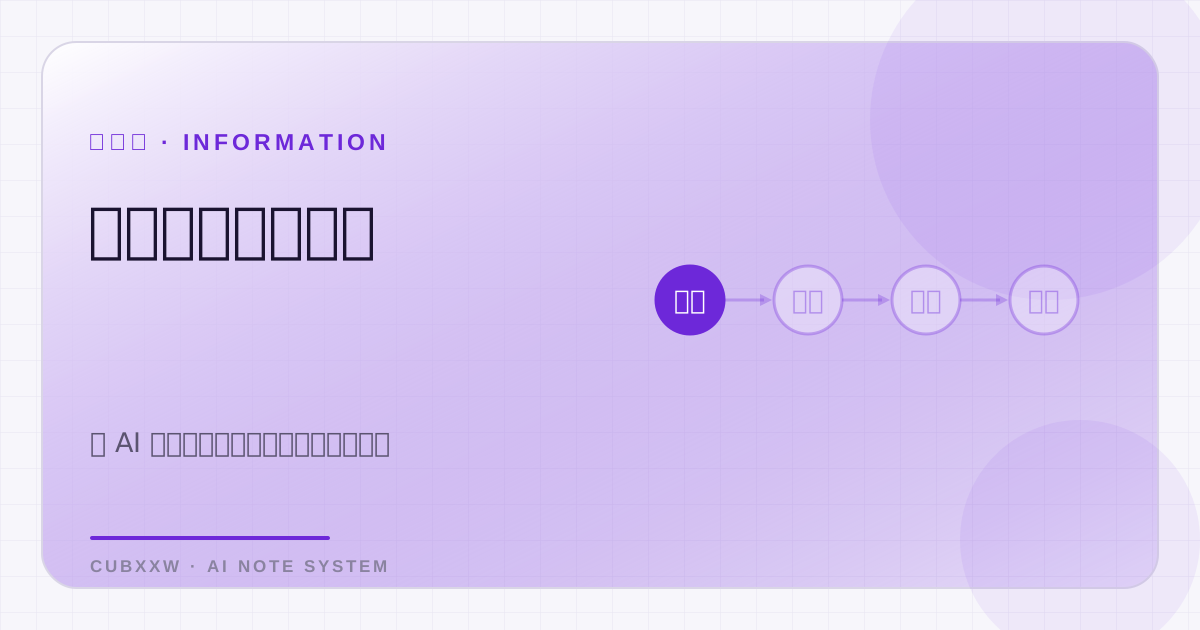
Sources passing through relevance, privacy, and verification gates before AI-assisted processing and entry into the records layer

AI Information Filtering Workflow: Capture Signal Without a Noise Archive

The Default State of Information Is Noise The previous essay laid out the framework: information, records, knowledge, and creation are four distinct stages. This one deals with only the first — information. The single most important thing to understand about information is this: its default state is noise. We have a natural greed for information. See a good article, want to bookmark it. See a great quote, want to save it. See a reading list someone recommended, want to add it to your queue. Every act of “saving” gives us a small illusion of “I’m making progress.” But saving, at its core, is just moving information from someone else’s warehouse into yours — it hasn’t gone through any processing by your own machine. ...

July 11, 2026 · 9 min · 1889 words · Xinwei Xiong, Me
Information crossing intake gates into records, verified knowledge, audience-facing creation, and a measured feedback loop

AI Knowledge Workflow: From Information to Records, Knowledge, and Creation

Four Names for Four Different Kinds of Work My notes used to grow in one direction: inward. Links entered, fragments accumulated, folders changed names, and the archive became heavier. I mistook possession for processing. AI made that mistake cheaper to repeat. A model can generate, summarize, classify, and reformat text quickly, but speed does not turn a source into evidence, an observation into knowledge, or a draft into something I should publish. It can make the warehouse larger without improving the machinery. ...

July 11, 2026 · 10 min · 1918 words · Xinwei Xiong, Me
The Super-Individual Stack: AI-Native Product Directions and Solo Builder Ops in 2026

The Super-Individual Stack: AI-Native Product Directions and Solo Builder Ops in 2026

“Software is eating the world.” — Marc Andreessen, 2011 “Now AI is eating software—and the question for the rest of us is: what’s left for one human, alone, in front of a screen?” — me, asking myself one night in 2026. Prologue: How Big Does One Person Need to Be? In February 2026, I ran my first complete overnight agent. I set a prompt, dropped it into Claude Code in a loop, and went to sleep. At 7 a.m. the next morning, what I saw on the screen was: 6 commits, 4 PRs, 3 auto-rolled-back failures, and a research brief I hadn’t even read myself. ...

June 24, 2026 · 21 min · 4314 words · Xinwei Xiong, Me
A solo developer's path from problem validation to a maintainable MVP

Independent Developer Roadmap: From Problem Validation to a Maintainable MVP

Independent development creates a seductive illusion: once the stack is chosen, the product is halfway built. I used to make long lists—frontend framework, database, authentication, payments, email, analytics, monitoring. The more complete the list looked, the safer I felt. But that safety came from the feeling of construction, not from evidence that anyone needed the thing. My rule is simpler now: the scarce resource for an independent developer is not code. It is the ability to place limited attention on the right problem. A stack should help you move cheaply, learn quickly, and reverse a decision while the evidence is still thin. ...

April 15, 2025 · 12 min · 2503 words · Xinwei Xiong, Me
A timeline of Sora from research preview and product launch to shutdown

Sora Retrospective: From Research Preview and Sora 2 to Shutdown

Status update, July 2026: The Sora website and app shut down on April 26, 2026. The Sora API is scheduled to shut down on September 24, 2026. This is no longer a guide to getting started; it is a record of what the technology, the product, and their ending can teach us. When I first wrote about Sora in February 2024, the irresistible detail was the one-minute video. Two years later, the more useful story is about boundaries: a research result is not a product specification, a better model does not guarantee a permanent service, safeguards do not erase risk, and generated media does not arrive with a simple answer to copyright. ...

February 24, 2024 · 10 min · 1942 words · Xinwei Xiong, Me

Project Management From Theory to Practice

Project management from theory to practice Theory introduction ⌀ Image no longer available · image-20230113165927930 Waterfall Model: ⌀ Image no longer available · image-20230113163949341 Agile Model: ⌀ Image no longer available · image-20230113164028753 Scrum Framework: ⌀ Image no longer available · image-20230113164207851 Differences between traditional and agile **Traditional project management methods typically follow a linear process, achieving project goals through pre-established planning, supervision, and control. Agile project management methods are more flexible and achieve project goals through iteration and continuous improvement. Agile methods emphasize teamwork, adapting to changes, and delivering value quickly. ** ...

May 7, 2023 · 28 min · 5838 words · Xinwei Xiong, Me