2026 June Thought Notes: The Pushing-Away Comes Before the Reason for Pushing Away

Prologue: A slack surface, and high density underneath In June I came back from Laos to Shenzhen. If you only look at the state, this was a slack month. What it looked like in practice — I would only come alive after dark, stay up to two or three a.m. every night, lulled to sleep by one short video clip after another. Waking up in the day to Shenzhen’s gray-white sky, I could not even gather the strength to leave the apartment. I told myself it was the weather, but inside I knew it was not just that. Every day I bargained with myself: tomorrow I will wake early, I will be disciplined, I will start working — and the next day I lost again to that version of me curled up in bed. The body felt empty, not tired-empty but hollowed-out-and-idling-empty. There were many bothers, but I could not point at any specific one. ...

June 30, 2026 · 35 min · 7339 words · Xinwei Xiong, Me
2024 Annual Review

2024 Annual Review

Introduction and self-positioning Annual Preface and Background 📅 Hi! 2025 ~ TIP: This article has a high density of information and is highly subjective. I have tried to include fewer opinions and more descriptions of my experiences, including my own experiences traveling, reflections on things I have experienced, and some experiences in making products. Experience is valuable, and I hope to leave more room for you to be touched and think. Just choose the content that interests you from the TOP. ...

February 12, 2025 · 157 min · 33278 words · Xinwei Xiong, Me
A shared organizational agent dispatch console connected to permission vaults, memory archives, and isolated work cells

Claude Tag Deep Dive: From Shared Slack AI to an Organizational Agent Runtime

Calling Claude Tag a Slack bot misses its most consequential product decision. It turns a channel into a place where an agent can be authorized, remember, and keep working: a team shares one executor; each task runs asynchronously in a thread-level sandbox hosted by Anthropic; Agent Proxy injects external credentials at the network boundary; and the result returns to the public thread with a traceable record. The Claude Tag documentation describes these mechanisms in unusually concrete terms. ...

August 5, 2026 · 23 min · 4772 words · Xinwei Xiong, Me
A precise wooden bridge extending from a drafting table into a steel load-testing rig

I Don't Have an Execution Problem. I Need a Battlefield That Can Say No

At the beginning of 2026, my GitHub contribution graph stayed nearly blank for several weeks. A few months later, the same graph showed hundreds of contributions in a single week. In July, this blog published 55 articles in Chinese , while GitHub’s contribution calendar recorded 733 contributions. Those numbers prove neither quality nor user value, much less a business result. GitHub also makes clear that contributions may include qualifying commits, pull requests, issues, reviews, and other activity; the number cannot simply be relabeled as a commit count. GitHub’s profile contributions reference ...

August 3, 2026 · 6 min · 1243 words · Xinwei Xiong, Me
A fixed demand axis beside industry workflow cards being reconnected

Common Sense Is Not the Mechanism: Rebuilding Industries Around Demand, Constraints, and Scarcity

“Is common sense the same as the mechanism underneath?” That was where I got stuck while testing ideas across several industries. I had also reviewed the published work of 22 frontier AI teams and more than 70 people whose work is public. A pattern kept returning: pursue one long-running question, define what good work looks like, connect papers, code, and products, then turn production failures into the next round of tests. But the pattern still did not tell me where industry analysis should begin. ...

August 1, 2026 · 18 min · 3834 words · Xinwei Xiong, Me
Luminous scoreboards pull teams into unified action, founders begin to examine its shadow

The Scoreboard You Choose Will Eventually Choose You: How Incentives Reshape an Organization

This is a thought experiment-style simulated interview. The respondents are composed of organizational psychology and organizational economics perspectives, and do not represent any real individuals’ original statements. In my June 2026 monthly review, I wrote: Incentive structures colonize personality. At that time, I studied several founders and observed myself. An organization initially selects a particular narrative, user model, and revenue framework primarily to launch a business. Years later, that structure reverses to filter what members can see, what they are willing to acknowledge, and which behaviors persist. ...

July 31, 2026 · 9 min · 1824 words · Xinwei Xiong, Me
A reader’s light precisely illuminates the creator’s manuscript, while distant applause remains hazy

Creators Don’t Lack Applause—They Lack an Accurate Witness

This piece is a thought experiment conducted through simulated interviews. The interviewees are composed of social psychology, editorial practice, and creator research perspectives and do not represent any real person’s original words. In November 2025, I recorded the phrase: “The creator’s loss: the scarcity of positive feedback.” In April 2026, I wrote: “Understanding generates positive feedback.” Together, these two sentences shift the question. Do creators truly seek only praise? When one hundred people like a piece but none articulate the contradictions it addresses, that void persists. Conversely, a single reader who precisely identifies how a detail altered their judgment—without public dissemination—might reignite the creator’s resolve to continue. ...

July 31, 2026 · 7 min · 1348 words · Xinwei Xiong, Me
Notebook and scissors cutting a complete sunset into individual record cards

Records Are Not Mirrors, But Scissors: What Tool You Use Ultimately Shapes Who You Become

This piece is a thought experiment-style simulated interview. The respondents are composed of cognitive science, archival studies, and product design perspectives and do not represent any actual expert’s original words. In May 2026, I stopped using flomo. That month had no daily reminders, no faint sense of debt from “today’s notes still pending,” and no rapid conversion of thoughts into cards. Surprisingly, life didn’t thin out. Instead, Laotian cities, caves, injuries, strangers, and bars coalesced in late May into a more complete self-reading than fragmented pieces. ...

July 31, 2026 · 6 min · 1239 words · Xinwei Xiong, Me
Several machines feed blank pages into one narrow inspection gate

After AI Solves a Problem, Where Does the Bottleneck Move?

This is the sixth essay in Reckoning with Reality. The previous essay separated fast feedback from slow results. This one turns to a question that technological progress makes easy to neglect: when an old bottleneck disappears, where does the new one appear? Whenever a new tool arrives, people first imagine what it will eliminate. AI makes writing faster, code cheaper, translation nearly instantaneous, and video production possible without a full team. Work that once took days can now be completed in minutes. ...

July 26, 2026 · 8 min · 1496 words · Xinwei Xiong, Me
A quick bell and a slow deep basin share the same chain of water

The Fastest Numbers Are Often Furthest from the Outcome

This is the fifth essay in Reckoning with Reality. The previous essay asked what kind of action can produce evidence. This one examines the speed at which evidence arrives—and how speed quietly changes our goals. A friend told me that content and retail have one enormous advantage: fast feedback. Change the opening today and the view count responds within hours. Adjust the price or the page and clicks or sales may change at once. Compared with spending months building a product in private, only to receive a faint response at launch, this rhythm does make it easier to preserve morale. ...

July 26, 2026 · 7 min · 1282 words · Xinwei Xiong, Me
Stepping stones are tested across dark water with a safety rope

Action Does Not Automatically Lead to Truth

This is the fourth essay in Reckoning with Reality. The previous essay examined how intelligent people use competence to escape. This one asks the next question: once we leave the study, what kind of action actually brings us closer to the facts? “Think less, do more” may be one of the hardest pieces of advice to dispute today. It sounds brave and direct, and it often works. Many people are stuck not because they lack ability, but because they never quite put their work into someone else’s hands. ...

July 26, 2026 · 7 min · 1469 words · Xinwei Xiong, Me
A precise machine keeps polishing a stone while a bridge waits outside

The Escape Routes of Smart People: Applying Ability to the Wrong Problem

This is the third essay in Reckoning with Reality. The previous essay examined the limits of profit. This one turns to a more personal question: why can greater ability sometimes make it harder to reach the facts? I used to think that avoiding something must look like scrolling on a phone, procrastinating, or doing nothing. Later I learned that the hardest form of avoidance to recognize is often remarkably diligent. It comes with thorough documentation, elegant architecture, an unbroken commit history, and late nights at work. ...

July 26, 2026 · 7 min · 1482 words · Xinwei Xiong, Me
A balance weighs coins, bread, and a burden outside the ledger

What Does Profit Actually Prove?

This is the second essay in Reckoning with Reality. The introduction began with a dinner-table argument. This essay asks only one question: what exactly does profit record on its scorecard? “If a business makes a lot of money,” my friend said, “that means it creates value.” My first impulse was to argue. Then I realized that calling him wrong was easy. Explaining precisely where he was right, and where he went too far, was much harder. ...

July 26, 2026 · 8 min · 1595 words · Xinwei Xiong, Me
A blank ledger at the meeting point of seven roads

What Should I Do Next? A Debate About Money, Action, and Ideals

This is the introduction to Reckoning with Reality, a seven-part collection of audits on profit, action, technology, and choice. A few days ago, over dinner with a friend, we began talking about what to do next. “The essence of entrepreneurship is making money,” he said. “If a business makes a lot of money, that means it creates value. If it keeps losing money, it is wasting everyone’s time and capital.” ...

July 26, 2026 · 8 min · 1639 words · Xinwei Xiong, Me
When Anyone Can Build the Thing, "He Built It" Becomes the Signal

When Anyone Can Build the Thing, "He Built It" Becomes the Signal

Same product, different name, different score There’s something I’ve been watching for a long time without finding the right place to write it down. In the same product community, you’ll regularly see two small tools with nearly identical features. One launches and sinks without a trace; the other gets shared repeatedly and draws serious questions. Look at both product pages: similar craftsmanship, similar pricing, landing pages built from the same template, even. The real difference sits in the small line under the maker’s name — “maintainer of such-and-such project,” “has written about xx for three years.” ...

July 19, 2026 · 29 min · 6026 words · Xinwei Xiong
Distribution for solo builders: a durable audience outlasting copied products

Distribution for Solo Builders: Your Readers Can't Be Copied

I wasted years on this one sentence “If the product is good enough, people will come.” I believed that line for years. It fits the engineer’s worldview: code is verifiable, performance is measurable, and there’s an objective difference between good and bad. If the difference is objective, then the good thing winning is just a matter of time — the market is efficient, it just needs a while. That was my logic through my open-source years. Write the project well, keep test coverage high, take the docs seriously, and then wait. Wait for stars, wait for issues, wait for someone to mention it in a blog post somewhere. Sometimes the wait paid off. More often it didn’t. And every time it didn’t, my first reaction was the same one: the thing isn’t good enough yet, go back and keep improving it. ...

July 19, 2026 · 24 min · 5000 words · Xinwei Xiong, Me
AI Writes Requirements for Free, and That's the Most Dangerous Part

AI Writes Requirements for Free, and That's the Most Dangerous Part

One morning, and three things that shouldn’t exist One morning I got up, made coffee, opened my laptop, and found the agents I’d left running overnight all parked at “done”: one had added full multilingual support to a small tool of mine — Chinese, English, Japanese copy, an i18n layer extracted; one had built reading-progress analytics for my blog; one had refactored a CLI I wrote six months ago into a plugin architecture. The code was clean. The tests were green. ...

July 19, 2026 · 32 min · 6720 words · Xinwei Xiong
Four-layer stack rising from AI production tools through judgment and distribution to reputation

The Four-Layer AI Stack for Super Individuals: What Actually Compounds

The fifteenth tool list changed the question Over six months, I read roughly twenty or thirty “AI-era super individual” tool lists. Around the fifteenth, the pattern became hard to ignore: the lists differed far less than the competitive advantage each one promised. I use most of the tools they recommend. The problem was not that the recommendations were bad. It was that ten thousand builders could install the same stack in the same week. Their absolute capacity might rise, while the distance between them barely moved. ...

July 19, 2026 · 11 min · 2221 words · Xinwei Xiong, Me
A narrow blue passage beyond a crowded red ocean, representing defensible AI agent businesses

Where AI Agents Still Have a Blue Ocean

Suppose you had to place a bet today on one direction in AI agents. What is the first question you should ask? Most people ask whether the thing can be built. By mid-2026, that is often the least interesting part. The colder question is: why has nobody made this opportunity routine yet? The answer is a useful filter. If nobody has solved it because everyone just noticed it, competition is probably coming. If nobody has solved it because the work is dirty, slow, and carries consequence, there may be something defensible—or there may be no market. The rest of the article is how I try to separate the two. ...

July 15, 2026 · 28 min · 5843 words · Xinwei Xiong, Me
When the AI Agent Starts Prompting You, What Has Actually Changed

When the AI Agent Starts Prompting You, What Has Actually Changed

A counterintuitive signal: it starts prompting you Start with a question. Suppose one day you open your workspace and the agent isn’t sitting there quietly waiting for your next command. It speaks first: “I noticed section three of yesterday’s proposal is still unfinished. I drafted something in the voice you used last week — want to take a look now?” Is that thoughtful, or is it presumptuous? Over the past six months I’ve noticed a counterintuitive signal while following agent launches, primary sources, papers, and benchmarks: more products are experimenting with agents that do not wait for the next instruction. They use available context, estimate what is worth doing, and bring a suggestion forward. ...

July 15, 2026 · 22 min · 4478 words · Xinwei Xiong, Me
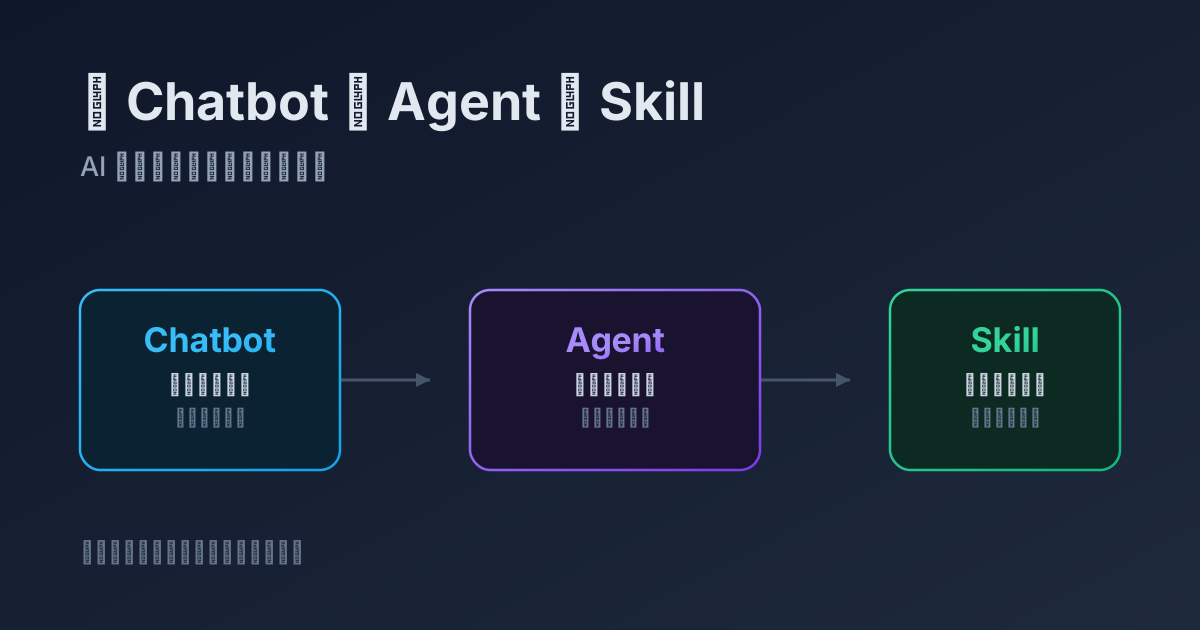
Chatbot to Agent to Skill, a three-stage framework for reusable AI workflows

From Chatbot to Agent to Skill: Turning Judgment into a System

A Year Later, Why Does AI Still Feel Like Extra Work? AI now writes copy, translates documents, summarizes meetings, and inspects spreadsheets. Yet one honest question cuts through the excitement: has it taken over a business step, or do you still explain the background, judge the answer, and decide what happens next every time? The model may be smarter. The person carrying the context and the responsibility often has not changed. ...

July 14, 2026 · 8 min · 1591 words · Xinwei Xiong, Me
Knowledge cards moving through an AI-assisted creation pipeline toward an audience, then returning as a measured feedback loop

AI Content Creation Workflow: Turning Knowledge Into Work People Want

Creation Is the Outward Half We’ve reached the final layer. Information has been denoised, records have been sedimented, knowledge has been structured into repeatedly callable capability — but up to this point, every stage has been solving your own problem. Knowledge makes you stronger, but it doesn’t automatically turn into something others want to read. Creation is the layer that reverses the direction of this pipeline. Knowledge faces inward; creation faces outward. Knowledge asks “can I reuse this”; creation asks “can others receive this.” Creation corresponds to a platform’s recommendation logic, a particular group of users’ reading habits, and the substantial research you did to support this specific piece of expression. It has exactly one goal: have the audience receive it, understand it, and want to connect with you. ...

July 11, 2026 · 12 min · 2476 words · Xinwei Xiong, Me
Text, voice, screenshots, code changes, and decisions moving through capture, clarification, and review toward a verified knowledge card

AI Note-Taking Workflow: Turn Fleeting Inputs Into Verifiable Records

The Semi-Finished Product Filed Under “Knowledge” In most people’s mental model, notes only have three tiers: see information → turn it into knowledge → use it to create. The act of “recording” in between gets quietly filed under “knowledge.” But as I said in the overview, records deserve to stand alone as their own layer. Because it’s an independent intermediate form: it’s relevant to you, but not necessarily useful forever; it might just be something you’ll need someday, or something you’re using right now to clarify your own thinking. That kind of thing doesn’t yet qualify as knowledge — only what’s structured for repeated future reuse counts as knowledge. ...

July 11, 2026 · 10 min · 1923 words · Xinwei Xiong, Me
Sources passing through relevance, privacy, and verification gates before AI-assisted processing and entry into the records layer

AI Information Filtering Workflow: Capture Signal Without a Noise Archive

The Default State of Information Is Noise The previous essay laid out the framework: information, records, knowledge, and creation are four distinct stages. This one deals with only the first — information. The single most important thing to understand about information is this: its default state is noise. We have a natural greed for information. See a good article, want to bookmark it. See a great quote, want to save it. See a reading list someone recommended, want to add it to your queue. Every act of “saving” gives us a small illusion of “I’m making progress.” But saving, at its core, is just moving information from someone else’s warehouse into yours — it hasn’t gone through any processing by your own machine. ...

July 11, 2026 · 9 min · 1889 words · Xinwei Xiong, Me
Information crossing intake gates into records, verified knowledge, audience-facing creation, and a measured feedback loop

AI Knowledge Workflow: From Information to Records, Knowledge, and Creation

Four Names for Four Different Kinds of Work My notes used to grow in one direction: inward. Links entered, fragments accumulated, folders changed names, and the archive became heavier. I mistook possession for processing. AI made that mistake cheaper to repeat. A model can generate, summarize, classify, and reformat text quickly, but speed does not turn a source into evidence, an observation into knowledge, or a draft into something I should publish. It can make the warehouse larger without improving the machinery. ...

July 11, 2026 · 10 min · 1918 words · Xinwei Xiong, Me
The Super-Individual Stack: AI-Native Product Directions and Solo Builder Ops in 2026

The Super-Individual Stack: AI-Native Product Directions and Solo Builder Ops in 2026

“Software is eating the world.” — Marc Andreessen, 2011 “Now AI is eating software—and the question for the rest of us is: what’s left for one human, alone, in front of a screen?” — me, asking myself one night in 2026. Prologue: How Big Does One Person Need to Be? In February 2026, I ran my first complete overnight agent. I set a prompt, dropped it into Claude Code in a loop, and went to sleep. At 7 a.m. the next morning, what I saw on the screen was: 6 commits, 4 PRs, 3 auto-rolled-back failures, and a research brief I hadn’t even read myself. ...

June 24, 2026 · 21 min · 4314 words · Xinwei Xiong, Me
A solo developer's path from problem validation to a maintainable MVP

Independent Developer Roadmap: From Problem Validation to a Maintainable MVP

Independent development creates a seductive illusion: once the stack is chosen, the product is halfway built. I used to make long lists—frontend framework, database, authentication, payments, email, analytics, monitoring. The more complete the list looked, the safer I felt. But that safety came from the feeling of construction, not from evidence that anyone needed the thing. My rule is simpler now: the scarce resource for an independent developer is not code. It is the ability to place limited attention on the right problem. A stack should help you move cheaply, learn quickly, and reverse a decision while the evidence is still thin. ...

April 15, 2025 · 12 min · 2503 words · Xinwei Xiong, Me
A timeline of Sora from research preview and product launch to shutdown

Sora Retrospective: From Research Preview and Sora 2 to Shutdown

Status update, July 2026: The Sora website and app shut down on April 26, 2026. The Sora API is scheduled to shut down on September 24, 2026. This is no longer a guide to getting started; it is a record of what the technology, the product, and their ending can teach us. When I first wrote about Sora in February 2024, the irresistible detail was the one-minute video. Two years later, the more useful story is about boundaries: a research result is not a product specification, a better model does not guarantee a permanent service, safeguards do not erase risk, and generated media does not arrive with a simple answer to copyright. ...

February 24, 2024 · 10 min · 1942 words · Xinwei Xiong, Me

Project Management From Theory to Practice

Project management from theory to practice Theory introduction ⌀ Image no longer available · image-20230113165927930 Waterfall Model: ⌀ Image no longer available · image-20230113163949341 Agile Model: ⌀ Image no longer available · image-20230113164028753 Scrum Framework: ⌀ Image no longer available · image-20230113164207851 Differences between traditional and agile **Traditional project management methods typically follow a linear process, achieving project goals through pre-established planning, supervision, and control. Agile project management methods are more flexible and achieve project goals through iteration and continuous improvement. Agile methods emphasize teamwork, adapting to changes, and delivering value quickly. ** ...

May 7, 2023 · 28 min · 5882 words · Xinwei Xiong, Me