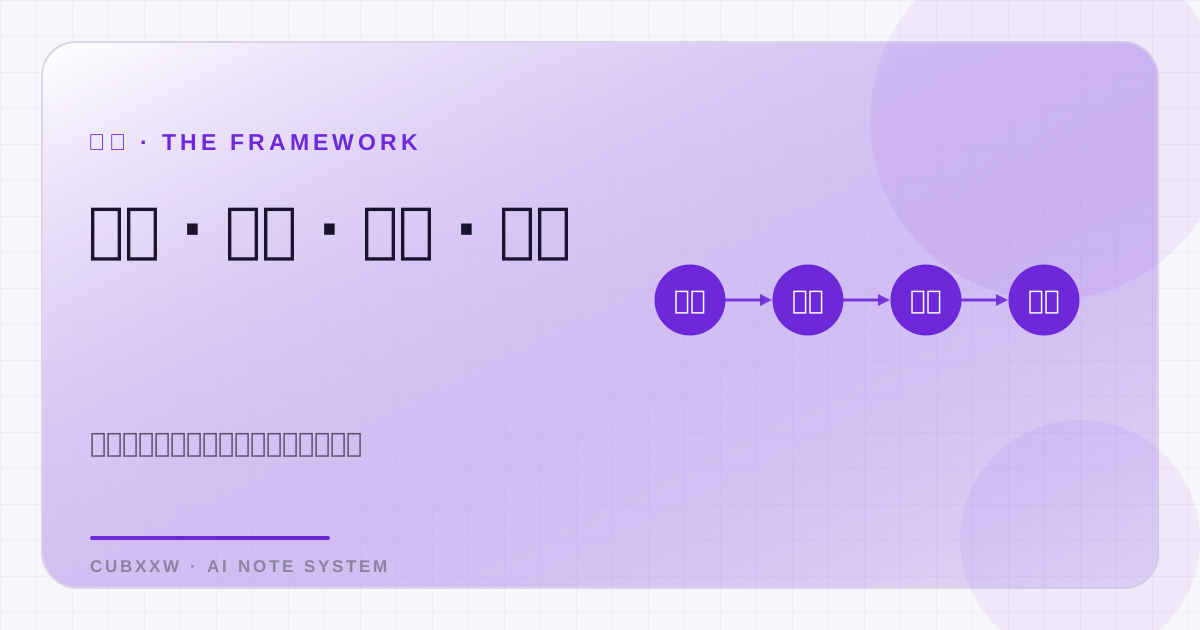
Friction is growth — deliberately keeping friction in an era when AI removes resistance

Friction Is Growth: When AI Removes All Resistance for You, Deliberately Keep Some

A Signal That Sent a Chill Down My Spine Let me start with a line from the retrospective of someone who uses AI heavily every day. Reading it gave me a bit of a chill: When I have a really enjoyable conversation with AI, it probably means I didn’t grow that day. They explained it clearly: a pleasant conversation usually means no friction was encountered. Real growth is always accompanied by some kind of discomfort — forcing a vague idea into a clear sentence, working through a problem you can’t figure out, being jolted into rethinking by an objection. None of that feels “good.” They kept using AI to remove friction, and the more they used it, the smoother and more pleasant the conversations got — until they stopped and realized: friction was exactly what they needed most, and they’d deleted it with their own hands. ...

July 11, 2026 · 7 min · 1353 words · Xinwei Xiong
Knowledge cards moving through an AI-assisted creation pipeline toward an audience, then returning as a measured feedback loop

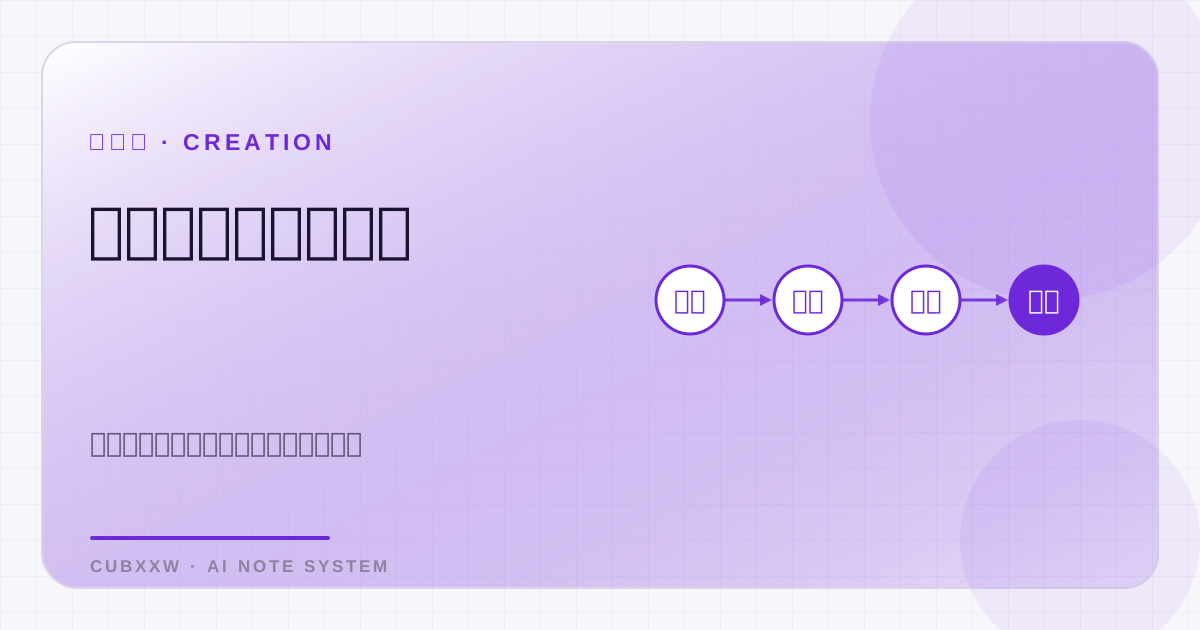
AI Content Creation Workflow: Turning Knowledge Into Work People Want

Creation Is the Outward Half We’ve reached the final layer. Information has been denoised, records have been sedimented, knowledge has been structured into repeatedly callable capability — but up to this point, every stage has been solving your own problem. Knowledge makes you stronger, but it doesn’t automatically turn into something others want to read. Creation is the layer that reverses the direction of this pipeline. Knowledge faces inward; creation faces outward. Knowledge asks “can I reuse this”; creation asks “can others receive this.” Creation corresponds to a platform’s recommendation logic, a particular group of users’ reading habits, and the substantial research you did to support this specific piece of expression. It has exactly one goal: have the audience receive it, understand it, and want to connect with you. ...

July 11, 2026 · 12 min · 2476 words · Xinwei Xiong, Me
Text, voice, screenshots, code changes, and decisions moving through capture, clarification, and review toward a verified knowledge card

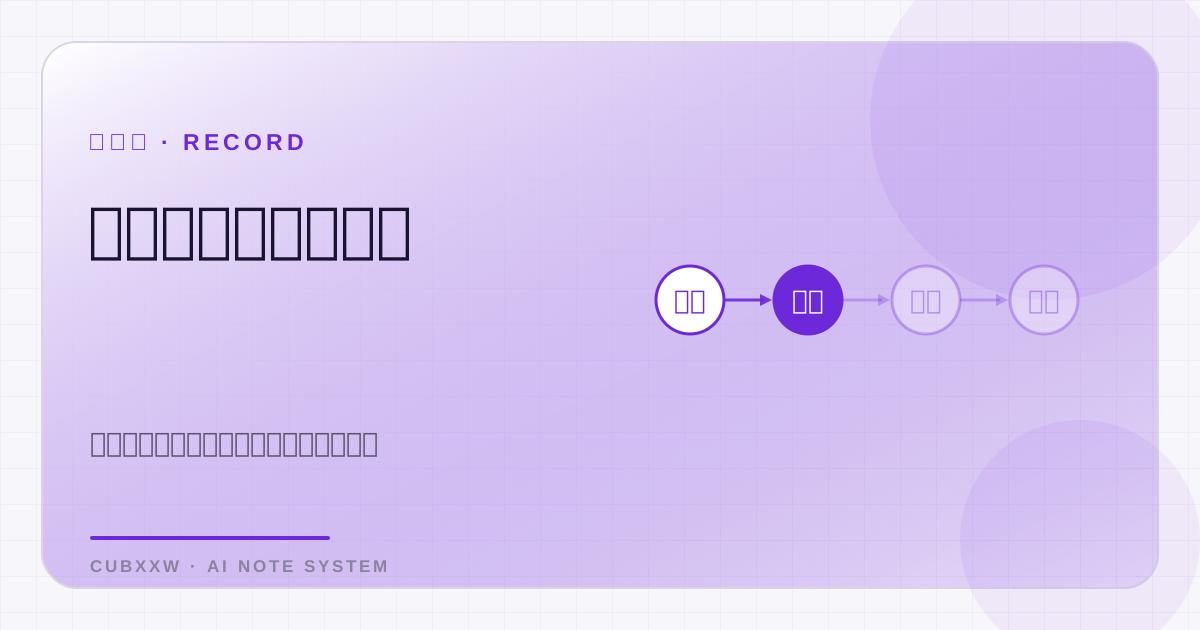
AI Note-Taking Workflow: Turn Fleeting Inputs Into Verifiable Records

The Semi-Finished Product Filed Under “Knowledge” In most people’s mental model, notes only have three tiers: see information → turn it into knowledge → use it to create. The act of “recording” in between gets quietly filed under “knowledge.” But as I said in the overview, records deserve to stand alone as their own layer. Because it’s an independent intermediate form: it’s relevant to you, but not necessarily useful forever; it might just be something you’ll need someday, or something you’re using right now to clarify your own thinking. That kind of thing doesn’t yet qualify as knowledge — only what’s structured for repeated future reuse counts as knowledge. ...

July 11, 2026 · 10 min · 1923 words · Xinwei Xiong, Me
Sources passing through relevance, privacy, and verification gates before AI-assisted processing and entry into the records layer

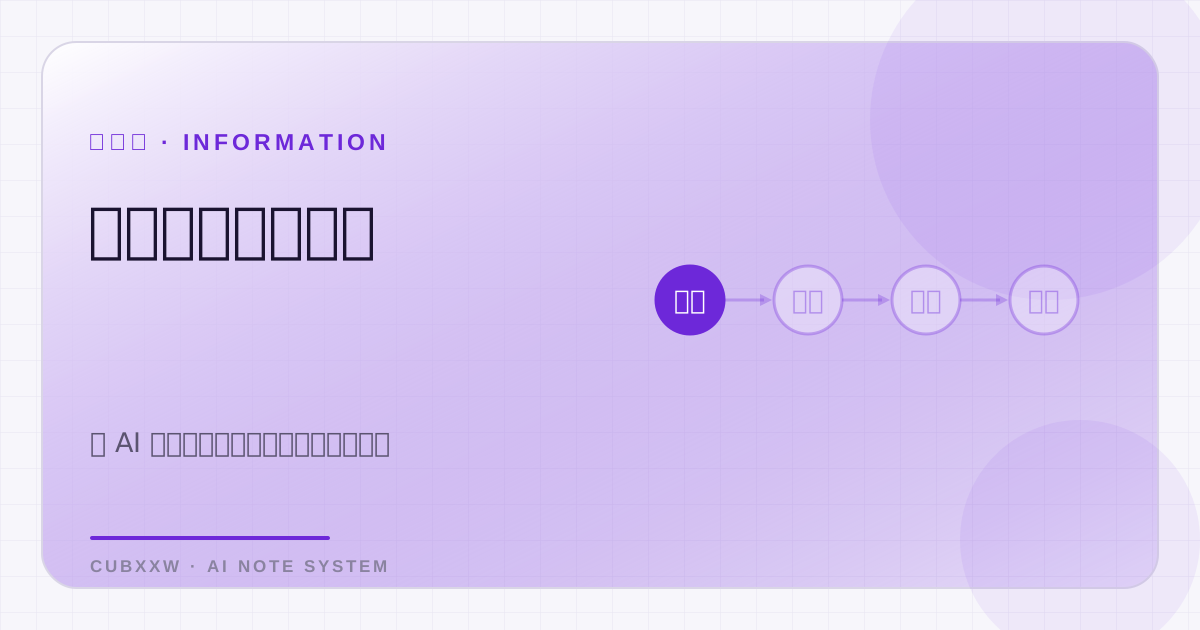
AI Information Filtering Workflow: Capture Signal Without a Noise Archive

The Default State of Information Is Noise The previous essay laid out the framework: information, records, knowledge, and creation are four distinct stages. This one deals with only the first — information. The single most important thing to understand about information is this: its default state is noise. We have a natural greed for information. See a good article, want to bookmark it. See a great quote, want to save it. See a reading list someone recommended, want to add it to your queue. Every act of “saving” gives us a small illusion of “I’m making progress.” But saving, at its core, is just moving information from someone else’s warehouse into yours — it hasn’t gone through any processing by your own machine. ...

July 11, 2026 · 9 min · 1889 words · Xinwei Xiong, Me
Information crossing intake gates into records, verified knowledge, audience-facing creation, and a measured feedback loop

AI Knowledge Workflow: From Information to Records, Knowledge, and Creation

Four Names for Four Different Kinds of Work My notes used to grow in one direction: inward. Links entered, fragments accumulated, folders changed names, and the archive became heavier. I mistook possession for processing. AI made that mistake cheaper to repeat. A model can generate, summarize, classify, and reformat text quickly, but speed does not turn a source into evidence, an observation into knowledge, or a draft into something I should publish. It can make the warehouse larger without improving the machinery. ...

July 11, 2026 · 10 min · 1918 words · Xinwei Xiong, Me

Ignite and Settle (Part 3): Anxious Attachment — Why We Keep Seeking Reassurance in Love

This is Part 3 of “Ignite and Settle,” and the close of the series. Part 1, The Quality and Time of Companionship , asked why we turn away just as we come close. Part 2, Avoidant Attachment , described how the “turning away” person is made. This part describes the other half — the one that looks opposite, and bites tight to the previous one at the bottom: the anxious. ...

June 28, 2026 · 21 min · 4280 words · Xinwei Xiong

Ignite and Settle (Part 2): Avoidant Attachment — Why We Want to Run When Someone Gets Close

This is Part 2 of “Ignite and Settle.” Part 1, The Quality and Time of Companionship , described the act of “running when someone gets close.” This part focuses on its origins and repair. Part 3 will describe anxious attachment — its mirror, with which it is biting at the bottom. ...

June 28, 2026 · 19 min · 3879 words · Xinwei Xiong

Ignite and Settle (Part 1): The Quality and Time of Companionship — and Why We Turn Away Just as We Come Close

This is Part 1 of the “Ignite and Settle” series. Part 2 is on avoidant attachment — why we want to run when someone gets close. Part 3 is on anxious attachment — why we keep seeking reassurance in love. You can enter from any of the three. Read together, they form one map. Opening: A deceptively simple question Let me start with a deceptively simple question: in companionship, which matters more — quality or time? ...

June 28, 2026 · 22 min · 4599 words · Xinwei Xiong
The Super-Individual Stack: AI-Native Product Directions and Solo Builder Ops in 2026

The Super-Individual Stack: AI-Native Product Directions and Solo Builder Ops in 2026

“Software is eating the world.” — Marc Andreessen, 2011 “Now AI is eating software—and the question for the rest of us is: what’s left for one human, alone, in front of a screen?” — me, asking myself one night in 2026. Prologue: How Big Does One Person Need to Be? In February 2026, I ran my first complete overnight agent. I set a prompt, dropped it into Claude Code in a loop, and went to sleep. At 7 a.m. the next morning, what I saw on the screen was: 6 commits, 4 PRs, 3 auto-rolled-back failures, and a research brief I hadn’t even read myself. ...

June 24, 2026 · 21 min · 4314 words · Xinwei Xiong, Me

Seen Clearly, Loved Deeply: Five Lenses on Love, and the Buddhist Synthesis

“From love springs grief, from love springs fear; for one freed from love there is no grief—whence, then, fear?” —Dhammapada “Just as a mother would protect her only child with her life, so let one cultivate a boundless love toward all beings.” —Metta Sutta In the same scriptural tradition, love is both the source of grief and fear, and a boundless, infinite kindness. These two seemingly contradictory lines are the doorway to this essay. To walk through that doorway, we will first borrow five modern lenses to illuminate the whole elephant of love, and then return to the one vantage point from which the whole elephant can be seen. ...

June 22, 2026 · 30 min · 6343 words · Xinwei Xiong
How to Maintain the Weight of Self in an Age When You Are No Longer Needed

Maintaining Self-Worth in the Age of AI

Pascal wrote in the 17th century: “All of humanity’s problems stem from one thing: man’s inability to sit quietly in a room alone.” Three hundred years later, I thought of this sentence late at night in Lhasa, and added one more: They’re not sure who exactly is the one sitting in that room. Introduction: The 3 AM Emptiness For a while, I woke up almost every day at 3 AM. ...

April 4, 2026 · 10 min · 1963 words · Xinwei Xiong, Me

How I Learned to Observe My Own Thinking: A Four-Month Metacognitive Shift

I once thought metacognition meant thinking more deeply about an experience and explaining an emotion more completely. Over four months, I recorded hundreds of fragments: why anxiety appears, why travel quiets the mind, why I become more sensitive after drinking, how AI might change engineering, and what it means for a product to respect the person using it. The notes multiplied, and my explanations became increasingly refined. Yet the number of ideas was not what changed me. The shift came when I began to see how a thought appears in the body, how emotion amplifies it, how I turn it into a story about myself, and how that story quietly makes decisions on my behalf. ...

June 2, 2025 · 11 min · 2315 words · Xinwei Xiong, Me
about 2023 year

2023 Annual Summary Reflections and Aspirations

My 2023 Annual Summary As 2023 swiftly draws to a close, my university life is nearing its end with just half a year remaining. A friend once said, “What’s frightening is not losing your passion for work, but never being able to find it again.” This year, I encountered many people and experienced numerous events, gradually shaping my world view. I’m fond of Maslow’s hierarchy of needs and often reflect on my own state through it. I enjoy challenges, both in my work and hobbies (like hiking, cycling…). It seems I’ve successfully fulfilled the first four levels of Maslow’s theory: physiological needs, safety needs, social needs, and esteem needs. I’m probably at the stage of self-actualization needs. However, it’s worth mentioning that while Maslow’s theory is hierarchical, human needs aren’t always linear or fixed. For instance, someone at the self-actualization stage might still encounter needs from other levels at different times. If a person loses their job or faces financial difficulties, they may refocus on safety needs like financial security and stability. Similarly, the end of a close relationship or changes in one’s social network might reignite a desire for social needs. Even in everyday life, when we fall ill or feel hungry, our focus might temporarily shift from higher-level needs like self-actualization to physiological needs. ...

December 30, 2023 · 13 min · 2736 words · Xinwei Xiong, Me