A shared organizational agent dispatch console connected to permission vaults, memory archives, and isolated work cells

Claude Tag Deep Dive: From Shared Slack AI to an Organizational Agent Runtime

Calling Claude Tag a Slack bot misses its most consequential product decision. It turns a channel into a place where an agent can be authorized, remember, and keep working: a team shares one executor; each task runs asynchronously in a thread-level sandbox hosted by Anthropic; Agent Proxy injects external credentials at the network boundary; and the result returns to the public thread with a traceable record. The Claude Tag documentation describes these mechanisms in unusually concrete terms. ...

August 5, 2026 · 23 min · 4772 words · Xinwei Xiong, Me
Open Design as a four-plane design harness for coding agents

Open Design 0.16.1: A Design Harness for Coding Agents

Open Design is easy to misread. The name also belongs to the older open-design movement around shared product blueprints, but this article is about nexu-io/open-design : an open-source workspace that turns coding agents into a design production system. It is not a model, and it is not simply an image generator. It is a harness. The harness gives an agent a controlled vocabulary, reusable workflows, visual constraints, an artifact loop, and a place to inspect the result. That distinction matters because the quality ceiling still comes from the model and the operator; Open Design improves the path between intention and output. ...

July 22, 2026 · 9 min · 1791 words · Xinwei Xiong, Me
A quiet control desk representing verifiable loop engineering for solo builders

Loop Engineering for Solo Builders: Verifiers, State, and Safe Automation

Why Does Getting Better at This Make Me More Tired? Let me start with a strange thing I banged my head against for a long time before I understood it. When I first started using Claude Code, the productivity gain was visible to the naked eye: an afternoon’s work covered what used to take two days. Once I got fluent, the gains kept coming — but so did the exhaustion at the end of each day. Because I was doing the same thing all day long: watch it finish, judge whether it’s right, think about what to say next, hit enter again. ...

July 20, 2026 · 30 min · 6201 words · Xinwei Xiong, Me
Designing devbox-doctor, a safer Mac toolchain audit

Designing devbox-doctor: A Safer Mac Toolchain Audit

I am building a developer-machine checkup skill called devbox-doctor. The idea sounds simple: inventory a Mac, identify tools that may no longer earn their keep, find actual toolchain conflicts, and trace data left behind by uninstalled apps. The dangerous word in that sentence is identify. A scanner can prove that two tools are installed. It cannot prove that one is useless. A directory can resemble an app’s name. That does not make the directory safe to delete. Spotlight can return no last-used date. That does not mean the app was never opened. ...

July 18, 2026 · 12 min · 2431 words · Xinwei Xiong, Me
Agent Skill design shown as code, model judgment, permission gates, and human confirmation

Agent Skill Design: What a Dangerous SKILL.md Taught Me

What makes an Agent Skill valuable is not a clever prompt, but a clean division of responsibility: deterministic work goes to code, judgment goes to the model, and execution confirmation returns to the human. Structured contracts hold those parts together. I reached that conclusion by dissecting a storage-cleanup Skill that can delete local files from a web page. Deletion is one of the most consequential powers an agent-adjacent tool can expose. The design did not make me fearless; it gave me specific controls I could inspect before deciding whether to click. ...

July 18, 2026 · 11 min · 2310 words · Xinwei Xiong, Me
A private AI knowledge arsenal connecting evidence cards, executable workflows, publishing platforms, and feedback loops

Building an AI Knowledge Base: From Notes to Executable Workflows

After the Framework Stood Up, I Realized I Had No “Shared Workshop” The five-part Info-to-Creation series got the framework standing: information gets collected and denoised, records settle into half-finished goods, knowledge gets structured into capability, creation reorganizes it for an audience. But after writing that line in Layer 3: Knowledge — “your knowledge base is the workshop you share with your AI” — something kept nagging at me. ...

July 17, 2026 · 12 min · 2352 words · Xinwei Xiong, Me
A narrow blue passage beyond a crowded red ocean, representing defensible AI agent businesses

Where AI Agents Still Have a Blue Ocean

Suppose you had to place a bet today on one direction in AI agents. What is the first question you should ask? Most people ask whether the thing can be built. By mid-2026, that is often the least interesting part. The colder question is: why has nobody made this opportunity routine yet? The answer is a useful filter. If nobody has solved it because everyone just noticed it, competition is probably coming. If nobody has solved it because the work is dirty, slow, and carries consequence, there may be something defensible—or there may be no market. The rest of the article is how I try to separate the two. ...

July 15, 2026 · 28 min · 5843 words · Xinwei Xiong, Me
A quiet control room supervising an unattended AI agent workflow

How to Build Real Trust in Unattended AI Agents That Act

Suppose you actually have one now — an agent that takes a job end to end. Pulls the data, writes the code, runs the tests, opens the PR, updates the docs. It doesn’t need you feeding it prompts line by line. You hand it the task at night and go to sleep. The real question isn’t whether it finishes. In coding, research, and content workflows, model capability is often already sufficient to produce a plausible result. That does not mean capability has stopped mattering everywhere: in unfamiliar domains and genuinely novel tasks, it can still be the limiting factor. But once an agent is capable enough to act, a different bottleneck appears — ...

July 15, 2026 · 24 min · 5027 words · Xinwei Xiong, Me
A measured cost test for routing work across an agent fleet

Agent Fleet Economics in 2026: Testing Low-Cost APIs and Open-Weight Options

How many agents can one person afford to keep running? The wrong way to answer is to count agents. An “agent” might classify one paragraph, search for twenty minutes, or refactor a repository through eighty tool calls. The useful unit is not the agent. It is the successful task, with its input tokens, output tokens, tool charges, retries, and human cleanup attached. That distinction changed how I think about two related but different choices: low-cost hosted model APIs and open-weight models that can be self-hosted. Falling API prices matter, but “90% cheaper” is meaningful only when three things are visible: ...

July 15, 2026 · 12 min · 2346 words · Xinwei Xiong, Me
When the AI Agent Starts Prompting You, What Has Actually Changed

When the AI Agent Starts Prompting You, What Has Actually Changed

A counterintuitive signal: it starts prompting you Start with a question. Suppose one day you open your workspace and the agent isn’t sitting there quietly waiting for your next command. It speaks first: “I noticed section three of yesterday’s proposal is still unfinished. I drafted something in the voice you used last week — want to take a look now?” Is that thoughtful, or is it presumptuous? Over the past six months I’ve noticed a counterintuitive signal while following agent launches, primary sources, papers, and benchmarks: more products are experimenting with agents that do not wait for the next instruction. They use available context, estimate what is worth doing, and bring a suggestion forward. ...

July 15, 2026 · 22 min · 4478 words · Xinwei Xiong, Me
An AI news pipeline reaching the boundary between automation and human judgment

AI News Pipelines: Automation Limits and Human Judgment

Suppose you ask an AI system to track one field — papers, releases, benchmarks, first-party changelogs, and the conversations around them. How far can it get on your behalf? This essay is not a census of every product. It is a field note from the systems I tested between January and June 2026, across AI research and developer-tool sources. In that sample, three patterns kept recurring: subscription aggregation, change monitoring, and agentic search. They were capable, but they shared a boundary: automation can haul information remarkably well; without your goals, context, and feedback, it cannot reliably make the final judgment for you. ...

July 15, 2026 · 17 min · 3431 words · Xinwei Xiong, Me
Chatbot to Agent to Skill, a three-stage framework for reusable AI workflows

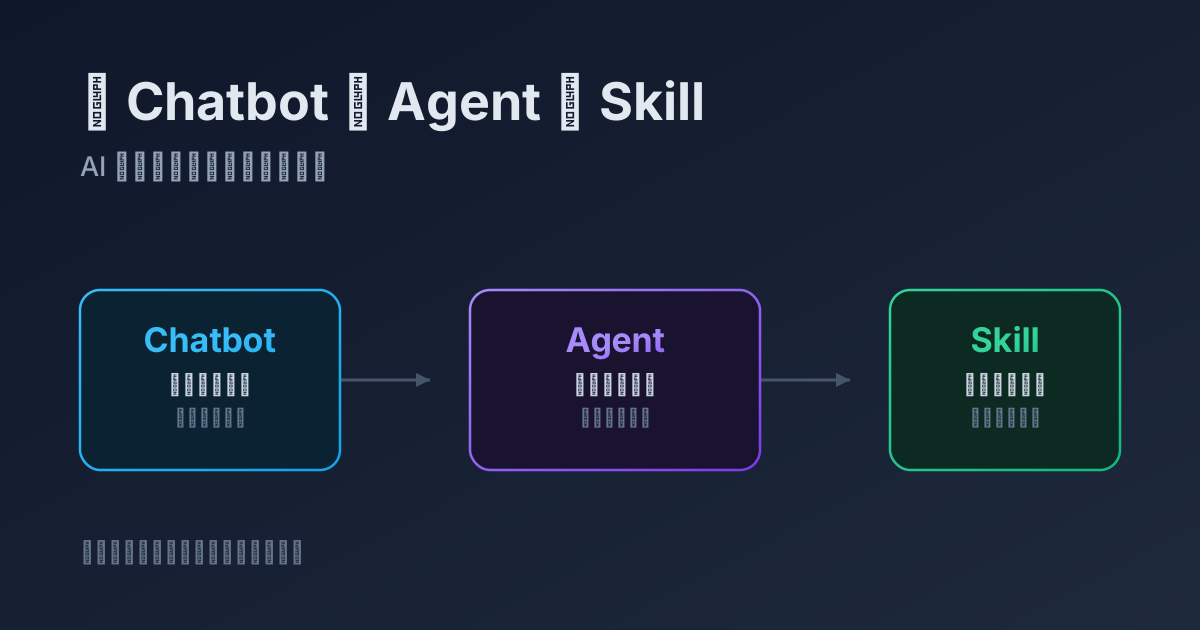
From Chatbot to Agent to Skill: Turning Judgment into a System

A Year Later, Why Does AI Still Feel Like Extra Work? AI now writes copy, translates documents, summarizes meetings, and inspects spreadsheets. Yet one honest question cuts through the excitement: has it taken over a business step, or do you still explain the background, judge the answer, and decide what happens next every time? The model may be smarter. The person carrying the context and the responsibility often has not changed. ...

July 14, 2026 · 8 min · 1591 words · Xinwei Xiong, Me
A six-part AI task card connecting an open direction to a verifiable result

Give AI Tasks, Not Just Direction: Define Done First

After Three Hours, What Is Left on the Table? I have had evenings that began with a modest intention: settle the angle of an essay. Soon I was discussing titles with AI, then business models, then the meaning of work. The conversation flowed beautifully. When I closed the window, the page was still blank. That does not make the conversation worthless. It reveals that exploration and execution are different kinds of work. ...

July 11, 2026 · 8 min · 1526 words · Xinwei Xiong, Me
Five quality gates surrounding an AI workflow, from evidence to human review

AI Workflow Quality Gates: A Practical Engineering Guide

“It Runs” Is Not a Reliability Standard Most personal AI workflows begin with one acceptance test: did it produce something? A draft appears, a patch compiles, ten pages become one, and the task feels finished. After enough repetitions, however, the costly failures are rarely dramatic. They arrive quietly: a polished paragraph built on a stale source, a tool call that never completed, a plausible plan that solved the wrong problem. ...

July 11, 2026 · 8 min · 1567 words · Xinwei Xiong, Me
A safe three-layer AI second brain built with Obsidian, Claude, and a capture inbox

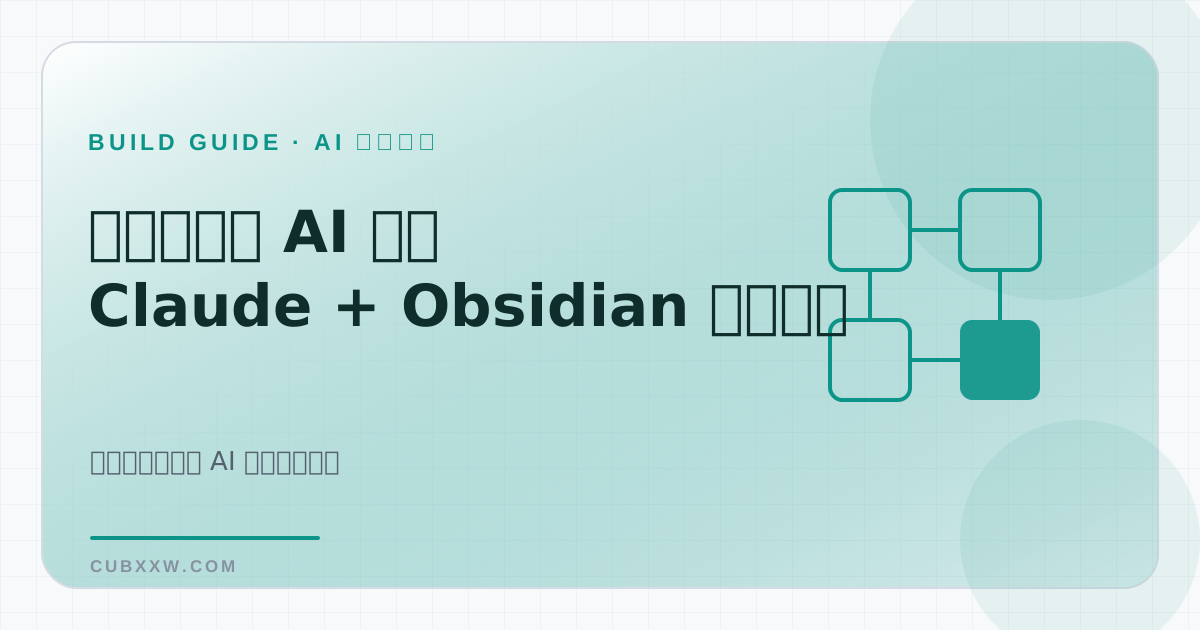
Build an AI Second Brain with Claude and Obsidian

A Second Brain Is a Working System, Not a Larger Notebook Most note systems are built for a future reader called you. You save a link, polish a heading, add two tags, and trust that one day you will return. Usually, you do not. An AI-native second brain begins with a different question: What useful work should this note make possible? The answer might be modest: turn an inbox note into a project brief, retrieve your earlier judgment before a meeting, or draft an article from claims you have already verified. The point is not to make AI read everything. The point is to give it a narrow, legible field in which it can help without quietly rearranging your life. ...

July 11, 2026 · 12 min · 2419 words · Xinwei Xiong, Me
Knowledge cards moving through an AI-assisted creation pipeline toward an audience, then returning as a measured feedback loop

AI Content Creation Workflow: Turning Knowledge Into Work People Want

Creation Is the Outward Half We’ve reached the final layer. Information has been denoised, records have been sedimented, knowledge has been structured into repeatedly callable capability — but up to this point, every stage has been solving your own problem. Knowledge makes you stronger, but it doesn’t automatically turn into something others want to read. Creation is the layer that reverses the direction of this pipeline. Knowledge faces inward; creation faces outward. Knowledge asks “can I reuse this”; creation asks “can others receive this.” Creation corresponds to a platform’s recommendation logic, a particular group of users’ reading habits, and the substantial research you did to support this specific piece of expression. It has exactly one goal: have the audience receive it, understand it, and want to connect with you. ...

July 11, 2026 · 12 min · 2476 words · Xinwei Xiong, Me
Draft records passing an evidence gate into retrievable knowledge cards, then returning through a review and retirement loop

AI Knowledge Base Workflow: Turn Notes Into Verified, Reusable Capability

Growing Bigger, Getting Less Useful We’ve reached layer three. Information has been captured and denoised; records have been written down and polished into semi-finished products — now the question is: how do you turn these semi-finished products into actual knowledge? Let’s start with a definition. Knowledge is structured, repeatedly reusable material relevant to you: a mental model, a handful of skills, a methodology, along with your judgment, positioning, and values. Its keyword is reusability, and it solves your own problems. ...

July 11, 2026 · 11 min · 2202 words · Xinwei Xiong, Me
Text, voice, screenshots, code changes, and decisions moving through capture, clarification, and review toward a verified knowledge card

AI Note-Taking Workflow: Turn Fleeting Inputs Into Verifiable Records

The Semi-Finished Product Filed Under “Knowledge” In most people’s mental model, notes only have three tiers: see information → turn it into knowledge → use it to create. The act of “recording” in between gets quietly filed under “knowledge.” But as I said in the overview, records deserve to stand alone as their own layer. Because it’s an independent intermediate form: it’s relevant to you, but not necessarily useful forever; it might just be something you’ll need someday, or something you’re using right now to clarify your own thinking. That kind of thing doesn’t yet qualify as knowledge — only what’s structured for repeated future reuse counts as knowledge. ...

July 11, 2026 · 10 min · 1923 words · Xinwei Xiong, Me
Sources passing through relevance, privacy, and verification gates before AI-assisted processing and entry into the records layer

AI Information Filtering Workflow: Capture Signal Without a Noise Archive

The Default State of Information Is Noise The previous essay laid out the framework: information, records, knowledge, and creation are four distinct stages. This one deals with only the first — information. The single most important thing to understand about information is this: its default state is noise. We have a natural greed for information. See a good article, want to bookmark it. See a great quote, want to save it. See a reading list someone recommended, want to add it to your queue. Every act of “saving” gives us a small illusion of “I’m making progress.” But saving, at its core, is just moving information from someone else’s warehouse into yours — it hasn’t gone through any processing by your own machine. ...

July 11, 2026 · 9 min · 1889 words · Xinwei Xiong, Me
Information crossing intake gates into records, verified knowledge, audience-facing creation, and a measured feedback loop

AI Knowledge Workflow: From Information to Records, Knowledge, and Creation

Four Names for Four Different Kinds of Work My notes used to grow in one direction: inward. Links entered, fragments accumulated, folders changed names, and the archive became heavier. I mistook possession for processing. AI made that mistake cheaper to repeat. A model can generate, summarize, classify, and reformat text quickly, but speed does not turn a source into evidence, an observation into knowledge, or a draft into something I should publish. It can make the warehouse larger without improving the machinery. ...

July 11, 2026 · 10 min · 1918 words · Xinwei Xiong, Me
GEO measurement framework connecting exposure, citations, referrals, and conversions

GEO Measurement in 2026: A Reproducible Citation and Referral Protocol

The short answer: there is no single GEO score GEO measurement becomes misleading the moment four different events are compressed into one number. An answer may show your name without linking to you. It may link to a page without supporting the nearby claim. A reader may visit through an AI product but arrive with no referrer. A well-cited page may still produce no useful outcome. So I use a four-layer framework: ...

July 11, 2026 · 14 min · 2799 words · Xinwei Xiong, Me
A verifiable network connecting an author, original work, independent evidence, and reader communities

Off-Site Trust for GEO: Identity, Evidence, and Ethical Distribution

The answer first: trust is evidence, not a platform trick A technically healthy page can be crawlable, clear, and quotable and still receive no visible citation from an answer engine. That does not prove a hidden “trust gate” rejected it. The page may never have been selected, another source may have matched the prompt better, the answer may have absorbed its facts without linking it, or the platform may have behaved differently on that run. ...

July 11, 2026 · 12 min · 2453 words · Xinwei Xiong, Me
A testable model of AI search retrieval, source selection, answer use, and citations

How AI Search Retrieves and Cites Sources: A Testable GEO Model

The answer first: there is no universal citation algorithm AI search does not expose one shared pipeline that publishers can reverse-engineer into a recipe. Google documents retrieval-augmented generation and query fan-out for AI Overviews and AI Mode. Perplexity documents real-time web search, synthesis, and source links. OpenAI says ChatGPT search uses third-party search providers and content supplied directly by partners. None of those statements proves that the products share the same index, chunker, lexical retriever, vector store, reranker, prompt assembly, or citation policy. ...

July 11, 2026 · 13 min · 2577 words · Xinwei Xiong, Me
A five-layer GEO workflow separating access, usefulness, evidence, extraction, and measurement

GEO in 2026: Evidence, Limits, and a Practical Workflow

The Short Answer Generative engine optimization (GEO) is a useful name for the work of making content eligible, useful, well-supported, and attributable when an AI-assisted search system builds an answer. It is not one ranking algorithm, and it is not a bag of markup tricks. For Google, the official position is deliberately unexciting: AI Overviews and AI Mode are rooted in the same core Search ranking and quality systems, and there are no additional technical requirements or special optimizations for inclusion. Other products have different retrieval stacks and crawler controls, so a responsible GEO practice begins by naming the system rather than speaking about “the AI” as if it were one machine. ...

July 10, 2026 · 13 min · 2681 words · Xinwei Xiong, Me
open-lovable architecture from web scraping through code generation to dual-sandbox preview

Inside open-lovable: Search, Text Protocols, and Sandboxes

open-lovable begins with a compact promise: give it a website, get back a React application you can keep editing. The generated page is the visible trick. The more useful subject is the plumbing underneath—how scraping, model output, and untrusted code execution are joined without surrendering the whole process to the model. First, pin the clock. This article audits firecrawl/open-lovable commit 69bd93bae7a9c97ef989eb70aabe6797fb3dac89 , dated November 19, 2025. “In the project” below means that exact revision. “The platform today” refers to current vendor documentation. A fixed commit is a small discipline, but it prevents later product features from being smuggled into an older implementation. ...

June 29, 2026 · 9 min · 1809 words · Xinwei Xiong, Me
Editorial architecture diagram of Relay with a coordinator, five domain agents, safeguards, browser delivery, and audit boundaries

Relay Agent Architecture in 2026: A Local Implementation Audit

An architecture diagram is a promise. A code audit asks which parts of that promise have acquired weight. My first version of this article treated Relay as a public open-source proposal whose Agent layer had not yet been built. Both claims are now wrong. As of July 31, 2026, the public GitHub URL previously cited by this article returns 404, while I can inspect a private local checkout. This piece is therefore a private/local implementation audit, fixed to local commit 22586e17ccd43cfaff0512511e71a100c5341608. Readers should not assume that repository or commit is publicly downloadable. ...

June 24, 2026 · 11 min · 2298 words · Xinwei Xiong, Me
A wide schematic of context engineering: the Write / Select / Compress / Isolate pillars feeding an AI, a laptop with notes, and a local-first world line

Context Engineering: The New Foundation for AI Agents

Context engineering is the set of strategies for curating, ordering, and evicting the tokens that enter an LLM’s context window on each inference call—system instructions, retrieved documents, conversation history, tool definitions, and memory. The short version is this: prompt engineering optimizes the wording of an instruction; context engineering optimizes the wiring of the whole window. Anthropic has articulated this distinction in its engineering guidance, and Karpathy helped popularize the term. The rest of this article takes the emerging discipline apart. ...

June 22, 2026 · 16 min · 3381 words · Xinwei Xiong, Me
A technical diagram with a tiny agent loop at the center, surrounded by concentric rings of the eight pillars: orchestration, context, memory, tools, reliability, evaluation, cost, governance

Agent Engineering Harness: The Eight Pillars Behind the 98.4%

A small model loop becomes a system only after we decide what it may remember, touch, spend, and survive. An agent demo can be a loop around an API call. A production agent is the surrounding discipline: state, tools, permissions, recovery, evaluation, and cost. This article offers a map of that discipline rather than a framework tutorial. Each pillar is described through the gap it fills, a minimal implementation, and the boundary where it stops helping. ...

June 17, 2026 · 19 min · 3836 words · Xinwei Xiong, Me
Files, memory, runtime boundaries, and evaluation for continuous agent identity

Agent Identity: From Locke to OpenClaw

A philosophical boundary and an engineering practice for continuity in AI agents Start by Making “Identity” Small Enough to Engineer Agent amnesia first damages the cost of cooperation, not the illusion of personhood. A strong session does not guarantee that the next one will preserve the same judgment. Users repeat preferences, teams restate constraints, and the system struggles to explain where an earlier decision came from. Long-term trust rests on these unglamorous forms of continuity: what the agent remembers, what it forgets, why it changed, and who approved the change. ...

April 5, 2026 · 16 min · 3207 words · Xinwei Xiong, Me
A quiet archive of linked memory cards illustrating Mem0 OSS v3 retrieval

Mem0 OSS v3 in Practice: Memory Architecture, Retrieval, and Trade-offs

This project note is part of my attempt to understand open-source AI systems by building with them, reading their migrations, and writing down where the abstraction holds—and where it leaks. Project learning list The problem is not remembering more An LLM can carry a conversation while the relevant messages still fit inside its context window. That is short-term continuity, not memory in the human sense and not durable application state. When the session ends, the model does not naturally retain that a user prefers terse answers, changed jobs last month, or abandoned an earlier plan. ...

May 9, 2025 · 11 min · 2303 words · Xinwei Xiong, Me