A fixed demand axis beside industry workflow cards being reconnected

Common Sense Is Not the Mechanism: Rebuilding Industries Around Demand, Constraints, and Scarcity

“Is common sense the same as the mechanism underneath?” That was where I got stuck while testing ideas across several industries. I had also reviewed the published work of 22 frontier AI teams and more than 70 people whose work is public. A pattern kept returning: pursue one long-running question, define what good work looks like, connect papers, code, and products, then turn production failures into the next round of tests. But the pattern still did not tell me where industry analysis should begin. ...

August 1, 2026 · 18 min · 3834 words · Xinwei Xiong, Me
Claude Code playbook for verification, permissions, worktrees, loops, and parallel agents

Claude Code Playbook: 10 Configurations for Reliable Agent Workflows

Put the Tip List Down for a Moment I began this article as a collection of Boris Cherny’s Claude Code habits. That version had a problem: social posts age with models and product releases, while fan-maintained collections tend to mix personal advice, previews, and impressive-looking statistics. A sharp opinion can become a historical footnote before the article reaches its readers. So I took the slower route. Product claims in this revision come from Anthropic or the official Claude Code documentation. Untraceable numbers, second-hand quotations, and claims of universal superiority are gone. Boris’s way of working remains an inspiration, but it is not treated as a specification. ...

July 20, 2026 · 15 min · 2996 words · Xinwei Xiong, Me
A quiet control desk representing verifiable loop engineering for solo builders

Loop Engineering for Solo Builders: Verifiers, State, and Safe Automation

Why Does Getting Better at This Make Me More Tired? Let me start with a strange thing I banged my head against for a long time before I understood it. When I first started using Claude Code, the productivity gain was visible to the naked eye: an afternoon’s work covered what used to take two days. Once I got fluent, the gains kept coming — but so did the exhaustion at the end of each day. Because I was doing the same thing all day long: watch it finish, judge whether it’s right, think about what to say next, hit enter again. ...

July 20, 2026 · 30 min · 6201 words · Xinwei Xiong, Me
A solo creator's AI video editing pipeline from camera to publication

A Solo Creator's AI Video Editing Pipeline That Actually Works

Last winter I ran a very ugly set of numbers. I’d spent an entire afternoon in a café, writing code and shooting footage in between — about forty minutes of material across phone and screen recording. I started editing that evening and exported at 1:30 in the morning. The finished cut was fifty-eight seconds. Forty minutes of footage. Six hours of editing. Fifty-eight seconds of output. And the numbers on it were mediocre. ...

July 19, 2026 · 24 min · 4918 words · Xinwei Xiong, Me
I Ran Ten Agents Overnight, Woke Up to Ten PRs, and Then I Got Stuck

I Ran Ten Agents Overnight, Woke Up to Ten PRs, and Then I Got Stuck

This is part two of “The Super Individual’s Gear Stack.” If you haven’t read the overview , start there — every judgment in this piece rests on the yardstick that essay proposed: does an advance in a layer of gear help only you, or does it help all of your competitors at the same time? ...

July 19, 2026 · 32 min · 6628 words · Xinwei Xiong
How AI agents rebuilt a 120-post Hugo blog with a human editor

How AI Agents Rebuilt My 120-Post Blog From Scratch

What actually happened here How large a team does it take to rebuild a four-year-old blog with 120+ posts — content architecture, operations, all of it? My answer, delivered over the first half of this year: one person and a crew of agents with clearly divided jobs. “Crew” is a working metaphor, not a fixed headcount of digital employees. As of July 2026, the repository contains seven Claude skills and four workflows whose names begin with seo-; Claude Code, Codex, the Claude jobs inside GitHub Actions, and temporary review sessions are started only when a task calls for them. The human owns judgment, boundaries, and the final signature. Agents own scoped work that can be tested. The result is the site you’re reading — cubxxw.com . It isn’t merely a redesign. It turned “a blog” from a static site into a system that generates a daily report, prepares fix proposals, and exposes its own search interface. ...

July 17, 2026 · 19 min · 4026 words · Xinwei Xiong, Me
A quiet control room supervising an unattended AI agent workflow

How to Build Real Trust in Unattended AI Agents That Act

Suppose you actually have one now — an agent that takes a job end to end. Pulls the data, writes the code, runs the tests, opens the PR, updates the docs. It doesn’t need you feeding it prompts line by line. You hand it the task at night and go to sleep. The real question isn’t whether it finishes. In coding, research, and content workflows, model capability is often already sufficient to produce a plausible result. That does not mean capability has stopped mattering everywhere: in unfamiliar domains and genuinely novel tasks, it can still be the limiting factor. But once an agent is capable enough to act, a different bottleneck appears — ...

July 15, 2026 · 24 min · 5027 words · Xinwei Xiong, Me
When the AI Agent Starts Prompting You, What Has Actually Changed

When the AI Agent Starts Prompting You, What Has Actually Changed

A counterintuitive signal: it starts prompting you Start with a question. Suppose one day you open your workspace and the agent isn’t sitting there quietly waiting for your next command. It speaks first: “I noticed section three of yesterday’s proposal is still unfinished. I drafted something in the voice you used last week — want to take a look now?” Is that thoughtful, or is it presumptuous? Over the past six months I’ve noticed a counterintuitive signal while following agent launches, primary sources, papers, and benchmarks: more products are experimenting with agents that do not wait for the next instruction. They use available context, estimate what is worth doing, and bring a suggestion forward. ...

July 15, 2026 · 22 min · 4478 words · Xinwei Xiong, Me
Five quality gates surrounding an AI workflow, from evidence to human review

AI Workflow Quality Gates: A Practical Engineering Guide

“It Runs” Is Not a Reliability Standard Most personal AI workflows begin with one acceptance test: did it produce something? A draft appears, a patch compiles, ten pages become one, and the task feels finished. After enough repetitions, however, the costly failures are rarely dramatic. They arrive quietly: a polished paragraph built on a stale source, a tool call that never completed, a plausible plan that solved the wrong problem. ...

July 11, 2026 · 8 min · 1567 words · Xinwei Xiong, Me
open-lovable architecture from web scraping through code generation to dual-sandbox preview

Inside open-lovable: Search, Text Protocols, and Sandboxes

open-lovable begins with a compact promise: give it a website, get back a React application you can keep editing. The generated page is the visible trick. The more useful subject is the plumbing underneath—how scraping, model output, and untrusted code execution are joined without surrendering the whole process to the model. First, pin the clock. This article audits firecrawl/open-lovable commit 69bd93bae7a9c97ef989eb70aabe6797fb3dac89 , dated November 19, 2025. “In the project” below means that exact revision. “The platform today” refers to current vendor documentation. A fixed commit is a small discipline, but it prevents later product features from being smuggled into an older implementation. ...

June 29, 2026 · 9 min · 1809 words · Xinwei Xiong, Me
The Super-Individual Stack: AI-Native Product Directions and Solo Builder Ops in 2026

The Super-Individual Stack: AI-Native Product Directions and Solo Builder Ops in 2026

“Software is eating the world.” — Marc Andreessen, 2011 “Now AI is eating software—and the question for the rest of us is: what’s left for one human, alone, in front of a screen?” — me, asking myself one night in 2026. Prologue: How Big Does One Person Need to Be? In February 2026, I ran my first complete overnight agent. I set a prompt, dropped it into Claude Code in a loop, and went to sleep. At 7 a.m. the next morning, what I saw on the screen was: 6 commits, 4 PRs, 3 auto-rolled-back failures, and a research brief I hadn’t even read myself. ...

June 24, 2026 · 21 min · 4314 words · Xinwei Xiong, Me
Files, memory, runtime boundaries, and evaluation for continuous agent identity

Agent Identity: From Locke to OpenClaw

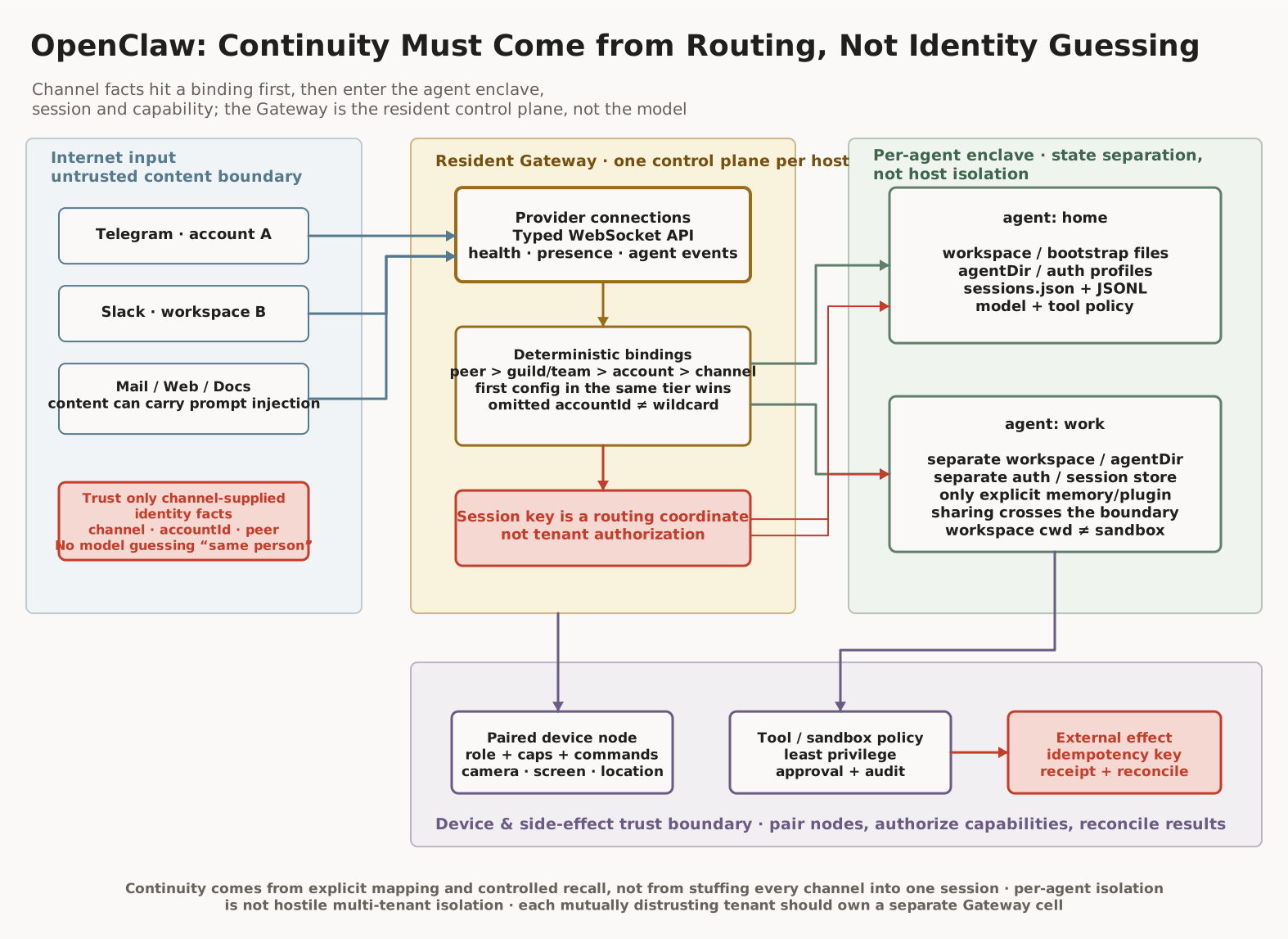
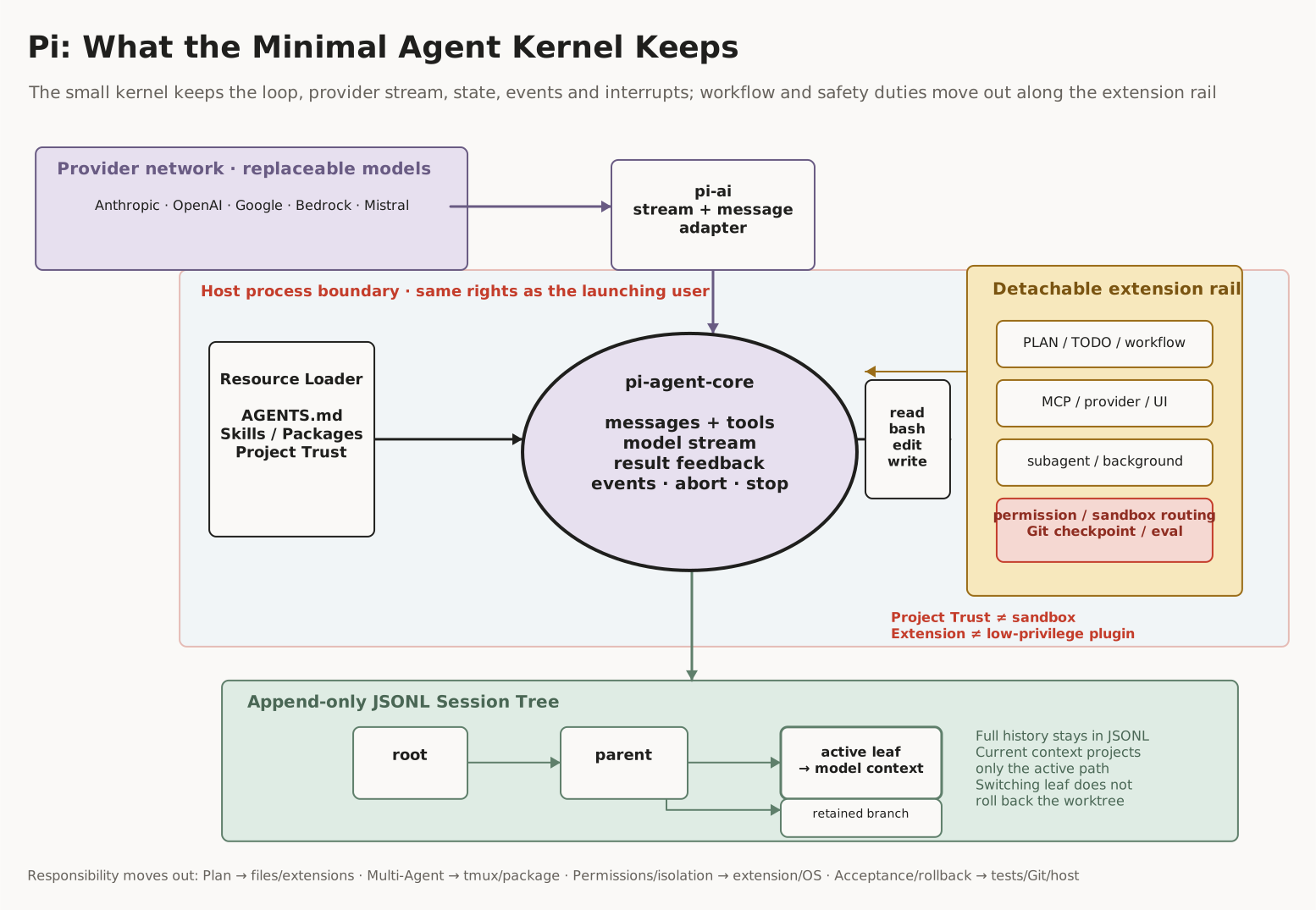
A philosophical boundary and an engineering practice for continuity in AI agents Start by Making “Identity” Small Enough to Engineer Agent amnesia first damages the cost of cooperation, not the illusion of personhood. A strong session does not guarantee that the next one will preserve the same judgment. Users repeat preferences, teams restate constraints, and the system struggles to explain where an earlier decision came from. Long-term trust rests on these unglamorous forms of continuity: what the agent remembers, what it forgets, why it changed, and who approved the change. ...

April 5, 2026 · 16 min · 3207 words · Xinwei Xiong, Me