Distribution for solo builders: a durable audience outlasting copied products

Distribution for Solo Builders: Your Readers Can't Be Copied

I wasted years on this one sentence “If the product is good enough, people will come.” I believed that line for years. It fits the engineer’s worldview: code is verifiable, performance is measurable, and there’s an objective difference between good and bad. If the difference is objective, then the good thing winning is just a matter of time — the market is efficient, it just needs a while. That was my logic through my open-source years. Write the project well, keep test coverage high, take the docs seriously, and then wait. Wait for stars, wait for issues, wait for someone to mention it in a blog post somewhere. Sometimes the wait paid off. More often it didn’t. And every time it didn’t, my first reaction was the same one: the thing isn’t good enough yet, go back and keep improving it. ...

July 19, 2026 · 24 min · 5000 words · Xinwei Xiong, Me
How AI agents rebuilt a 120-post Hugo blog with a human editor

How AI Agents Rebuilt My 120-Post Blog From Scratch

What actually happened here How large a team does it take to rebuild a four-year-old blog with 120+ posts — content architecture, operations, all of it? My answer, delivered over the first half of this year: one person and a crew of agents with clearly divided jobs. “Crew” is a working metaphor, not a fixed headcount of digital employees. As of July 2026, the repository contains seven Claude skills and four workflows whose names begin with seo-; Claude Code, Codex, the Claude jobs inside GitHub Actions, and temporary review sessions are started only when a task calls for them. The human owns judgment, boundaries, and the final signature. Agents own scoped work that can be tested. The result is the site you’re reading — cubxxw.com . It isn’t merely a redesign. It turned “a blog” from a static site into a system that generates a daily report, prepares fix proposals, and exposes its own search interface. ...

July 17, 2026 · 19 min · 4026 words · Xinwei Xiong, Me
GEO measurement framework connecting exposure, citations, referrals, and conversions

GEO Measurement in 2026: A Reproducible Citation and Referral Protocol

The short answer: there is no single GEO score GEO measurement becomes misleading the moment four different events are compressed into one number. An answer may show your name without linking to you. It may link to a page without supporting the nearby claim. A reader may visit through an AI product but arrive with no referrer. A well-cited page may still produce no useful outcome. So I use a four-layer framework: ...

July 11, 2026 · 14 min · 2799 words · Xinwei Xiong, Me
GEO blog rebuild case study cover showing a real-data dashboard and growth curve

GEO Blog Rebuild Case Study: Running the Five-Layer Model on Real Data

The answer first: a clean technical audit was not the same as demand In July 2026, I put the previous four chapters’ five-layer GEO model against my own blog. The useful result was not “technical SEO is perfect.” It was narrower: The tested homepage passed every Lighthouse SEO audit, while a three-month Search Console snapshot showed 878K impressions and only 852 clicks. Once I segmented the data, most clicks came from a small technical core, while many impressions came from unrelated long-tail queries. ...

July 11, 2026 · 10 min · 2077 words · Xinwei Xiong, Me
A verifiable network connecting an author, original work, independent evidence, and reader communities

Off-Site Trust for GEO: Identity, Evidence, and Ethical Distribution

The answer first: trust is evidence, not a platform trick A technically healthy page can be crawlable, clear, and quotable and still receive no visible citation from an answer engine. That does not prove a hidden “trust gate” rejected it. The page may never have been selected, another source may have matched the prompt better, the answer may have absorbed its facts without linking it, or the platform may have behaved differently on that run. ...

July 11, 2026 · 12 min · 2453 words · Xinwei Xiong, Me
GEO structured tactics cover showing clear, reusable content blocks

Structured Content for GEO: A Reader-First Playbook

The answer first: structure is a promise to the reader Good structure reduces the amount of reconstruction a reader must do. A useful technical section makes its conclusion, evidence, limits, and next action easy to find. That also gives search and answer systems cleaner material to process, but no heading pattern, paragraph length, summary block, or schema type guarantees an AI citation. That distinction matters. It is tempting to turn GEO into a writing ritual: put the answer first, keep the paragraph within a magic range, add FAQ schema, and wait for citations. Google explicitly says its AI search features use the same foundational SEO requirements as ordinary Search and require no special AI markup or content format. The safer order is: ...

July 11, 2026 · 10 min · 2116 words · Xinwei Xiong, Me
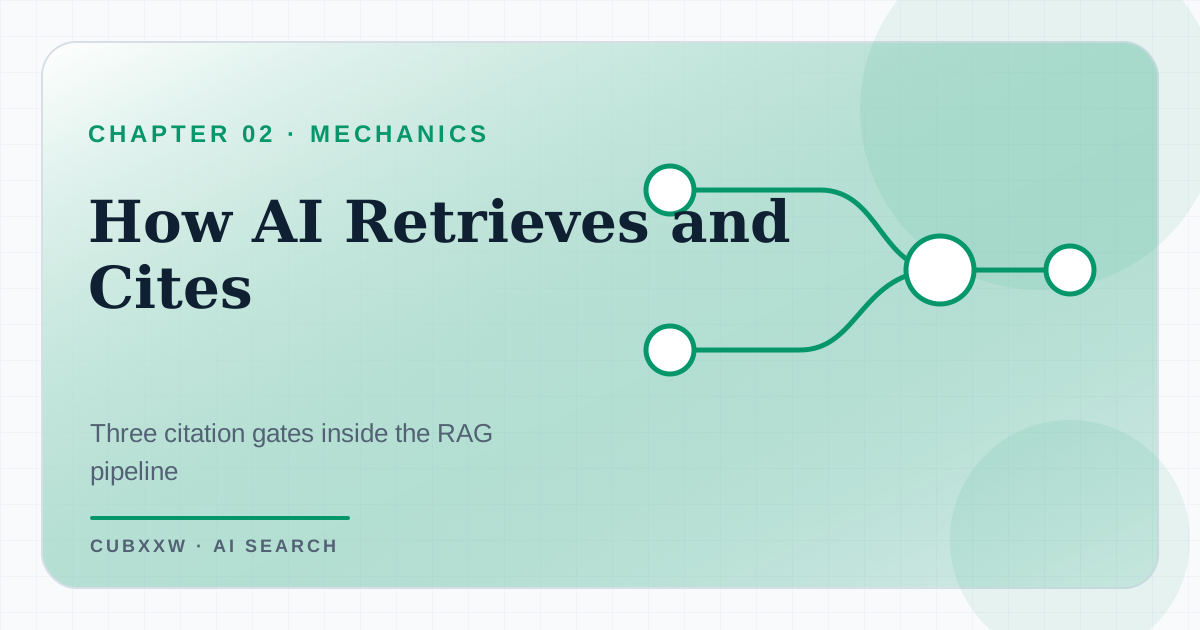
A testable model of AI search retrieval, source selection, answer use, and citations

How AI Search Retrieves and Cites Sources: A Testable GEO Model

The answer first: there is no universal citation algorithm AI search does not expose one shared pipeline that publishers can reverse-engineer into a recipe. Google documents retrieval-augmented generation and query fan-out for AI Overviews and AI Mode. Perplexity documents real-time web search, synthesis, and source links. OpenAI says ChatGPT search uses third-party search providers and content supplied directly by partners. None of those statements proves that the products share the same index, chunker, lexical retriever, vector store, reranker, prompt assembly, or citation policy. ...

July 11, 2026 · 13 min · 2577 words · Xinwei Xiong, Me
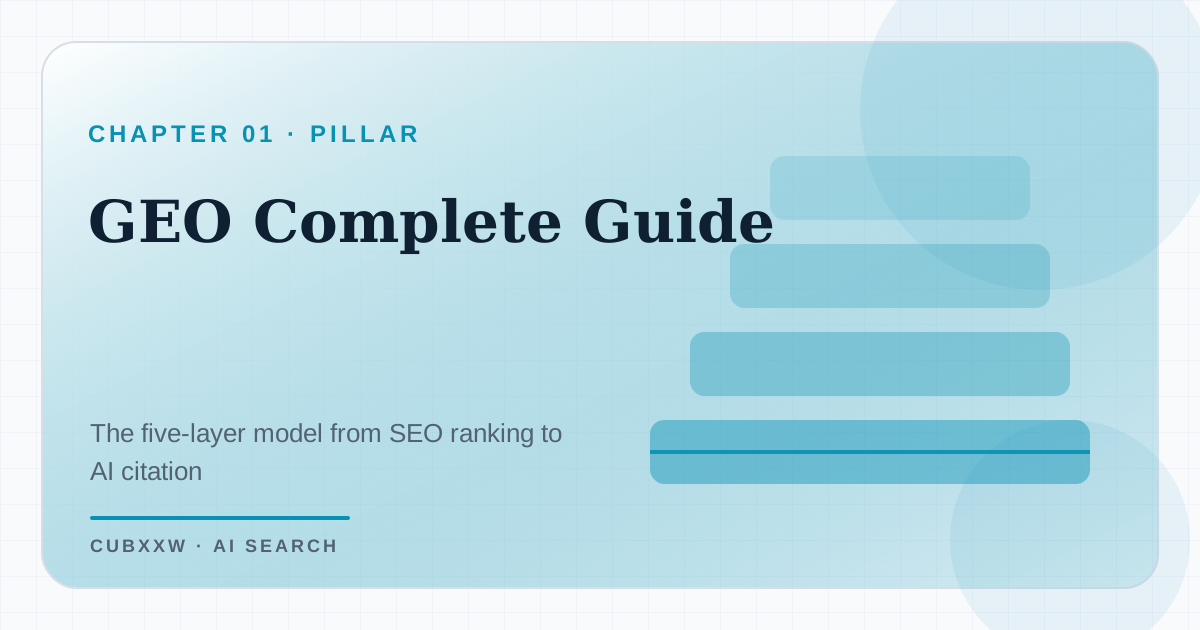
A five-layer GEO workflow separating access, usefulness, evidence, extraction, and measurement

GEO in 2026: Evidence, Limits, and a Practical Workflow

The Short Answer Generative engine optimization (GEO) is a useful name for the work of making content eligible, useful, well-supported, and attributable when an AI-assisted search system builds an answer. It is not one ranking algorithm, and it is not a bag of markup tricks. For Google, the official position is deliberately unexciting: AI Overviews and AI Mode are rooted in the same core Search ranking and quality systems, and there are no additional technical requirements or special optimizations for inclusion. Other products have different retrieval stacks and crawler controls, so a responsible GEO practice begins by naming the system rather than speaking about “the AI” as if it were one machine. ...

July 10, 2026 · 13 min · 2681 words · Xinwei Xiong, Me