A shared organizational agent dispatch console connected to permission vaults, memory archives, and isolated work cells

Claude Tag Deep Dive: From Shared Slack AI to an Organizational Agent Runtime

Calling Claude Tag a Slack bot misses its most consequential product decision. It turns a channel into a place where an agent can be authorized, remember, and keep working: a team shares one executor; each task runs asynchronously in a thread-level sandbox hosted by Anthropic; Agent Proxy injects external credentials at the network boundary; and the result returns to the public thread with a traceable record. The Claude Tag documentation describes these mechanisms in unusually concrete terms. ...

August 5, 2026 · 23 min · 4772 words · Xinwei Xiong, Me
Hierarchical memory systems heat active nodes, sink outdated information, and retain audit trails

Forgetting Is Harder Than Remembering: Why a Living System Must Know When to Let Go

This piece is a thought experiment conducted through simulated interviews from the perspectives of cognitive neuroscience and AI memory engineering—representing no actual experts. In March 2026, I wrote in a note: In the AI era, perhaps forgetting is more important than remembering. The image that came to mind was simple: a water layer with hot, warm, and cold strata. Recently used knowledge resides in the hot layer, while content untouched for a while gradually sinks downward—only being retrieved under exceptional circumstances. If a knowledge system absorbs information without releasing it, it will eventually degenerate from wisdom into a mere repository. ...

July 31, 2026 · 9 min · 1734 words · Xinwei Xiong, Me
AI Writes Requirements for Free, and That's the Most Dangerous Part

AI Writes Requirements for Free, and That's the Most Dangerous Part

One morning, and three things that shouldn’t exist One morning I got up, made coffee, opened my laptop, and found the agents I’d left running overnight all parked at “done”: one had added full multilingual support to a small tool of mine — Chinese, English, Japanese copy, an i18n layer extracted; one had built reading-progress analytics for my blog; one had refactored a CLI I wrote six months ago into a plugin architecture. The code was clean. The tests were green. ...

July 19, 2026 · 32 min · 6720 words · Xinwei Xiong
Designing devbox-doctor, a safer Mac toolchain audit

Designing devbox-doctor: A Safer Mac Toolchain Audit

I am building a developer-machine checkup skill called devbox-doctor. The idea sounds simple: inventory a Mac, identify tools that may no longer earn their keep, find actual toolchain conflicts, and trace data left behind by uninstalled apps. The dangerous word in that sentence is identify. A scanner can prove that two tools are installed. It cannot prove that one is useless. A directory can resemble an app’s name. That does not make the directory safe to delete. Spotlight can return no last-used date. That does not mean the app was never opened. ...

July 18, 2026 · 12 min · 2431 words · Xinwei Xiong, Me
Agent Skill design shown as code, model judgment, permission gates, and human confirmation

Agent Skill Design: What a Dangerous SKILL.md Taught Me

What makes an Agent Skill valuable is not a clever prompt, but a clean division of responsibility: deterministic work goes to code, judgment goes to the model, and execution confirmation returns to the human. Structured contracts hold those parts together. I reached that conclusion by dissecting a storage-cleanup Skill that can delete local files from a web page. Deletion is one of the most consequential powers an agent-adjacent tool can expose. The design did not make me fearless; it gave me specific controls I could inspect before deciding whether to click. ...

July 18, 2026 · 11 min · 2310 words · Xinwei Xiong, Me
A private AI knowledge arsenal connecting evidence cards, executable workflows, publishing platforms, and feedback loops

Building an AI Knowledge Base: From Notes to Executable Workflows

After the Framework Stood Up, I Realized I Had No “Shared Workshop” The five-part Info-to-Creation series got the framework standing: information gets collected and denoised, records settle into half-finished goods, knowledge gets structured into capability, creation reorganizes it for an audience. But after writing that line in Layer 3: Knowledge — “your knowledge base is the workshop you share with your AI” — something kept nagging at me. ...

July 17, 2026 · 12 min · 2352 words · Xinwei Xiong, Me
A personal intelligence pipeline connecting monitored sources to evidence, judgment, and action

Build a Personal Intelligence System That Leads to Action

The quiet dashboard can be the dangerous one A morning briefing with no new items may mean that nothing relevant happened. It may also mean an RSS route broke, an API began returning empty pages, or a credential expired during the night. From the reader’s side, those very different states look identical: silence. That is the first lesson of a personal intelligence system. Gathering more information is easy to demonstrate; knowing whether the machine is healthy, whether its summaries are faithful, and whether a signal deserves action is the real work. The system I want is not an account that publishes automatically. It is a pipeline that can show me what changed, why it may matter, what evidence supports the claim, and which decision—if any—should follow. ...

July 15, 2026 · 12 min · 2452 words · Xinwei Xiong, Me
When the AI Agent Starts Prompting You, What Has Actually Changed

When the AI Agent Starts Prompting You, What Has Actually Changed

A counterintuitive signal: it starts prompting you Start with a question. Suppose one day you open your workspace and the agent isn’t sitting there quietly waiting for your next command. It speaks first: “I noticed section three of yesterday’s proposal is still unfinished. I drafted something in the voice you used last week — want to take a look now?” Is that thoughtful, or is it presumptuous? Over the past six months I’ve noticed a counterintuitive signal while following agent launches, primary sources, papers, and benchmarks: more products are experimenting with agents that do not wait for the next instruction. They use available context, estimate what is worth doing, and bring a suggestion forward. ...

July 15, 2026 · 22 min · 4478 words · Xinwei Xiong, Me
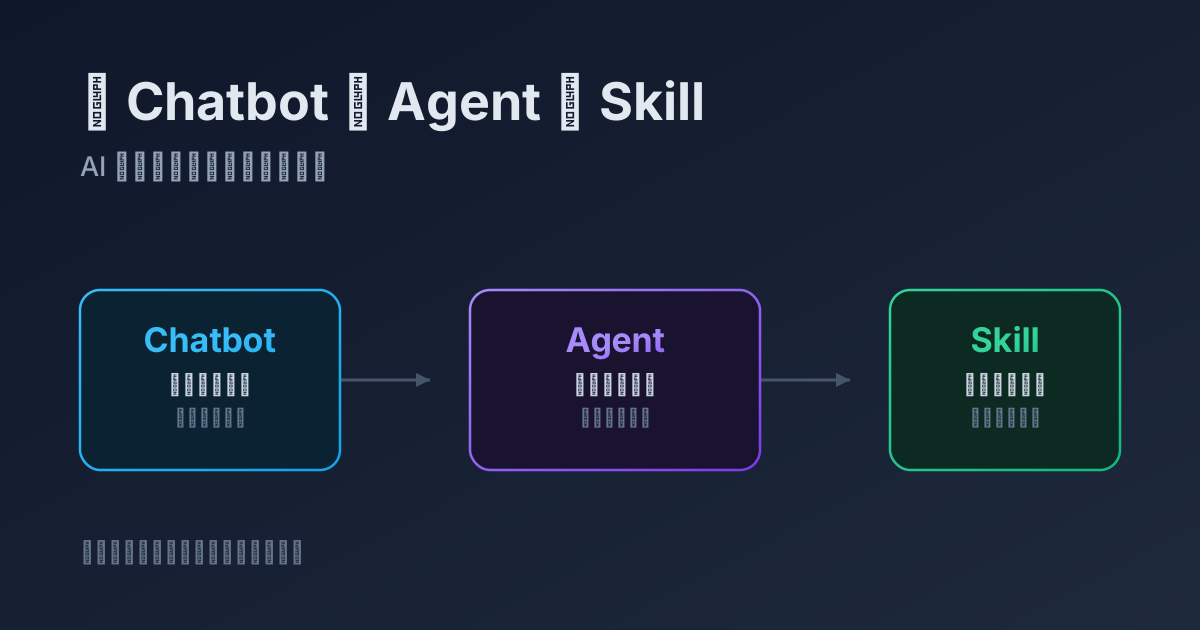
Chatbot to Agent to Skill, a three-stage framework for reusable AI workflows

From Chatbot to Agent to Skill: Turning Judgment into a System

A Year Later, Why Does AI Still Feel Like Extra Work? AI now writes copy, translates documents, summarizes meetings, and inspects spreadsheets. Yet one honest question cuts through the excitement: has it taken over a business step, or do you still explain the background, judge the answer, and decide what happens next every time? The model may be smarter. The person carrying the context and the responsibility often has not changed. ...

July 14, 2026 · 8 min · 1591 words · Xinwei Xiong, Me
A six-part AI task card connecting an open direction to a verifiable result

Give AI Tasks, Not Just Direction: Define Done First

After Three Hours, What Is Left on the Table? I have had evenings that began with a modest intention: settle the angle of an essay. Soon I was discussing titles with AI, then business models, then the meaning of work. The conversation flowed beautifully. When I closed the window, the page was still blank. That does not make the conversation worthless. It reveals that exploration and execution are different kinds of work. ...

July 11, 2026 · 8 min · 1526 words · Xinwei Xiong, Me
Draft records passing an evidence gate into retrievable knowledge cards, then returning through a review and retirement loop

AI Knowledge Base Workflow: Turn Notes Into Verified, Reusable Capability

Growing Bigger, Getting Less Useful We’ve reached layer three. Information has been captured and denoised; records have been written down and polished into semi-finished products — now the question is: how do you turn these semi-finished products into actual knowledge? Let’s start with a definition. Knowledge is structured, repeatedly reusable material relevant to you: a mental model, a handful of skills, a methodology, along with your judgment, positioning, and values. Its keyword is reusability, and it solves your own problems. ...

July 11, 2026 · 11 min · 2202 words · Xinwei Xiong, Me
Information crossing intake gates into records, verified knowledge, audience-facing creation, and a measured feedback loop

AI Knowledge Workflow: From Information to Records, Knowledge, and Creation

Four Names for Four Different Kinds of Work My notes used to grow in one direction: inward. Links entered, fragments accumulated, folders changed names, and the archive became heavier. I mistook possession for processing. AI made that mistake cheaper to repeat. A model can generate, summarize, classify, and reformat text quickly, but speed does not turn a source into evidence, an observation into knowledge, or a draft into something I should publish. It can make the warehouse larger without improving the machinery. ...

July 11, 2026 · 10 min · 1918 words · Xinwei Xiong, Me
A wide schematic of context engineering: the Write / Select / Compress / Isolate pillars feeding an AI, a laptop with notes, and a local-first world line

Context Engineering: The New Foundation for AI Agents

Context engineering is the set of strategies for curating, ordering, and evicting the tokens that enter an LLM’s context window on each inference call—system instructions, retrieved documents, conversation history, tool definitions, and memory. The short version is this: prompt engineering optimizes the wording of an instruction; context engineering optimizes the wiring of the whole window. Anthropic has articulated this distinction in its engineering guidance, and Karpathy helped popularize the term. The rest of this article takes the emerging discipline apart. ...

June 22, 2026 · 16 min · 3381 words · Xinwei Xiong, Me
A technical diagram with a tiny agent loop at the center, surrounded by concentric rings of the eight pillars: orchestration, context, memory, tools, reliability, evaluation, cost, governance

Agent Engineering Harness: The Eight Pillars Behind the 98.4%

A small model loop becomes a system only after we decide what it may remember, touch, spend, and survive. An agent demo can be a loop around an API call. A production agent is the surrounding discipline: state, tools, permissions, recovery, evaluation, and cost. This article offers a map of that discipline rather than a framework tutorial. Each pillar is described through the gap it fills, a minimal implementation, and the boundary where it stops helping. ...

June 17, 2026 · 19 min · 3836 words · Xinwei Xiong, Me
Files, memory, runtime boundaries, and evaluation for continuous agent identity

Agent Identity: From Locke to OpenClaw

A philosophical boundary and an engineering practice for continuity in AI agents Start by Making “Identity” Small Enough to Engineer Agent amnesia first damages the cost of cooperation, not the illusion of personhood. A strong session does not guarantee that the next one will preserve the same judgment. Users repeat preferences, teams restate constraints, and the system struggles to explain where an earlier decision came from. Long-term trust rests on these unglamorous forms of continuity: what the agent remembers, what it forgets, why it changed, and who approved the change. ...

April 5, 2026 · 16 min · 3207 words · Xinwei Xiong, Me
A research notebook connecting source pages, citations, and synthesized outputs

Gemini Notebook (Formerly NotebookLM): A Source-Grounded Research Workflow

On July 16, 2026, Google renamed NotebookLM to Gemini Notebook. The old name will remain in search results, screenshots, and habits for a while, but the product did not disappear. Google describes it as the same standalone research tool, now connected more closely to the Gemini app and, eventually, Google Search. The rename also marks a larger change: notebooks are becoming places where software can not only read sources, but also run analysis against them. ...

April 21, 2025 · 18 min · 3787 words · Xinwei Xiong, Me
From Language Models to RAG: Capabilities, Limits, and Engineering

From Language Models to RAG: Capabilities, Limits, and Engineering

Introduction: Do Not Learn the Model from the Chat Window The first encounter with a large language model creates a powerful illusion. Something on the other side of the screen appears to have read widely, reasoned carefully, and chosen to explain itself. It can write code, summarize papers, preserve a tone across a conversation, and offer a polished rationale for an answer that is completely wrong. The chat window shows behavior, not mechanism. Fluency hides missing evidence. Completeness hides uncertainty. A human voice invites us to overestimate how firmly the model is connected to the world. ...

May 15, 2024 · 20 min · 4118 words · Xinwei Xiong, Me