A shared organizational agent dispatch console connected to permission vaults, memory archives, and isolated work cells

Claude Tag Deep Dive: From Shared Slack AI to an Organizational Agent Runtime

Calling Claude Tag a Slack bot misses its most consequential product decision. It turns a channel into a place where an agent can be authorized, remember, and keep working: a team shares one executor; each task runs asynchronously in a thread-level sandbox hosted by Anthropic; Agent Proxy injects external credentials at the network boundary; and the result returns to the public thread with a traceable record. The Claude Tag documentation describes these mechanisms in unusually concrete terms. ...

August 5, 2026 · 23 min · 4772 words · Xinwei Xiong, Me
A fixed demand axis beside industry workflow cards being reconnected

Common Sense Is Not the Mechanism: Rebuilding Industries Around Demand, Constraints, and Scarcity

“Is common sense the same as the mechanism underneath?” That was where I got stuck while testing ideas across several industries. I had also reviewed the published work of 22 frontier AI teams and more than 70 people whose work is public. A pattern kept returning: pursue one long-running question, define what good work looks like, connect papers, code, and products, then turn production failures into the next round of tests. But the pattern still did not tell me where industry analysis should begin. ...

August 1, 2026 · 18 min · 3834 words · Xinwei Xiong, Me
Claude Code playbook for verification, permissions, worktrees, loops, and parallel agents

Claude Code Playbook: 10 Configurations for Reliable Agent Workflows

Put the Tip List Down for a Moment I began this article as a collection of Boris Cherny’s Claude Code habits. That version had a problem: social posts age with models and product releases, while fan-maintained collections tend to mix personal advice, previews, and impressive-looking statistics. A sharp opinion can become a historical footnote before the article reaches its readers. So I took the slower route. Product claims in this revision come from Anthropic or the official Claude Code documentation. Untraceable numbers, second-hand quotations, and claims of universal superiority are gone. Boris’s way of working remains an inspiration, but it is not treated as a specification. ...

July 20, 2026 · 15 min · 2996 words · Xinwei Xiong, Me
A quiet control desk representing verifiable loop engineering for solo builders

Loop Engineering for Solo Builders: Verifiers, State, and Safe Automation

Why Does Getting Better at This Make Me More Tired? Let me start with a strange thing I banged my head against for a long time before I understood it. When I first started using Claude Code, the productivity gain was visible to the naked eye: an afternoon’s work covered what used to take two days. Once I got fluent, the gains kept coming — but so did the exhaustion at the end of each day. Because I was doing the same thing all day long: watch it finish, judge whether it’s right, think about what to say next, hit enter again. ...

July 20, 2026 · 30 min · 6201 words · Xinwei Xiong, Me
A solo creator's AI video editing pipeline from camera to publication

A Solo Creator's AI Video Editing Pipeline That Actually Works

Last winter I ran a very ugly set of numbers. I’d spent an entire afternoon in a café, writing code and shooting footage in between — about forty minutes of material across phone and screen recording. I started editing that evening and exported at 1:30 in the morning. The finished cut was fifty-eight seconds. Forty minutes of footage. Six hours of editing. Fifty-eight seconds of output. And the numbers on it were mediocre. ...

July 19, 2026 · 24 min · 4918 words · Xinwei Xiong, Me
Designing devbox-doctor, a safer Mac toolchain audit

Designing devbox-doctor: A Safer Mac Toolchain Audit

I am building a developer-machine checkup skill called devbox-doctor. The idea sounds simple: inventory a Mac, identify tools that may no longer earn their keep, find actual toolchain conflicts, and trace data left behind by uninstalled apps. The dangerous word in that sentence is identify. A scanner can prove that two tools are installed. It cannot prove that one is useless. A directory can resemble an app’s name. That does not make the directory safe to delete. Spotlight can return no last-used date. That does not mean the app was never opened. ...

July 18, 2026 · 12 min · 2431 words · Xinwei Xiong, Me
Agent Skill design shown as code, model judgment, permission gates, and human confirmation

Agent Skill Design: What a Dangerous SKILL.md Taught Me

What makes an Agent Skill valuable is not a clever prompt, but a clean division of responsibility: deterministic work goes to code, judgment goes to the model, and execution confirmation returns to the human. Structured contracts hold those parts together. I reached that conclusion by dissecting a storage-cleanup Skill that can delete local files from a web page. Deletion is one of the most consequential powers an agent-adjacent tool can expose. The design did not make me fearless; it gave me specific controls I could inspect before deciding whether to click. ...

July 18, 2026 · 11 min · 2310 words · Xinwei Xiong, Me
A private AI knowledge arsenal connecting evidence cards, executable workflows, publishing platforms, and feedback loops

Building an AI Knowledge Base: From Notes to Executable Workflows

After the Framework Stood Up, I Realized I Had No “Shared Workshop” The five-part Info-to-Creation series got the framework standing: information gets collected and denoised, records settle into half-finished goods, knowledge gets structured into capability, creation reorganizes it for an audience. But after writing that line in Layer 3: Knowledge — “your knowledge base is the workshop you share with your AI” — something kept nagging at me. ...

July 17, 2026 · 12 min · 2352 words · Xinwei Xiong, Me
How AI agents rebuilt a 120-post Hugo blog with a human editor

How AI Agents Rebuilt My 120-Post Blog From Scratch

What actually happened here How large a team does it take to rebuild a four-year-old blog with 120+ posts — content architecture, operations, all of it? My answer, delivered over the first half of this year: one person and a crew of agents with clearly divided jobs. “Crew” is a working metaphor, not a fixed headcount of digital employees. As of July 2026, the repository contains seven Claude skills and four workflows whose names begin with seo-; Claude Code, Codex, the Claude jobs inside GitHub Actions, and temporary review sessions are started only when a task calls for them. The human owns judgment, boundaries, and the final signature. Agents own scoped work that can be tested. The result is the site you’re reading — cubxxw.com . It isn’t merely a redesign. It turned “a blog” from a static site into a system that generates a daily report, prepares fix proposals, and exposes its own search interface. ...

July 17, 2026 · 19 min · 4026 words · Xinwei Xiong, Me
A personal intelligence pipeline connecting monitored sources to evidence, judgment, and action

Build a Personal Intelligence System That Leads to Action

The quiet dashboard can be the dangerous one A morning briefing with no new items may mean that nothing relevant happened. It may also mean an RSS route broke, an API began returning empty pages, or a credential expired during the night. From the reader’s side, those very different states look identical: silence. That is the first lesson of a personal intelligence system. Gathering more information is easy to demonstrate; knowing whether the machine is healthy, whether its summaries are faithful, and whether a signal deserves action is the real work. The system I want is not an account that publishes automatically. It is a pipeline that can show me what changed, why it may matter, what evidence supports the claim, and which decision—if any—should follow. ...

July 15, 2026 · 12 min · 2452 words · Xinwei Xiong, Me
An AI news pipeline reaching the boundary between automation and human judgment

AI News Pipelines: Automation Limits and Human Judgment

Suppose you ask an AI system to track one field — papers, releases, benchmarks, first-party changelogs, and the conversations around them. How far can it get on your behalf? This essay is not a census of every product. It is a field note from the systems I tested between January and June 2026, across AI research and developer-tool sources. In that sample, three patterns kept recurring: subscription aggregation, change monitoring, and agentic search. They were capable, but they shared a boundary: automation can haul information remarkably well; without your goals, context, and feedback, it cannot reliably make the final judgment for you. ...

July 15, 2026 · 17 min · 3431 words · Xinwei Xiong, Me
Chatbot to Agent to Skill, a three-stage framework for reusable AI workflows

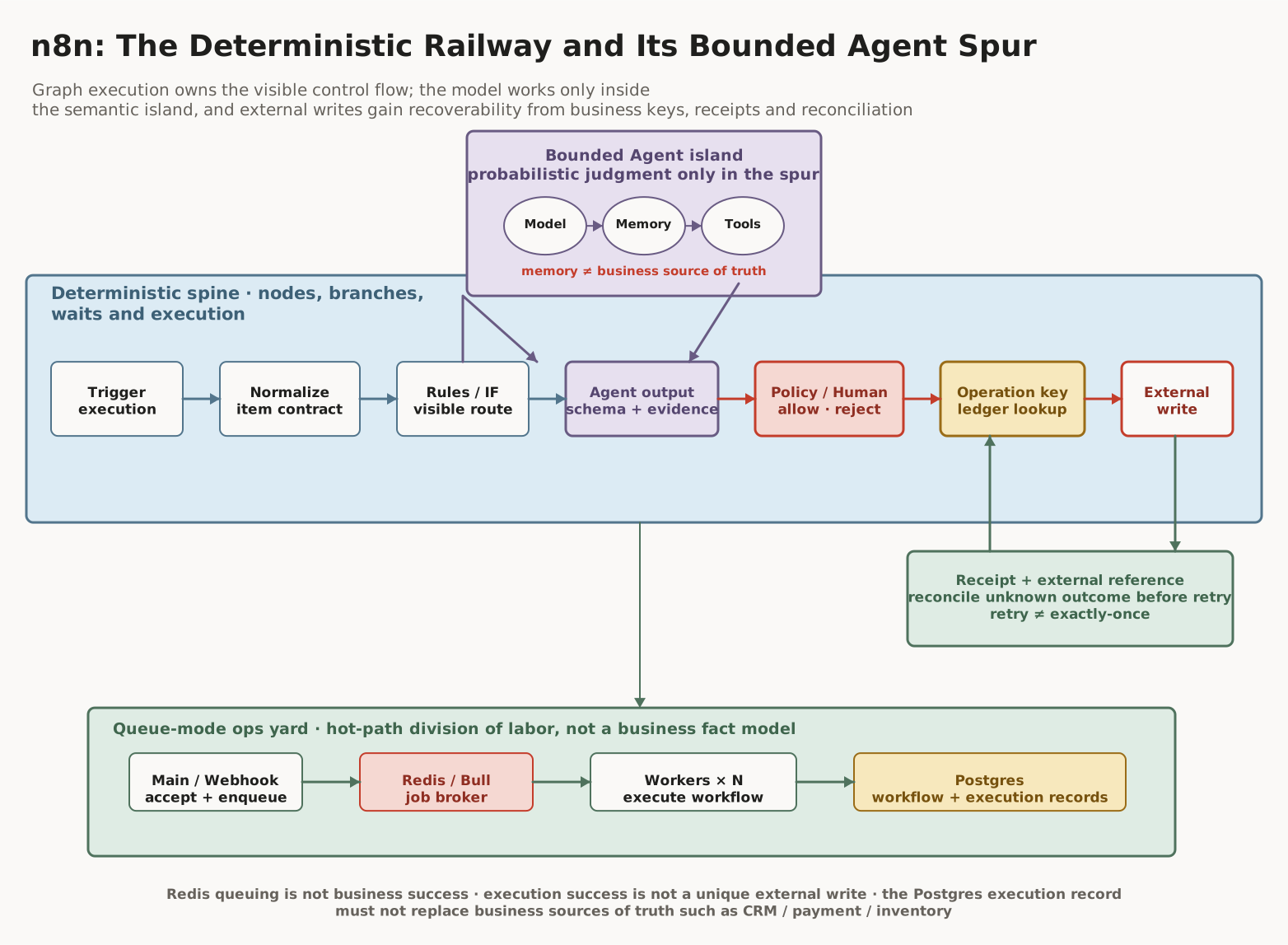
From Chatbot to Agent to Skill: Turning Judgment into a System

A Year Later, Why Does AI Still Feel Like Extra Work? AI now writes copy, translates documents, summarizes meetings, and inspects spreadsheets. Yet one honest question cuts through the excitement: has it taken over a business step, or do you still explain the background, judge the answer, and decide what happens next every time? The model may be smarter. The person carrying the context and the responsibility often has not changed. ...

July 14, 2026 · 8 min · 1591 words · Xinwei Xiong, Me
A safe three-layer AI second brain built with Obsidian, Claude, and a capture inbox

Build an AI Second Brain with Claude and Obsidian

A Second Brain Is a Working System, Not a Larger Notebook Most note systems are built for a future reader called you. You save a link, polish a heading, add two tags, and trust that one day you will return. Usually, you do not. An AI-native second brain begins with a different question: What useful work should this note make possible? The answer might be modest: turn an inbox note into a project brief, retrieve your earlier judgment before a meeting, or draft an article from claims you have already verified. The point is not to make AI read everything. The point is to give it a narrow, legible field in which it can help without quietly rearranging your life. ...

July 11, 2026 · 12 min · 2419 words · Xinwei Xiong, Me
Knowledge cards moving through an AI-assisted creation pipeline toward an audience, then returning as a measured feedback loop

AI Content Creation Workflow: Turning Knowledge Into Work People Want

Creation Is the Outward Half We’ve reached the final layer. Information has been denoised, records have been sedimented, knowledge has been structured into repeatedly callable capability — but up to this point, every stage has been solving your own problem. Knowledge makes you stronger, but it doesn’t automatically turn into something others want to read. Creation is the layer that reverses the direction of this pipeline. Knowledge faces inward; creation faces outward. Knowledge asks “can I reuse this”; creation asks “can others receive this.” Creation corresponds to a platform’s recommendation logic, a particular group of users’ reading habits, and the substantial research you did to support this specific piece of expression. It has exactly one goal: have the audience receive it, understand it, and want to connect with you. ...

July 11, 2026 · 12 min · 2476 words · Xinwei Xiong, Me
Draft records passing an evidence gate into retrievable knowledge cards, then returning through a review and retirement loop

AI Knowledge Base Workflow: Turn Notes Into Verified, Reusable Capability

Growing Bigger, Getting Less Useful We’ve reached layer three. Information has been captured and denoised; records have been written down and polished into semi-finished products — now the question is: how do you turn these semi-finished products into actual knowledge? Let’s start with a definition. Knowledge is structured, repeatedly reusable material relevant to you: a mental model, a handful of skills, a methodology, along with your judgment, positioning, and values. Its keyword is reusability, and it solves your own problems. ...

July 11, 2026 · 11 min · 2202 words · Xinwei Xiong, Me
Text, voice, screenshots, code changes, and decisions moving through capture, clarification, and review toward a verified knowledge card

AI Note-Taking Workflow: Turn Fleeting Inputs Into Verifiable Records

The Semi-Finished Product Filed Under “Knowledge” In most people’s mental model, notes only have three tiers: see information → turn it into knowledge → use it to create. The act of “recording” in between gets quietly filed under “knowledge.” But as I said in the overview, records deserve to stand alone as their own layer. Because it’s an independent intermediate form: it’s relevant to you, but not necessarily useful forever; it might just be something you’ll need someday, or something you’re using right now to clarify your own thinking. That kind of thing doesn’t yet qualify as knowledge — only what’s structured for repeated future reuse counts as knowledge. ...

July 11, 2026 · 10 min · 1923 words · Xinwei Xiong, Me
Sources passing through relevance, privacy, and verification gates before AI-assisted processing and entry into the records layer

AI Information Filtering Workflow: Capture Signal Without a Noise Archive

The Default State of Information Is Noise The previous essay laid out the framework: information, records, knowledge, and creation are four distinct stages. This one deals with only the first — information. The single most important thing to understand about information is this: its default state is noise. We have a natural greed for information. See a good article, want to bookmark it. See a great quote, want to save it. See a reading list someone recommended, want to add it to your queue. Every act of “saving” gives us a small illusion of “I’m making progress.” But saving, at its core, is just moving information from someone else’s warehouse into yours — it hasn’t gone through any processing by your own machine. ...

July 11, 2026 · 9 min · 1889 words · Xinwei Xiong, Me
Information crossing intake gates into records, verified knowledge, audience-facing creation, and a measured feedback loop

AI Knowledge Workflow: From Information to Records, Knowledge, and Creation

Four Names for Four Different Kinds of Work My notes used to grow in one direction: inward. Links entered, fragments accumulated, folders changed names, and the archive became heavier. I mistook possession for processing. AI made that mistake cheaper to repeat. A model can generate, summarize, classify, and reformat text quickly, but speed does not turn a source into evidence, an observation into knowledge, or a draft into something I should publish. It can make the warehouse larger without improving the machinery. ...

July 11, 2026 · 10 min · 1918 words · Xinwei Xiong, Me
Microsoft UFO desktop agent architecture

Microsoft UFO³ Explained: From Windows Desktop AgentOS to a Multi-Device Agent Galaxy

Why UFO matters Desktop automation has always had an awkward boundary. Scripts are fast and precise when an application exposes the right interface. GUI automation is broad, but a changed label, a delayed window, or a custom-drawn control can break an otherwise sensible workflow. A vision-language model can interpret what it sees, yet perception alone does not make an action reliable. Microsoft’s UFO project is interesting because its evolution follows that boundary instead of pretending it does not exist. ...

May 9, 2025 · 15 min · 3008 words · Xinwei Xiong, Me
Argo CD continuously comparing desired state in Git with live Kubernetes state

Argo CD in Production: GitOps Sync, ApplicationSets, Rollbacks, and Security

A green sync does not prove the delivery system is safe When Argo CD turns an application green, it proves one narrow thing: at that moment, the cluster matches the desired manifests Argo CD calculated. It does not prove that the image passed its tests, that a deletion is safe, or that the next Git change belongs in production. That boundary is the right place to begin. Argo CD is not a pipeline that makes release judgments for a team. It is a Kubernetes controller that repeatedly compares, reports, and—when policy permits—reconciles state. Its value is not another attractive dashboard. Its value is turning deployment intent from scattered commands into something reviewable and reproducible. ...

May 9, 2025 · 13 min · 2705 words · Xinwei Xiong, Me
A red, green, and blue testing loop surrounding an AI system

Test-Driven Development for AI and LLM Applications: A Practical 2026 Guide

Test-driven development is easy to explain when the function under test adds two numbers. Write a failing test, make it pass, then improve the implementation without changing its behavior. The difficulty begins when the function calls a language model and five different answers may all be acceptable. That does not make TDD obsolete. It means the word test has to become more precise. For an AI application, I use TDD as a discipline for discovering contracts. Some contracts are exact: a parser must reject malformed JSON, an authorization check must not leak another tenant’s data, and a tool call must match its schema. Other contracts are statistical: a support assistant should resolve most routine cases, cite the supplied policy, and rarely invent a refund rule. The first group belongs in ordinary tests. The second belongs in evaluations and monitoring. ...

April 21, 2025 · 16 min · 3402 words · Xinwei Xiong, Me
LangChain 1.x architecture connecting models, agents, memory, retrieval, and observability

LangChain 1.x in Practice: A Developer Guide to Reliable Agents

A framework is most dangerous not when it lacks features, but when its old tutorials still look plausible. Familiar code can cross a version boundary long before it produces an obvious error. This guide follows the current LangChain Python 1.x path: model calls, agents, tools, structured output, middleware, memory, RAG, SQL, Ollama, and LangSmith. It is deliberately different from a framework overview. The aim is to leave you with a compact application architecture, runnable examples, and a way to recognize code that belongs to the 0.x era. ...

May 22, 2024 · 11 min · 2221 words · Xinwei Xiong, Me
An abandoned film strip crossing a bridge toward a new modular video workflow

SoraEase After Sora: A Prompt Archive and Developer Migration Guide

In March 2024, this page was a long collection of Sora prompts. It belonged to the brief season when a research preview could become a small open-source movement before most people had touched the product. We copied examples, named camera movements, and tried to infer a grammar from a handful of remarkable clips. That guide can no longer honestly call itself a guide to “mastering Sora.” The Sora web and app experiences closed on April 26, 2026. OpenAI says its Sora API will be discontinued on September 24, 2026. A page that still teaches Sora as a growing platform would turn search traffic into misinformation. ...

March 14, 2024 · 13 min · 2722 words · Xinwei Xiong, Me

GoReleaser v2 + GitHub Actions: Go Release Guide

The goal of GoReleaser is to automate much of the tedious work when releasing software, by using sensible defaults and making it simple for the most common use cases. Preparation: .goreleaser.yaml file: contains all configuration information. (For more information, see Customization ) Clean working tree: Make sure the code is up to date and all changes have been committed. SemVer compliant version number (e.g. 10.21.34-prerelease+buildmeta) GoReleaser running steps: The operation of GoReleaser is mainly divided into the following four steps: ...

September 16, 2023 · 53 min · 11224 words · Xinwei Xiong, Me
A clockwork cart passing through controlled gates, representing the evolution from AutoGPT Classic to a governed agent platform

AutoGPT in 2026: From the Classic Experiment to the Platform

Status note, verified July 31, 2026: this article originally explained how to install the 2023 stand-alone Auto-GPT agent. Those commands are obsolete. The official project now says that AutoGPT Classic is unsupported, its dependencies will not be updated, and it has known security issues. Treat Classic as a historical laboratory, not a production tool. For new work, use the maintained AutoGPT Platform or another actively maintained workflow system. In the spring of 2023, Auto-GPT made a compelling promise: describe an objective, give a model some tools, and watch it plan its own way forward. I installed it because the idea felt less like a chatbot feature and more like a change in the shape of software. ...

March 18, 2023 · 10 min · 2100 words · Xinwei Xiong, Me