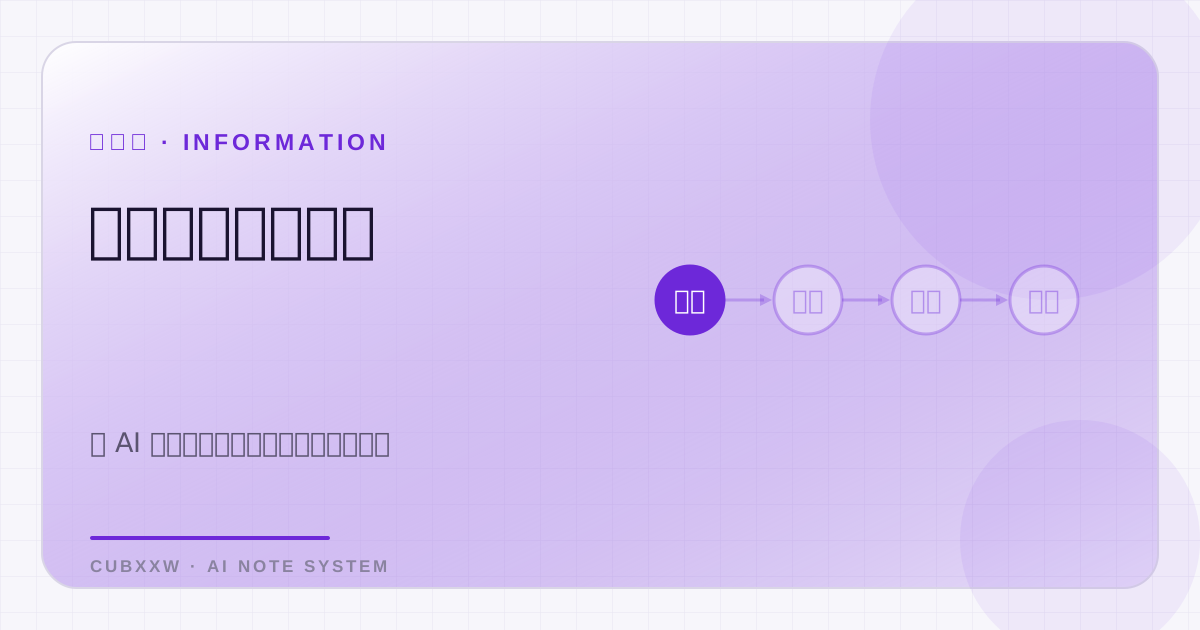
A personal intelligence pipeline connecting monitored sources to evidence, judgment, and action

Build a Personal Intelligence System That Leads to Action

The quiet dashboard can be the dangerous one A morning briefing with no new items may mean that nothing relevant happened. It may also mean an RSS route broke, an API began returning empty pages, or a credential expired during the night. From the reader’s side, those very different states look identical: silence. That is the first lesson of a personal intelligence system. Gathering more information is easy to demonstrate; knowing whether the machine is healthy, whether its summaries are faithful, and whether a signal deserves action is the real work. The system I want is not an account that publishes automatically. It is a pipeline that can show me what changed, why it may matter, what evidence supports the claim, and which decision—if any—should follow. ...

July 15, 2026 · 12 min · 2452 words · Xinwei Xiong, Me
A measured cost test for routing work across an agent fleet

Agent Fleet Economics in 2026: Testing Low-Cost APIs and Open-Weight Options

How many agents can one person afford to keep running? The wrong way to answer is to count agents. An “agent” might classify one paragraph, search for twenty minutes, or refactor a repository through eighty tool calls. The useful unit is not the agent. It is the successful task, with its input tokens, output tokens, tool charges, retries, and human cleanup attached. That distinction changed how I think about two related but different choices: low-cost hosted model APIs and open-weight models that can be self-hosted. Falling API prices matter, but “90% cheaper” is meaningful only when three things are visible: ...

July 15, 2026 · 12 min · 2346 words · Xinwei Xiong, Me
When the AI Agent Starts Prompting You, What Has Actually Changed

When the AI Agent Starts Prompting You, What Has Actually Changed

A counterintuitive signal: it starts prompting you Start with a question. Suppose one day you open your workspace and the agent isn’t sitting there quietly waiting for your next command. It speaks first: “I noticed section three of yesterday’s proposal is still unfinished. I drafted something in the voice you used last week — want to take a look now?” Is that thoughtful, or is it presumptuous? Over the past six months I’ve noticed a counterintuitive signal while following agent launches, primary sources, papers, and benchmarks: more products are experimenting with agents that do not wait for the next instruction. They use available context, estimate what is worth doing, and bring a suggestion forward. ...

July 15, 2026 · 22 min · 4478 words · Xinwei Xiong, Me
An AI news pipeline reaching the boundary between automation and human judgment

AI News Pipelines: Automation Limits and Human Judgment

Suppose you ask an AI system to track one field — papers, releases, benchmarks, first-party changelogs, and the conversations around them. How far can it get on your behalf? This essay is not a census of every product. It is a field note from the systems I tested between January and June 2026, across AI research and developer-tool sources. In that sample, three patterns kept recurring: subscription aggregation, change monitoring, and agentic search. They were capable, but they shared a boundary: automation can haul information remarkably well; without your goals, context, and feedback, it cannot reliably make the final judgment for you. ...

July 15, 2026 · 17 min · 3431 words · Xinwei Xiong, Me
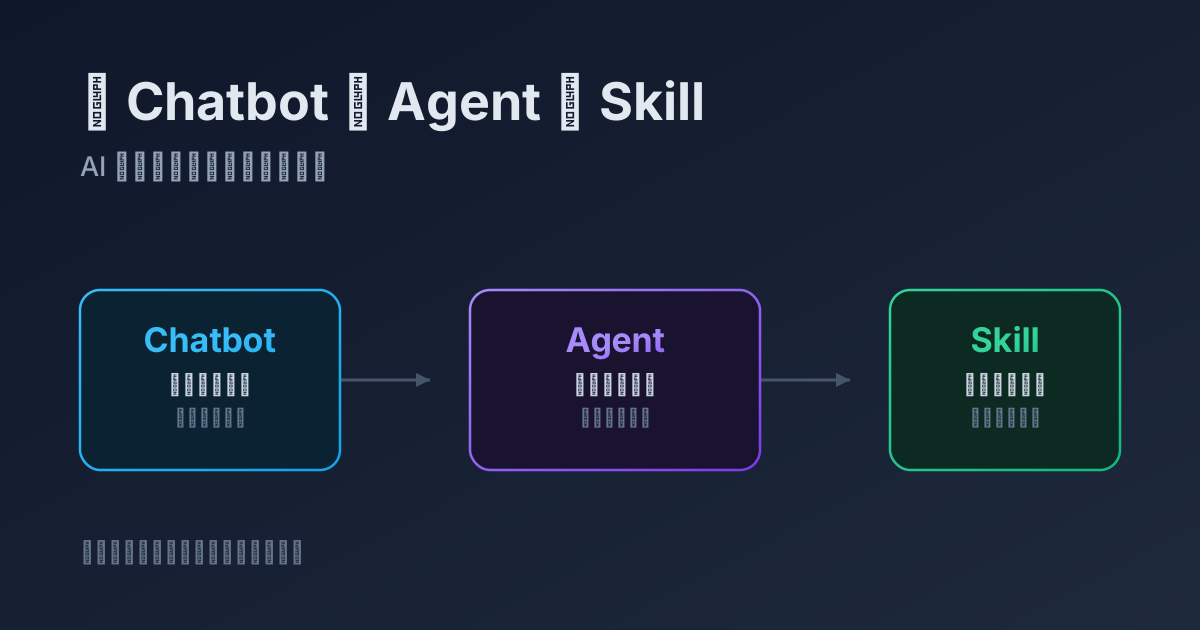
Chatbot to Agent to Skill, a three-stage framework for reusable AI workflows

From Chatbot to Agent to Skill: Turning Judgment into a System

A Year Later, Why Does AI Still Feel Like Extra Work? AI now writes copy, translates documents, summarizes meetings, and inspects spreadsheets. Yet one honest question cuts through the excitement: has it taken over a business step, or do you still explain the background, judge the answer, and decide what happens next every time? The model may be smarter. The person carrying the context and the responsibility often has not changed. ...

July 14, 2026 · 8 min · 1591 words · Xinwei Xiong, Me
A six-part AI task card connecting an open direction to a verifiable result

Give AI Tasks, Not Just Direction: Define Done First

After Three Hours, What Is Left on the Table? I have had evenings that began with a modest intention: settle the angle of an essay. Soon I was discussing titles with AI, then business models, then the meaning of work. The conversation flowed beautifully. When I closed the window, the page was still blank. That does not make the conversation worthless. It reveals that exploration and execution are different kinds of work. ...

July 11, 2026 · 8 min · 1526 words · Xinwei Xiong, Me
Friction is growth — deliberately keeping friction in an era when AI removes resistance

Friction Is Growth: When AI Removes All Resistance for You, Deliberately Keep Some

A Signal That Sent a Chill Down My Spine Let me start with a line from the retrospective of someone who uses AI heavily every day. Reading it gave me a bit of a chill: When I have a really enjoyable conversation with AI, it probably means I didn’t grow that day. They explained it clearly: a pleasant conversation usually means no friction was encountered. Real growth is always accompanied by some kind of discomfort — forcing a vague idea into a clear sentence, working through a problem you can’t figure out, being jolted into rethinking by an objection. None of that feels “good.” They kept using AI to remove friction, and the more they used it, the smoother and more pleasant the conversations got — until they stopped and realized: friction was exactly what they needed most, and they’d deleted it with their own hands. ...

July 11, 2026 · 7 min · 1353 words · Xinwei Xiong
Five quality gates surrounding an AI workflow, from evidence to human review

AI Workflow Quality Gates: A Practical Engineering Guide

“It Runs” Is Not a Reliability Standard Most personal AI workflows begin with one acceptance test: did it produce something? A draft appears, a patch compiles, ten pages become one, and the task feels finished. After enough repetitions, however, the costly failures are rarely dramatic. They arrive quietly: a polished paragraph built on a stale source, a tool call that never completed, a plausible plan that solved the wrong problem. ...

July 11, 2026 · 8 min · 1567 words · Xinwei Xiong, Me
A safe three-layer AI second brain built with Obsidian, Claude, and a capture inbox

Build an AI Second Brain with Claude and Obsidian

A Second Brain Is a Working System, Not a Larger Notebook Most note systems are built for a future reader called you. You save a link, polish a heading, add two tags, and trust that one day you will return. Usually, you do not. An AI-native second brain begins with a different question: What useful work should this note make possible? The answer might be modest: turn an inbox note into a project brief, retrieve your earlier judgment before a meeting, or draft an article from claims you have already verified. The point is not to make AI read everything. The point is to give it a narrow, legible field in which it can help without quietly rearranging your life. ...

July 11, 2026 · 12 min · 2419 words · Xinwei Xiong, Me
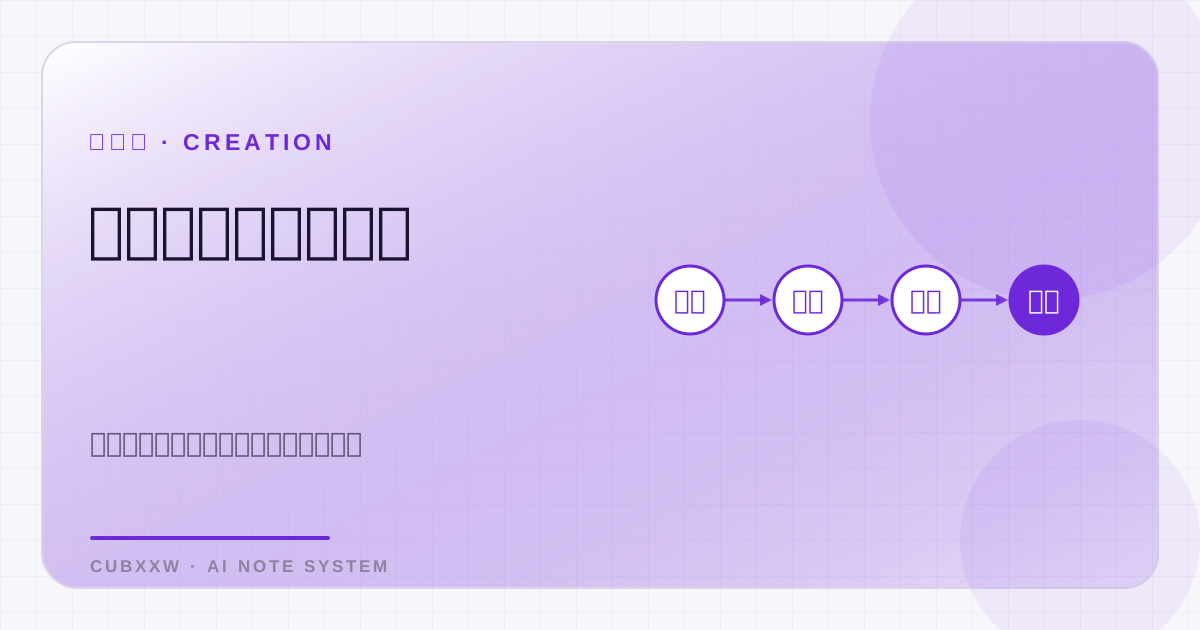
Knowledge cards moving through an AI-assisted creation pipeline toward an audience, then returning as a measured feedback loop

AI Content Creation Workflow: Turning Knowledge Into Work People Want

Creation Is the Outward Half We’ve reached the final layer. Information has been denoised, records have been sedimented, knowledge has been structured into repeatedly callable capability — but up to this point, every stage has been solving your own problem. Knowledge makes you stronger, but it doesn’t automatically turn into something others want to read. Creation is the layer that reverses the direction of this pipeline. Knowledge faces inward; creation faces outward. Knowledge asks “can I reuse this”; creation asks “can others receive this.” Creation corresponds to a platform’s recommendation logic, a particular group of users’ reading habits, and the substantial research you did to support this specific piece of expression. It has exactly one goal: have the audience receive it, understand it, and want to connect with you. ...

July 11, 2026 · 12 min · 2476 words · Xinwei Xiong, Me
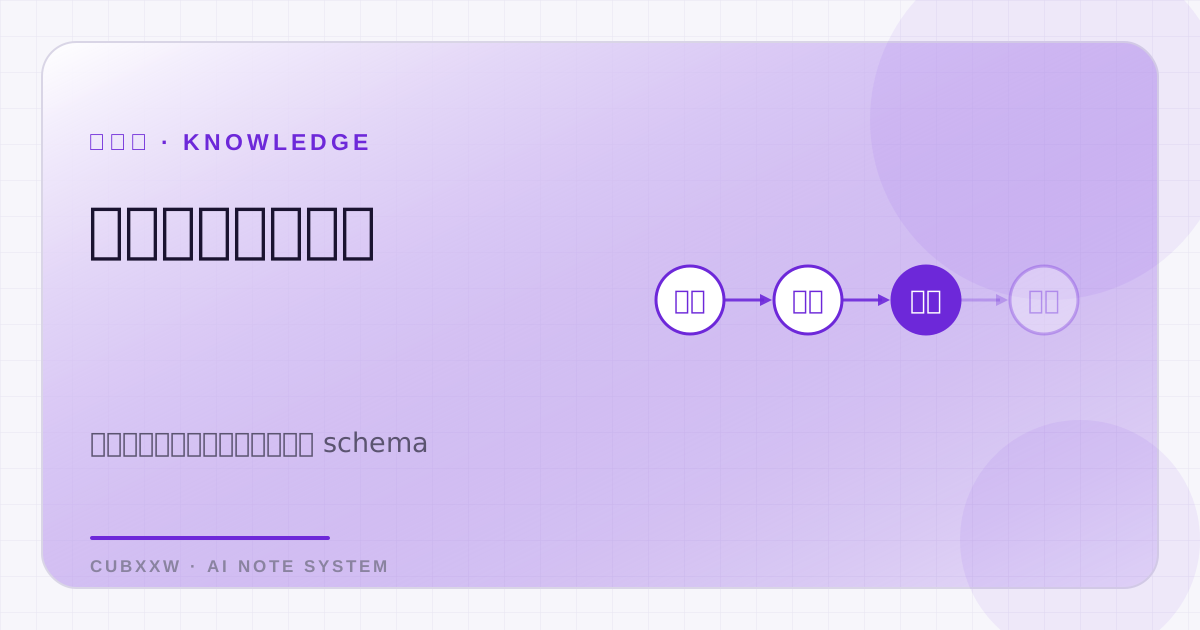
Draft records passing an evidence gate into retrievable knowledge cards, then returning through a review and retirement loop

AI Knowledge Base Workflow: Turn Notes Into Verified, Reusable Capability

Growing Bigger, Getting Less Useful We’ve reached layer three. Information has been captured and denoised; records have been written down and polished into semi-finished products — now the question is: how do you turn these semi-finished products into actual knowledge? Let’s start with a definition. Knowledge is structured, repeatedly reusable material relevant to you: a mental model, a handful of skills, a methodology, along with your judgment, positioning, and values. Its keyword is reusability, and it solves your own problems. ...

July 11, 2026 · 11 min · 2202 words · Xinwei Xiong, Me
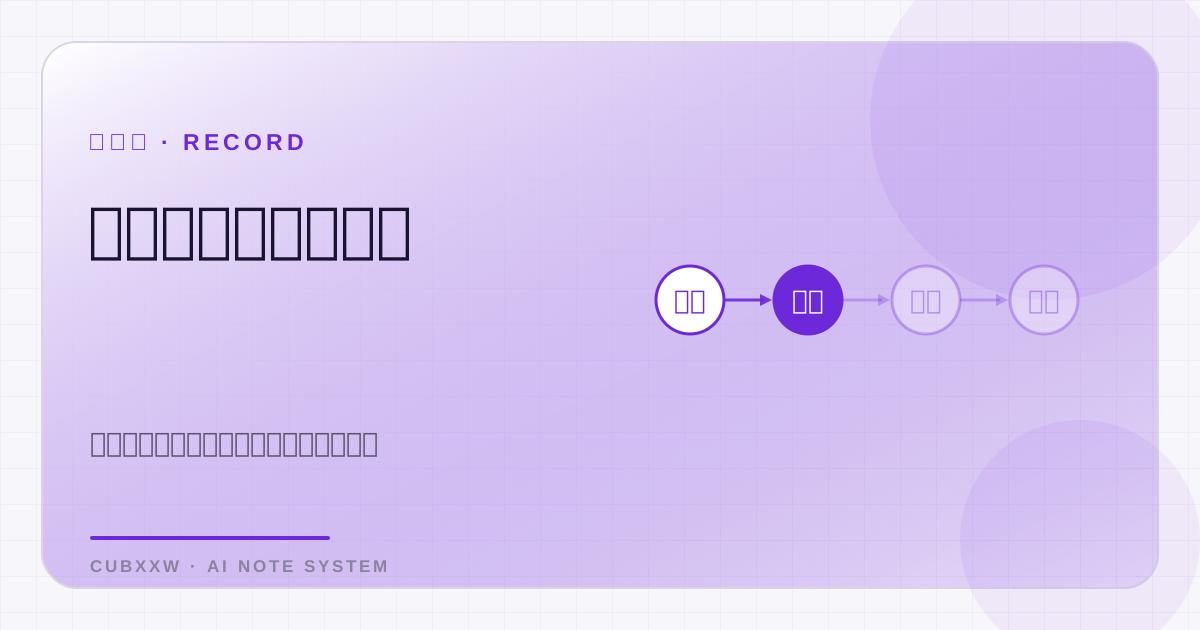
Text, voice, screenshots, code changes, and decisions moving through capture, clarification, and review toward a verified knowledge card

AI Note-Taking Workflow: Turn Fleeting Inputs Into Verifiable Records

The Semi-Finished Product Filed Under “Knowledge” In most people’s mental model, notes only have three tiers: see information → turn it into knowledge → use it to create. The act of “recording” in between gets quietly filed under “knowledge.” But as I said in the overview, records deserve to stand alone as their own layer. Because it’s an independent intermediate form: it’s relevant to you, but not necessarily useful forever; it might just be something you’ll need someday, or something you’re using right now to clarify your own thinking. That kind of thing doesn’t yet qualify as knowledge — only what’s structured for repeated future reuse counts as knowledge. ...

July 11, 2026 · 10 min · 1923 words · Xinwei Xiong, Me
Sources passing through relevance, privacy, and verification gates before AI-assisted processing and entry into the records layer

AI Information Filtering Workflow: Capture Signal Without a Noise Archive

The Default State of Information Is Noise The previous essay laid out the framework: information, records, knowledge, and creation are four distinct stages. This one deals with only the first — information. The single most important thing to understand about information is this: its default state is noise. We have a natural greed for information. See a good article, want to bookmark it. See a great quote, want to save it. See a reading list someone recommended, want to add it to your queue. Every act of “saving” gives us a small illusion of “I’m making progress.” But saving, at its core, is just moving information from someone else’s warehouse into yours — it hasn’t gone through any processing by your own machine. ...

July 11, 2026 · 9 min · 1889 words · Xinwei Xiong, Me
Information crossing intake gates into records, verified knowledge, audience-facing creation, and a measured feedback loop

AI Knowledge Workflow: From Information to Records, Knowledge, and Creation

Four Names for Four Different Kinds of Work My notes used to grow in one direction: inward. Links entered, fragments accumulated, folders changed names, and the archive became heavier. I mistook possession for processing. AI made that mistake cheaper to repeat. A model can generate, summarize, classify, and reformat text quickly, but speed does not turn a source into evidence, an observation into knowledge, or a draft into something I should publish. It can make the warehouse larger without improving the machinery. ...

July 11, 2026 · 10 min · 1918 words · Xinwei Xiong, Me
A verifiable network connecting an author, original work, independent evidence, and reader communities

Off-Site Trust for GEO: Identity, Evidence, and Ethical Distribution

The answer first: trust is evidence, not a platform trick A technically healthy page can be crawlable, clear, and quotable and still receive no visible citation from an answer engine. That does not prove a hidden “trust gate” rejected it. The page may never have been selected, another source may have matched the prompt better, the answer may have absorbed its facts without linking it, or the platform may have behaved differently on that run. ...

July 11, 2026 · 12 min · 2453 words · Xinwei Xiong, Me
open-lovable architecture from web scraping through code generation to dual-sandbox preview

Inside open-lovable: Search, Text Protocols, and Sandboxes

open-lovable begins with a compact promise: give it a website, get back a React application you can keep editing. The generated page is the visible trick. The more useful subject is the plumbing underneath—how scraping, model output, and untrusted code execution are joined without surrendering the whole process to the model. First, pin the clock. This article audits firecrawl/open-lovable commit 69bd93bae7a9c97ef989eb70aabe6797fb3dac89 , dated November 19, 2025. “In the project” below means that exact revision. “The platform today” refers to current vendor documentation. A fixed commit is a small discipline, but it prevents later product features from being smuggled into an older implementation. ...

June 29, 2026 · 9 min · 1809 words · Xinwei Xiong, Me
The Super-Individual Stack: AI-Native Product Directions and Solo Builder Ops in 2026

The Super-Individual Stack: AI-Native Product Directions and Solo Builder Ops in 2026

“Software is eating the world.” — Marc Andreessen, 2011 “Now AI is eating software—and the question for the rest of us is: what’s left for one human, alone, in front of a screen?” — me, asking myself one night in 2026. Prologue: How Big Does One Person Need to Be? In February 2026, I ran my first complete overnight agent. I set a prompt, dropped it into Claude Code in a loop, and went to sleep. At 7 a.m. the next morning, what I saw on the screen was: 6 commits, 4 PRs, 3 auto-rolled-back failures, and a research brief I hadn’t even read myself. ...

June 24, 2026 · 21 min · 4314 words · Xinwei Xiong, Me
Editorial architecture diagram of Relay with a coordinator, five domain agents, safeguards, browser delivery, and audit boundaries

Relay Agent Architecture in 2026: A Local Implementation Audit

An architecture diagram is a promise. A code audit asks which parts of that promise have acquired weight. My first version of this article treated Relay as a public open-source proposal whose Agent layer had not yet been built. Both claims are now wrong. As of July 31, 2026, the public GitHub URL previously cited by this article returns 404, while I can inspect a private local checkout. This piece is therefore a private/local implementation audit, fixed to local commit 22586e17ccd43cfaff0512511e71a100c5341608. Readers should not assume that repository or commit is publicly downloadable. ...

June 24, 2026 · 11 min · 2298 words · Xinwei Xiong, Me
A wide schematic of context engineering: the Write / Select / Compress / Isolate pillars feeding an AI, a laptop with notes, and a local-first world line

Context Engineering: The New Foundation for AI Agents

Context engineering is the set of strategies for curating, ordering, and evicting the tokens that enter an LLM’s context window on each inference call—system instructions, retrieved documents, conversation history, tool definitions, and memory. The short version is this: prompt engineering optimizes the wording of an instruction; context engineering optimizes the wiring of the whole window. Anthropic has articulated this distinction in its engineering guidance, and Karpathy helped popularize the term. The rest of this article takes the emerging discipline apart. ...

June 22, 2026 · 16 min · 3381 words · Xinwei Xiong, Me
A technical diagram with a tiny agent loop at the center, surrounded by concentric rings of the eight pillars: orchestration, context, memory, tools, reliability, evaluation, cost, governance

Agent Engineering Harness: The Eight Pillars Behind the 98.4%

A small model loop becomes a system only after we decide what it may remember, touch, spend, and survive. An agent demo can be a loop around an API call. A production agent is the surrounding discipline: state, tools, permissions, recovery, evaluation, and cost. This article offers a map of that discipline rather than a framework tutorial. Each pillar is described through the gap it fills, a minimal implementation, and the boundary where it stops helping. ...

June 17, 2026 · 19 min · 3836 words · Xinwei Xiong, Me
Files, memory, runtime boundaries, and evaluation for continuous agent identity

Agent Identity: From Locke to OpenClaw

A philosophical boundary and an engineering practice for continuity in AI agents Start by Making “Identity” Small Enough to Engineer Agent amnesia first damages the cost of cooperation, not the illusion of personhood. A strong session does not guarantee that the next one will preserve the same judgment. Users repeat preferences, teams restate constraints, and the system struggles to explain where an earlier decision came from. Long-term trust rests on these unglamorous forms of continuity: what the agent remembers, what it forgets, why it changed, and who approved the change. ...

April 5, 2026 · 16 min · 3207 words · Xinwei Xiong, Me
How to Maintain the Weight of Self in an Age When You Are No Longer Needed

Maintaining Self-Worth in the Age of AI

Pascal wrote in the 17th century: “All of humanity’s problems stem from one thing: man’s inability to sit quietly in a room alone.” Three hundred years later, I thought of this sentence late at night in Lhasa, and added one more: They’re not sure who exactly is the one sitting in that room. Introduction: The 3 AM Emptiness For a while, I woke up almost every day at 3 AM. ...

April 4, 2026 · 10 min · 1963 words · Xinwei Xiong, Me
A quiet archive of linked memory cards illustrating Mem0 OSS v3 retrieval

Mem0 OSS v3 in Practice: Memory Architecture, Retrieval, and Trade-offs

This project note is part of my attempt to understand open-source AI systems by building with them, reading their migrations, and writing down where the abstraction holds—and where it leaks. Project learning list The problem is not remembering more An LLM can carry a conversation while the relevant messages still fit inside its context window. That is short-term continuity, not memory in the human sense and not durable application state. When the session ends, the model does not naturally retain that a user prefers terse answers, changed jobs last month, or abandoned an earlier plan. ...

May 9, 2025 · 11 min · 2303 words · Xinwei Xiong, Me
Microsoft UFO desktop agent architecture

Microsoft UFO³ Explained: From Windows Desktop AgentOS to a Multi-Device Agent Galaxy

Why UFO matters Desktop automation has always had an awkward boundary. Scripts are fast and precise when an application exposes the right interface. GUI automation is broad, but a changed label, a delayed window, or a custom-drawn control can break an otherwise sensible workflow. A vision-language model can interpret what it sees, yet perception alone does not make an action reliable. Microsoft’s UFO project is interesting because its evolution follows that boundary instead of pretending it does not exist. ...

May 9, 2025 · 15 min · 3008 words · Xinwei Xiong, Me
Blank cards passing through a wooden ranking staircase toward a reader

LLM Recommendation Systems: Retrieval, Ranking, RAG, and Evaluation

Recommendation systems create a tempting illusion: the newer the model, the more advanced the system. Anyone who has operated one knows that the model is only the part above water. Below it sit exposure bias, latency budgets, feature freshness, inventory constraints, exploration risk, and counterfactual evaluation. Large language models add a useful semantic layer, but they do not make those older problems disappear. They also introduce new ones: higher cost, variable output, and explanations that can sound persuasive without reflecting the reasons an item was ranked. ...

April 23, 2025 · 18 min · 3653 words · Xinwei Xiong, Me
A research notebook connecting source pages, citations, and synthesized outputs

Gemini Notebook (Formerly NotebookLM): A Source-Grounded Research Workflow

On July 16, 2026, Google renamed NotebookLM to Gemini Notebook. The old name will remain in search results, screenshots, and habits for a while, but the product did not disappear. Google describes it as the same standalone research tool, now connected more closely to the Gemini app and, eventually, Google Search. The rename also marks a larger change: notebooks are becoming places where software can not only read sources, but also run analysis against them. ...

April 21, 2025 · 18 min · 3787 words · Xinwei Xiong, Me
A red, green, and blue testing loop surrounding an AI system

Test-Driven Development for AI and LLM Applications: A Practical 2026 Guide

Test-driven development is easy to explain when the function under test adds two numbers. Write a failing test, make it pass, then improve the implementation without changing its behavior. The difficulty begins when the function calls a language model and five different answers may all be acceptable. That does not make TDD obsolete. It means the word test has to become more precise. For an AI application, I use TDD as a discipline for discovering contracts. Some contracts are exact: a parser must reject malformed JSON, an authorization check must not leak another tenant’s data, and a tool call must match its schema. Other contracts are statistical: a support assistant should resolve most routine cases, cite the supplied policy, and rarely invent a refund rule. The first group belongs in ordinary tests. The second belongs in evaluations and monitoring. ...

April 21, 2025 · 16 min · 3402 words · Xinwei Xiong, Me
Documents flowing through a measured conversion pipeline into structured Markdown

Microsoft MarkItDown 0.1.6: A Practical Document-to-Markdown Guide

A document converter is a bridge, not a source of truth. The important question is not whether the output looks clean at first glance, but whether the bridge preserves the evidence your next system needs. MarkItDown is easy to demonstrate: install a package, pass it a file, receive Markdown. The difficult work begins one minute later. A PDF may contain selectable text, scanned pages, diagrams, tables, or all four. A slide deck may hide essential numbers inside screenshots. A spreadsheet may be understandable only through formulas, merged cells, and spatial relationships. No single conversion mode handles every case equally well. ...

April 21, 2025 · 15 min · 3073 words · Xinwei Xiong, Me
A checkpointed LangGraph StateGraph with recovery paths

LangGraph Architecture in 2026: StateGraph, Persistence, and Recovery

This project is an ongoing journey — learning AI open source projects with steady, daily progress. Through hands-on work with real projects and AI tooling, the goal is to develop the ability to solve complex problems and document the process. Notion List Basic Information: Project Name: LangGraph GitHub URL: langchain-ai/langgraph Main Tech Stack: Python, JavaScript/TypeScript, LangChain, LangSmith, checkpoint stores, LLM providers 1. What LangGraph Actually Solves LangGraph is the low-level orchestration framework and runtime in the LangChain ecosystem. It is useful when an agent must retain typed state, branch or loop, pause for a person, survive a process failure, or expose each transition to tracing and tests. You can use LangGraph without using LangChain’s model abstractions. ...

April 19, 2025 · 7 min · 1348 words · Xinwei Xiong, Me
A restrained editorial illustration of connected paths representing models, agents, and graph workflows

LangChain 1.x in Production: Choosing Models, Agents, and LangGraph

LangChain used to be introduced as a box of chains, memory classes, prompt templates, loaders, and integrations. That description is historically accurate and operationally unhelpful. As of July 2026, the useful way to understand LangChain 1.x is much narrower: Call a model directly when the task is one inference with a clear input and output. Use create_agent when a model must choose among tools in a conventional model–tool loop. Use LangGraph when your application has durable state, explicit branches, retries, parallel work, long-running steps, or human decisions that are part of the workflow. This is not merely a taxonomy. It is an engineering rule about where complexity should live. Every framework abstraction creates a second system beside your product: another execution model, another vocabulary, and another place for failure to hide. The abstraction earns its place only when it makes the real system easier to operate. ...

April 16, 2025 · 15 min · 3178 words · Xinwei Xiong, Me