GEO measurement and tools cover showing citation rate, share of voice, and monitoring radar

GEO Measurement & Tools: How to Know If AI Actually Cites You (with a DIY Monitor)

The answer first: swap your metrics, stop staring at rank and clicks In the GEO era, classic “rank + click” fails systematically — because most value happens in AI answers the user never clicks through to. Swap in two core metrics: citation rate (how often AI answers cite you) and share of voice (your mentions vs competitors). This chapter gives you a workable measurement system, from zero-cost manual spot-checks to dedicated tools to a DIY monitor built on this repo’s scripts. ...

July 11, 2026 · 7 min · 1337 words · Xinwei Xiong
GEO blog rebuild case study cover showing a real-data dashboard and growth curve

GEO Blog Rebuild Case Study: Running the Five-Layer Model on Real Data

The answer first: perfect tech, stuck at “impressions without being chosen” I dug through cubxxw.com’s real data, and the conclusion is blunt: technical SEO is near-perfect (Lighthouse SEO 100), yet the last 3 months turned 878K impressions into only 852 clicks — a 0.1% CTR at average position 13.2 (page two). The problem isn’t the technical layer; it’s “impressions without being chosen.” This chapter runs the previous four chapters’ five-layer model against those real numbers, diagnosis and rebuild schedule included. ...

July 11, 2026 · 7 min · 1289 words · Xinwei Xiong
GEO trust and endorsement cover showing entity consistency and community proof

GEO Trust & Endorsement: Why Reddit and Wikipedia Make Up Half of AI Citations

The answer first: the final gate is trust, not content You can max out your technical base and turn every paragraph into extractable LEGO — and AI may still not cite you. Because the final citation gate hinges on trust, and most trust comes from off-site: how others talk about you, where you’re mentioned on high-credibility platforms. This chapter turns that invisible trust into operable signals. The first three chapters solved crawlable, understandable, and quotable (layers L1–L4 of the model). This one is the hardest and most differentiating: L5, Endorsed. ...

July 11, 2026 · 7 min · 1348 words · Xinwei Xiong
GEO structured tactics cover showing citable paragraph blocks

GEO Structured Tactics: Writing "Worth Citing" Into Every Paragraph (Answer-First, Schema, llms.txt)

The answer first: structure isn’t tidiness, it’s citability engineering Getting cited by AI isn’t about prose; it’s about extractability — whether each of your paragraphs can be lifted out and used as an answer on its own. This chapter hands you four copyable crafts: the Answer-First paragraph formula, a question-heading system, AI-facing Schema, and the right way to do llms.txt / tldr / internal links. All with code or before/after. You can ship it today. ...

July 11, 2026 · 8 min · 1523 words · Xinwei Xiong
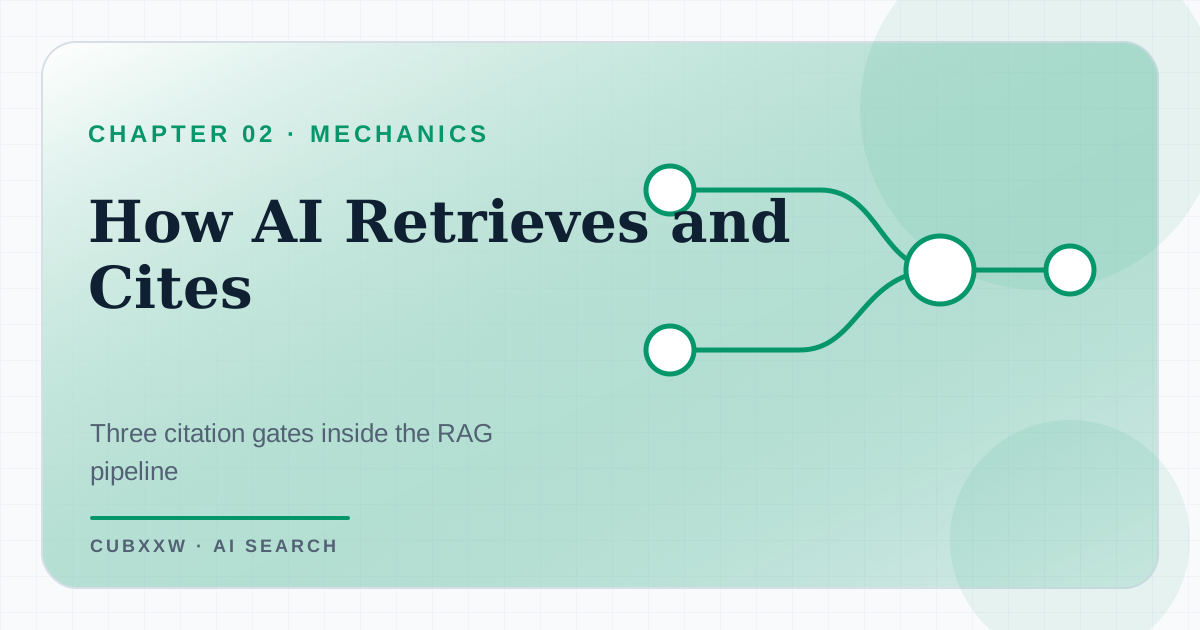
GEO mechanics cover showing the RAG pipeline for AI retrieval, reranking, and citation

GEO Mechanics: How AI Retrieves, Re-ranks, and Cites You

The answer first: you’re winning three gates, not one ranking AI search runs on RAG (Retrieval-Augmented Generation). A question comes in; the system first retrieves a set of candidate content, then re-ranks it by score, then has the LLM generate an answer and cite sources. GEO means clearing three gates: get retrieved (enter the candidate pool), score high in re-ranking (land near the top), and get chosen as a citation at generation (get named). ...

July 11, 2026 · 10 min · 1927 words · Xinwei Xiong
GEO complete guide cover showing the five-layer model from SEO ranking to AI citation

GEO: The Complete Guide to Generative Engine Optimization (When Search Stops Giving Links and Starts Giving Answers)

The answer, first (this paragraph is GEO itself) GEO (Generative Engine Optimization) is the systematic optimization of your content, structure, and off-site reputation so that generative AI systems — ChatGPT, Perplexity, Google AI Overviews, Doubao, DeepSeek — can more easily understand, trust, and cite you when answering a user’s question. It doesn’t replace SEO; it layers on top of it. Classic SEO fights to rank high and get clicked. GEO fights so that when the AI hands the answer directly to the user, you’re in that answer, credited as the source. (Search Engine Land , Frase ) ...

July 10, 2026 · 15 min · 3050 words · Xinwei Xiong