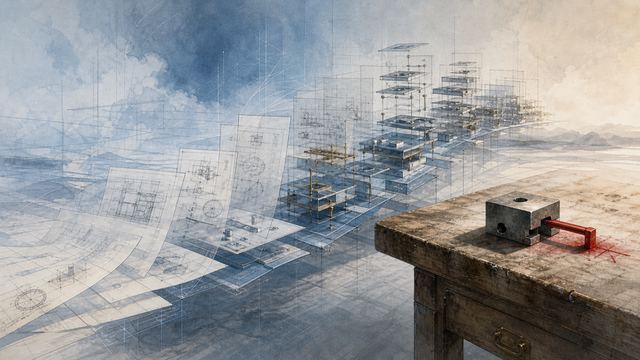

During a 48-hour engineering task, I wrote down one sentence:
“At this point, I’ve spent half the time designing, researching, understanding the requirements, judging the boundaries, and developing my taste and intuition. I haven’t started writing code.”
The task began as a limited feature. After I kept discussing it with AI, it quickly grew a product model, system boundaries, and a complete design. Every step had a rationale. Every piece connected to the next. I could feel myself thinking faster and farther, holding more layers in mind at once.
When I was finally ready to implement it, I wrote another line: “I can’t believe I’m only starting to code now.”
This task did not stall because I could not think it through. The opposite was true: I could keep thinking indefinitely. In this particular task, AI made it almost frictionless to keep building upward, while the first piece of code that could fail and expose an error arrived late. I began to wonder whether the smoothness of the former was postponing the feedback of the latter.
I had become smarter, and I had also postponed reality.
AI Is Best at Filling What May Still Be Empty
Defining a problem, listing the actors, separating the data model, adding automation, discussing future extensions—each of these matters. AI’s strength is that it can give them language and structure in very little time. A vague idea that once might have stopped under the cost of articulation can now keep growing into a candidate system as long as I keep asking questions.
The danger is hidden inside that growth. The code has not run. No one has walked through the flow. No real object has rejected my assumptions. Yet the plan already feels complete. Plausible language fills the gaps in the framework. Smooth causal stories appear between the arrows. Capabilities far in the future receive names before they have earned them.
Psychology offers an older warning. In their experiments, Rozenblit and Keil found that people’s subjective understanding of complex mechanisms was often deeper than the detailed explanations they could actually produce; confidence fell when they were asked to explain the mechanism step by step. Their work studied everyday devices and natural phenomena, not generative AI. The “illusion of explanatory depth” cannot diagnose my experience , but it makes me wary of one gap: speaking fluently about a system is still separated from understanding how it works by the act of unfolding it, operating it, and watching it fail.
AI raises the ceiling of “speaking fluently.” It can continue an explanation before I get stuck. It can also lift my view whenever a local problem first resists. Looking upward is often valuable. But once the view rises, the small result that might force the entire explanation to contract can recede again.
I Delayed the Moment Reality Could Refute Me
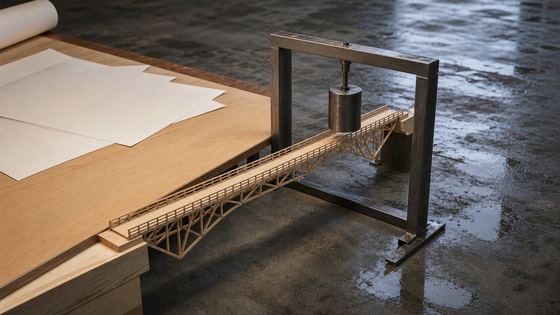
Looking back, the late event was not the physical act of typing. It was the moment an external object gained veto power.
A hundred lines of boilerplate may look concrete, but if they never touch the central assumption, they remain an extension of the plan. A polished prototype may look concrete, too; if no one has manually completed its critical flow, it still cannot refute the product model. A tiny failing test, a user stopping at one decisive step, or a comparison against real data can do what all that visible activity cannot: invalidate a large part of the design at once.
In “I Know What an Agent Is, but I Cannot Define It” , I wrote that a concept has to descend from felt sense to a working definition, an eval, and feedback from reality. That essay focused on the ability to move up and down. This task revealed the next cost: AI makes the ascent exceptionally smooth, but the descent does not happen by itself.
I have also written about whether reality can resist a narrative . An engineering task turns that sentence into a question of time: at what hour does the first object capable of resisting the plan appear? For me, if it arrives too late, every layer of reasonable design that came before it can make the plan more expensive to shrink.
This is what I mean by a capacity for contact with reality. It has nothing to do with how busy I am, and it does not mean doing more physical work. It means handing my judgment, earlier, to something outside the control of my current story—and accepting its right to rewrite the scope, the explanation, or the next step.
Abstraction and Concreteness Are Not a Hierarchy
Construal-level theory offers a limited explanation. When something feels more distant in time, space, social relation, or probability, people tend to represent it through more abstract and stable features. When it feels closer, the representation contains more situational detail. The theory describes a relationship between psychological distance and representation ; it does not prove that AI caused the delayed feedback in this task. “High” and “low” refer to levels of representation here, not levels of ability.
Still, it helped me correct my language. What I lack is not a form of “concrete thinking” somehow inferior to systems thinking. Systems design lets me see how a local change can travel through permissions, states, and future evolution. That is a real ability. The problem is one-way movement: I can rise rapidly from a limited feature to an entire system, yet I do not return equally early to a call that can throw an error, a flow someone has completed, or a change that can be merged.
I have completed long-distance hikes of more than 400 kilometers, and I have long documented travel through photographs and writing. The physical world rarely cooperates with a complete narrative. Road conditions, weather, fatigue, and omissions all leave resistance behind. But those experiences cannot prove my judgment in an engineering setting. A willingness to accept the slope beneath my feet does not mean I will invite the first error to appear while designing a system.
Nor does the body hold a monopoly on reality. A failing test, a log entry, or a real dataset may have more power to refute me than hours of hands-on activity. Contact with reality depends on whether the feedback has authority, not on whether the medium looks humble.
AI Can Pull Reality Closer, Too
It is tempting to blame all of this on AI. It would also be inaccurate.
Generative AI has no fixed direction. I can ask it to keep completing the architecture. I can also ask it to construct a minimal reproduction, generate a failing test, compare samples, search for counterexamples, or turn my judgment into a falsifiable prediction. The first use adds candidate explanations. The second puts an explanation into a feedback loop.
A small CHI 2025 mixed-methods study offers a counterexample. Twenty-one participants used both of two tools in an investment decision task: one provided direct recommendations, while the other first asked people to write their own reasons and then used AI to expand them. The second tool entered participants’ own reasoning more readily, and their results were slightly better. This specific task does not establish the universal superiority of one interface , but it does show that the interaction changes how AI enters thought. Giving an answer, completing a model, proposing a counterexample, and forcing a test are not the same collaboration.
So I do not want to weaken the abstract capacity AI gives me. I want to change where AI enters the work. If it is connected only after a requirement appears, the system expands faster. If it is also connected to tests, reproductions, comparisons, and the return path from failure, reality may arrive sooner.
I Will Move the First Refutation Forward
After this task, I proposed one small correction:
“For the first clearly defined problem, finish the smallest self-contained PR. Put more design and more discovered errors into later PRs.”
This is not yet a method proven through repeated deliveries. I do not know whether it will solve my problem reliably, and I will not turn one attempt at convergence into a success story. For now, it does only one thing: it gives continued expansion an earlier expiration time.
“Smallest” is not a line count. A PR can be short and still avoid the central uncertainty; when that happens, feedback has not arrived. What deserves to move forward is the point of contact with reality: it faces an object independent of the current explanation, produces an observable result in this cycle of work, and gives that result genuine authority to change what happens next.
For this task, that point might have been reproducing the critical failure, writing a test that would fail first, or running the narrowest end-to-end call. I need to choose whichever one touches the central uncertainty earliest. The rest of the design can wait instead of continuing to swell with the conversation.
Before I begin, I also need to write down what result would make me delete a layer of design, narrow the scope, or admit that I framed the problem incorrectly. Without a condition for changing my mind, “validation” can easily become a way of collecting material for the plan I already prefer.
At the time, I wrote one more line: “Less thinking, more execution.”
That sentence can sound anti-intellectual. What I actually want to reduce is the unlimited growth of explanation before the first feedback arrives. Design still matters. System boundaries still require judgment. They simply need to meet an object with the right to say no, earlier.
Next Time, Ask What Result Could Change My Mind
I do not know whether this 48-hour task will become a lasting turning point. The method has not survived multiple real deliveries, and I cannot infer a stable personality flaw from one experience.
The next time a complete plan appears in front of me within hours, I want to pause and ask: What is the smallest result that has the right to change my mind?
That question still cannot prove the method works. It only moves the first chance of being refuted forward. Whether it helps me deliver faster and spend less time in false progress is something the next real task—and the one after that—will have to answer.
References
- The misunderstood limits of folk science: An illusion of explanatory depth — Leonid Rozenblit, Frank Keil, 2002
- Construal-Level Theory of Psychological Distance — Yaacov Trope, Nira Liberman, 2010
- AI, Help Me Think—but for Myself — Leon Reicherts et al., CHI 2025

Responses