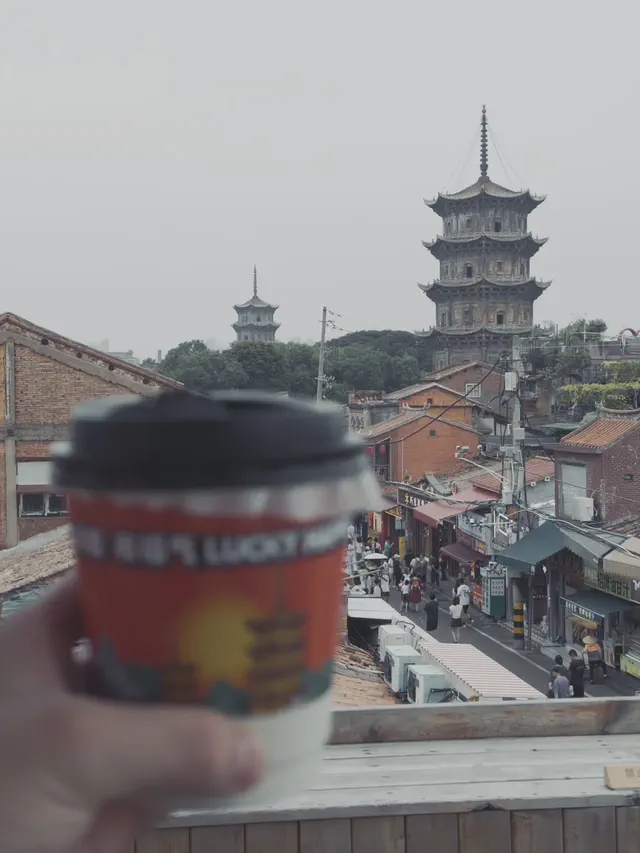

At dusk, I sat on the rooftop of Youli Café and raised my coffee cup toward the twin pagodas of Kaiyuan Temple. The camera recognized the distant towers and ignored the hand in front of it. Cup and fingers dissolved into a red blur; across the old city, the pagodas held their edges.
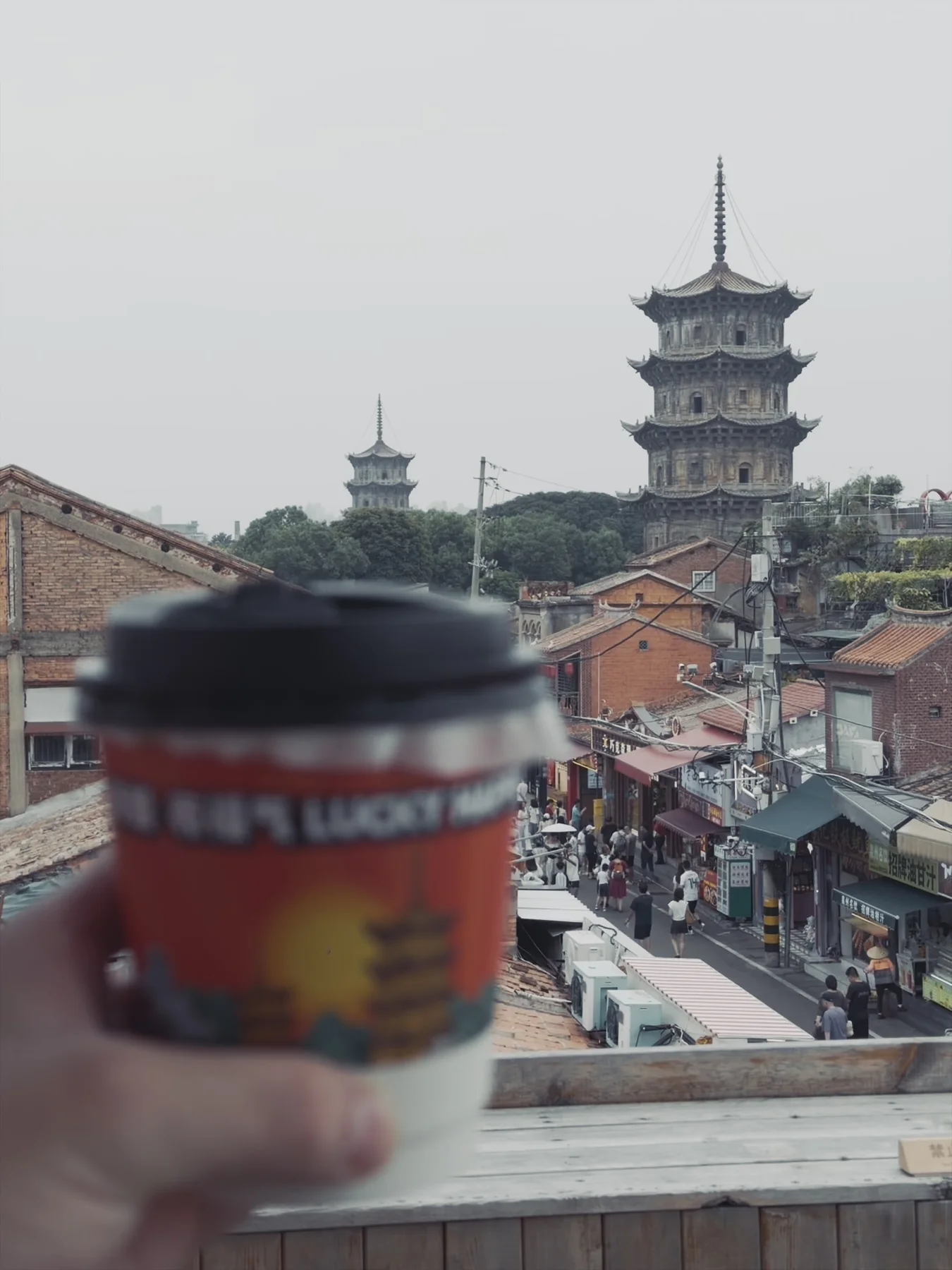
It was August 3, 2026. That morning I had taken the high-speed train from Shenzhen to Quanzhou, then walked through Qingjing Mosque, Tonghuai Guanyue Temple, Chengtian Temple, and Kaiyuan Temple before coming up here to sort my photographs.
One question had followed me all day. I am building a company, and I already know that wanting an outcome creates pain. If that is true, should I want less and leave the game?
By evening, I still chose to continue. The answer did not arrive as a slogan about perseverance, nor did a quiet temple hand it to me whole. It took shape through the incense at Guanyue Temple, the turtles beside Chengtian Temple’s pond, Master Hongyi’s work on Buddhist discipline, and the carved pillars behind Kaiyuan Temple’s main hall: see through winning and losing, then take this round seriously; if I want freedom of movement, I must first accept the constraints that freedom creates.
Desire Steps Into the Incense
The first thing that held me at Qingjing Mosque was a wall inscribed with the Chinese characters for “Revere Heaven.” Pale plaster, grey stone lions, Minnan red brick: the elements resisted a single, pure style.
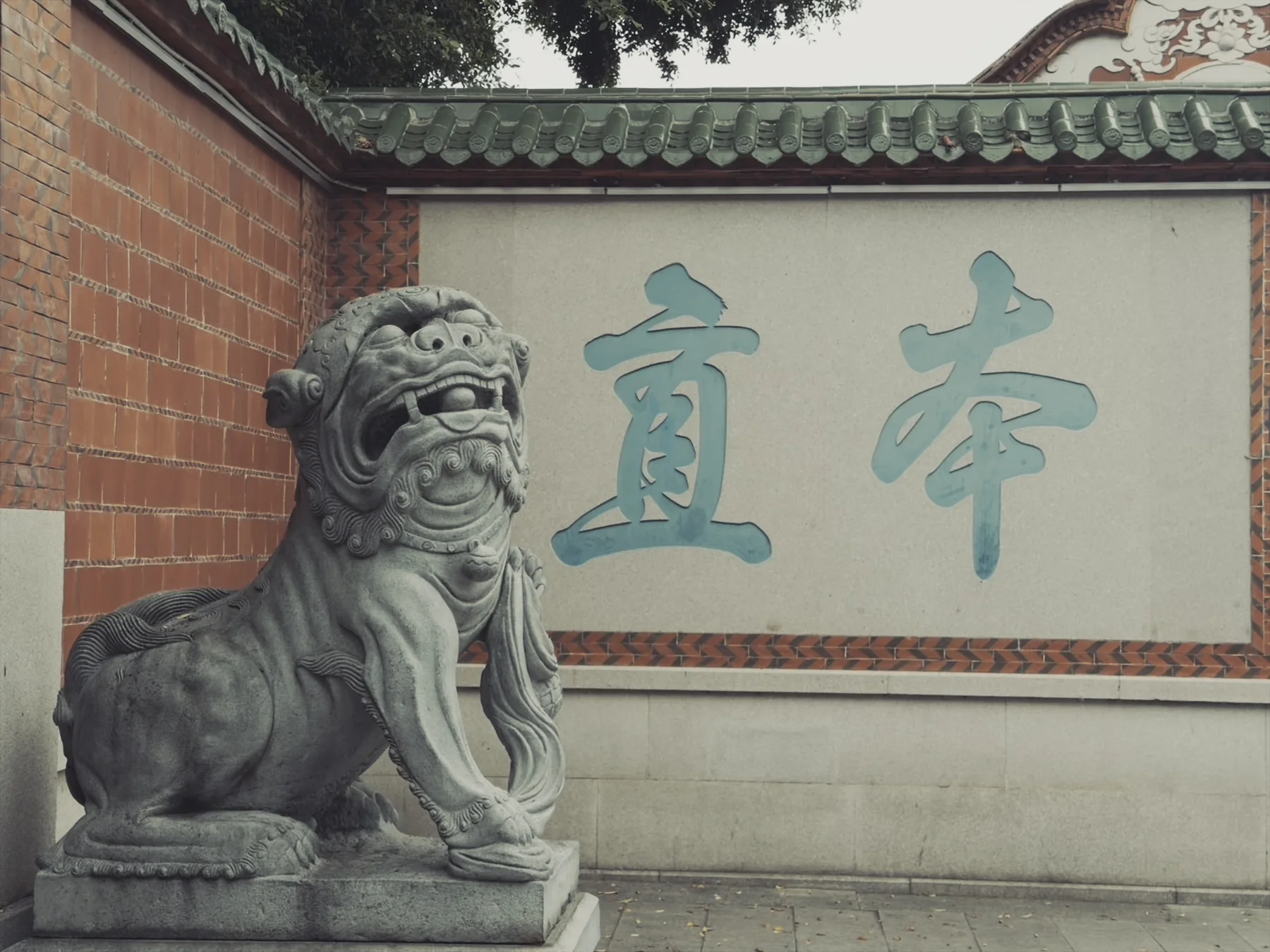
Founded in 1009, Qingjing Mosque preserves a stone gate and prayer-hall remains with West Asian Islamic features alongside traditional Chinese elements. It once stood outside the city. As foreign merchant communities grew and Quanzhou expanded south in the twelfth and thirteenth centuries, the mosque was drawn into the urban fabric. The city’s expansion around the mosque is material evidence of merchants, communities, and an urban system growing together . UNESCO likewise explains Quanzhou through a working port: from the tenth to the fourteenth century, maritime trade connected merchants, religious communities, markets, and institutions inside one city. Quanzhou’s plurality grew from that ordinary exchange , long before it became a polished slogan.
Only a few hundred metres away, Tonghuai Guanyue Temple overturned the field of vision. Dragons, suns, jiǎozhǐ pottery, and cut-porcelain ornament crowded the roofline.
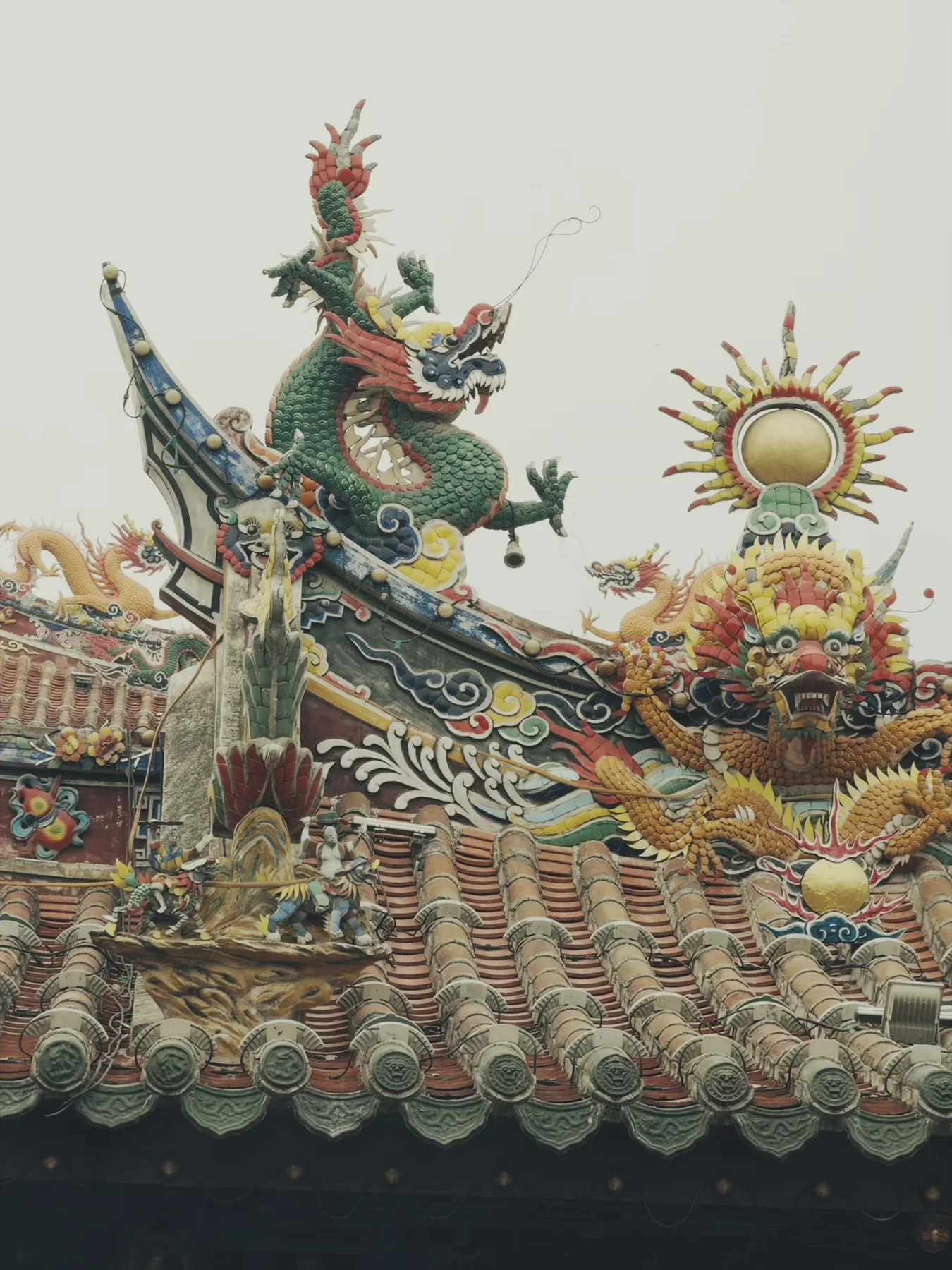
The wishes inside were equally unembarrassed. Safety, wealth, exams, careers: each could rise into public view with the incense.
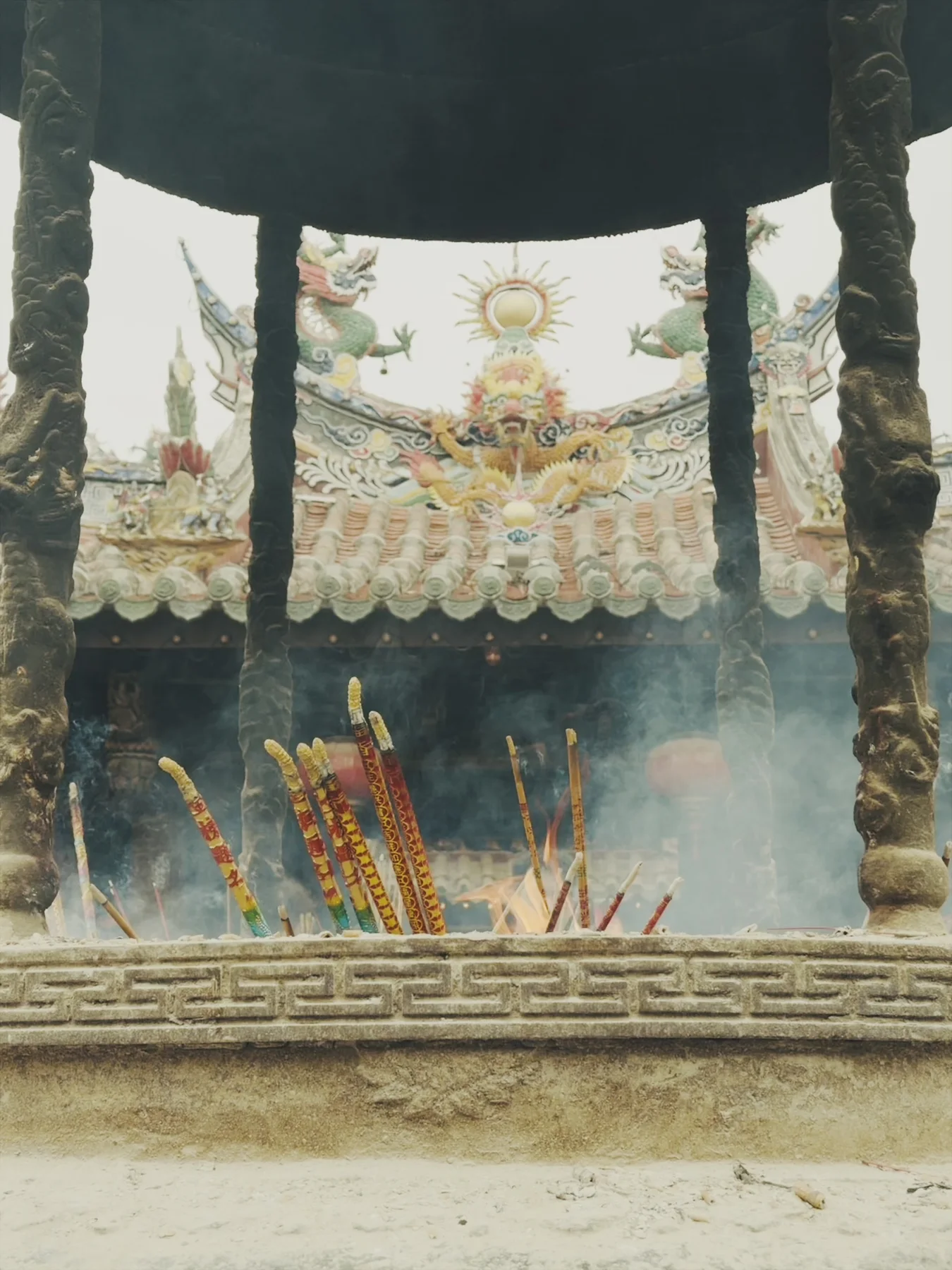
Standing in that smoke, I could no longer treat desire as one undifferentiated source of suffering. It can harden into attachment and make a person use results as proof of worth. It can also be life reaching outward: I care about something, and I want it to exist.
The desire to create and the desire to prove oneself never enter a company in single file. They share the same stick of incense. Admitting the mixture is more honest than claiming to have transcended it. The question I actually have to answer is which desires deserve the consequences I will incur for them.
The Turtles Slowed Time for a Few Minutes
At Chengtian Temple, my attention finally decelerated.
Gateways, courtyards, and tree shade pulled the street farther away. Beside the release pond, turtles pressed together on the stone edge while fish crossed the cloudy green water below. The turtles moved only once every few minutes.
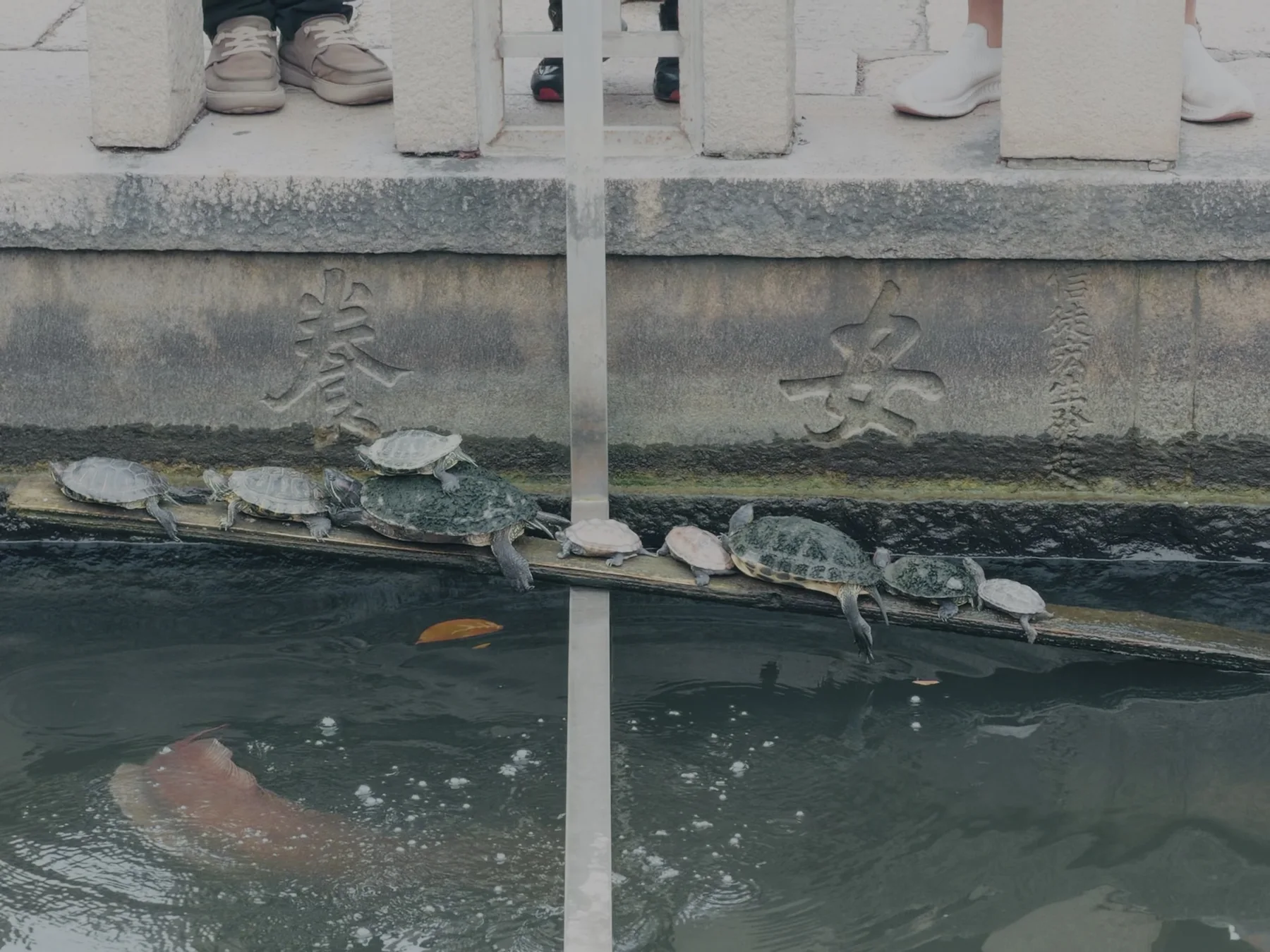
I do not want to conscript them into teaching Buddhist doctrine. The same pause might have happened in another quiet temple, a library, or a hot spring.
What those minutes did was modest. They turned the volume down. “Building is painful, so leave” stopped looking like a conclusion and became one thought that had just appeared. The pond made no decision for me. The afternoon still required more walking.
Hongyi’s Renunciation Took the Form of Precepts
Chengtian Temple brought Master Hongyi into view, and made “leaving the world” feel considerably less weightless.
Li Shutong was tonsured at Hupao Temple in Hangzhou in 1918 and became the monk known as Hongyi. The date and transition are documented in public sources . He lived for twenty-four years as a monk, fourteen of them in southern Fujian. In Quanzhou, he left traces at Chengtian, Kaiyuan, and other temples. He died in the Wanqing Room of the Wenling Home for the Elderly in 1942, while his cremation ceremony took place at Chengtian Temple. These sites belong to the same Quanzhou life, but they do not mean the same thing .
Popular retellings compress Li Shutong’s transformation into a single word: renunciation. Yet something exacting and highly concrete occupied an important place in his later life—Vinaya, the study and practice of Buddhist discipline.
Hongyi’s Buddhism extended well beyond Vinaya. His writing and daily practice also moved through Huayan, Pure Land, and Samantabhadra’s vows; a biographical account published by Lingyin Temple describes him teaching through Buddha-recitation, precepts, and recitation of the Samantabhadra Practices and Vows . This essay singles out precepts because they most directly changed how I understand the game of life.
He edited and compiled works including the Annotated Table of Bhikshu Precepts in the Dharmaguptaka Vinaya and the Concise Guide to Nanshan Vinaya for Lay Buddhists, and came to be honoured as the eleventh patriarch of the Nanshan Vinaya tradition. Research centred on the latter work shows how he organised a vast body of disciplinary literature into the precept as teaching, its embodiment, its practice, its observable form, and the gradations of keeping and violation. The project was designed to move precepts from terminology into understanding and conduct . Hongyi put the commitment more bluntly in a lecture: “Better not take a precept than take it and fail to keep it.” After studying Vinaya for nearly twenty years, he still said he could count himself only as preparing to study it, having glimpsed a small part of the entrance. In his own account, discipline was a lifelong practice that no posture could counterfeit .
This revealed another Hongyi to me. Leaving his former life happened in a moment; for the next twenty-four years, he pressed that moment into daily boundaries, actions, and violations. Here Buddhism offers no airy sensation of transcendence. A precept first asks which constraint a person is willing to accept, then tests conduct against that intention day after day.
Yet his later rigour cannot travel backward in time and settle what his family bore when he left.
Public accounts disagree about the dialogue with his wife, the timing of their final meeting, and even the name of his Japanese partner. The available memoirs cannot substantiate the dramatic scene that is so often retold . I will not reconstruct that farewell, and I cannot distribute praise or blame among people whose full circumstances I do not know. The ethical question survives the uncertainty: when someone leaves a marriage and a family role, the weight of living does not vanish. Someone still carries it.
Hongyi’s later discipline tells us how he ordered the rest of his own life. It cannot answer on behalf of those whose lives his decision reordered. Respect and scrutiny can remain in the same sentence.
The analogy with a company stops at commitment. A family and a venture involve different relationships, rights, and consequences; their costs are not convertible. They do force the same narrow question upon me: once my choice changes another person’s time, trust, or risk, I lose the right to explain it only as my own growth.
Hongyi did not choose engagement or withdrawal for me. His Vinaya made every choice more expensive.
The Pillars Preserve the Seams of Reuse
At Kaiyuan Temple, I walked around the Mahavira Hall to look at a pair of pillars carved with figures from Hindu mythology. The temple’s official account confirms the pair behind the hall . Material assembled by the Quanzhou Maritime Museum links the sixteen-sided pillars to Hindu remains from Yuan-era Quanzhou and identifies episodes involving Vishnu and his avatars. The carvings are material evidence that South Indian merchants and their religious life entered the city . That is as far as I can verify; the adjacent material is not enough for me to present one definitive story about the original temple and the pillars’ passage here.
Today the pillars support a rear corridor of a Buddhist temple. The religious space that gave the carvings their first context is gone. Here, preservation came with removal, transport, and a change of meaning. The stone continues to bear weight, and the seams remain visible.
The Quanzhou I read in those pillars is rougher than a story about many gods living in harmony. A city can receive heterogeneous material and still rewrite it over centuries. An object may acquire a new place after the world that made it has fractured.
Only this object could have forced the thought: to re-situate something is never merely to give it a new name; the load-bearing relation changes with it.
A company continually re-situates its goals. The founder’s first intention meets the user’s task, a partner’s livelihood, cash constraints, and market feedback. A founder may revise the product or end a direction altogether. Each move should register who else is carrying weight inside the structure. Otherwise, both “staying true to the vision” and “pivoting quickly” can become stories that benefit only the person telling them.
In the Game of Life, the Stress Falls on Consent
In an earlier essay, You Think You’re the Player—But “Player” Is Also a Role , I traced the phrase yóuxì sānmèi, often rendered “the samādhi of play,” back through its Buddhist sources. That essay ended with a claim: in the texts, play is closer to unobstructed freedom, and the movement it names is entry. See through the world, then dare to mean the person and task in front of you.
Quanzhou moved the claim one step further. Entering requires boundaries. Hongyi’s precepts and Kaiyuan’s pillars both say that freedom of movement never cancels a load-bearing relation.
I am therefore willing to keep calling entrepreneurship a game, but the stress falls on consent:
I consent to a round with winning and losing, so I pursue the outcome seriously. I accept that the authority of any result is limited, so one set of numbers cannot judge the whole person. And I acknowledge that users and partners have lives of their own; their losses cannot be reduced to my experience points.
I place metacognition after a round of action. While delivering, failing, and making promises, I bear consequences in the first person. Once reality has occurred, I step back far enough to examine the evidence. Metacognition returns to life only when it changes the next choice .
The sequence matters. If I climb into the stands to explain my fear before every delivery, my self-understanding will grow while no product enters the world. A clumsier and more honest rhythm is to let reality happen, then return and distinguish learning from defence.
The spirit of play limits what failure may say about me. Precepts limit what freedom may permit me to do. Their intersection is large enough for wholehearted action.
Before the Twin Pagodas, I Choose to Continue
On the rooftop, the coffee cup was close and the twin pagodas were far away. The ancient towers did not expel the café, visitors, or streets. The café did not need to explain eternity on the towers’ behalf.
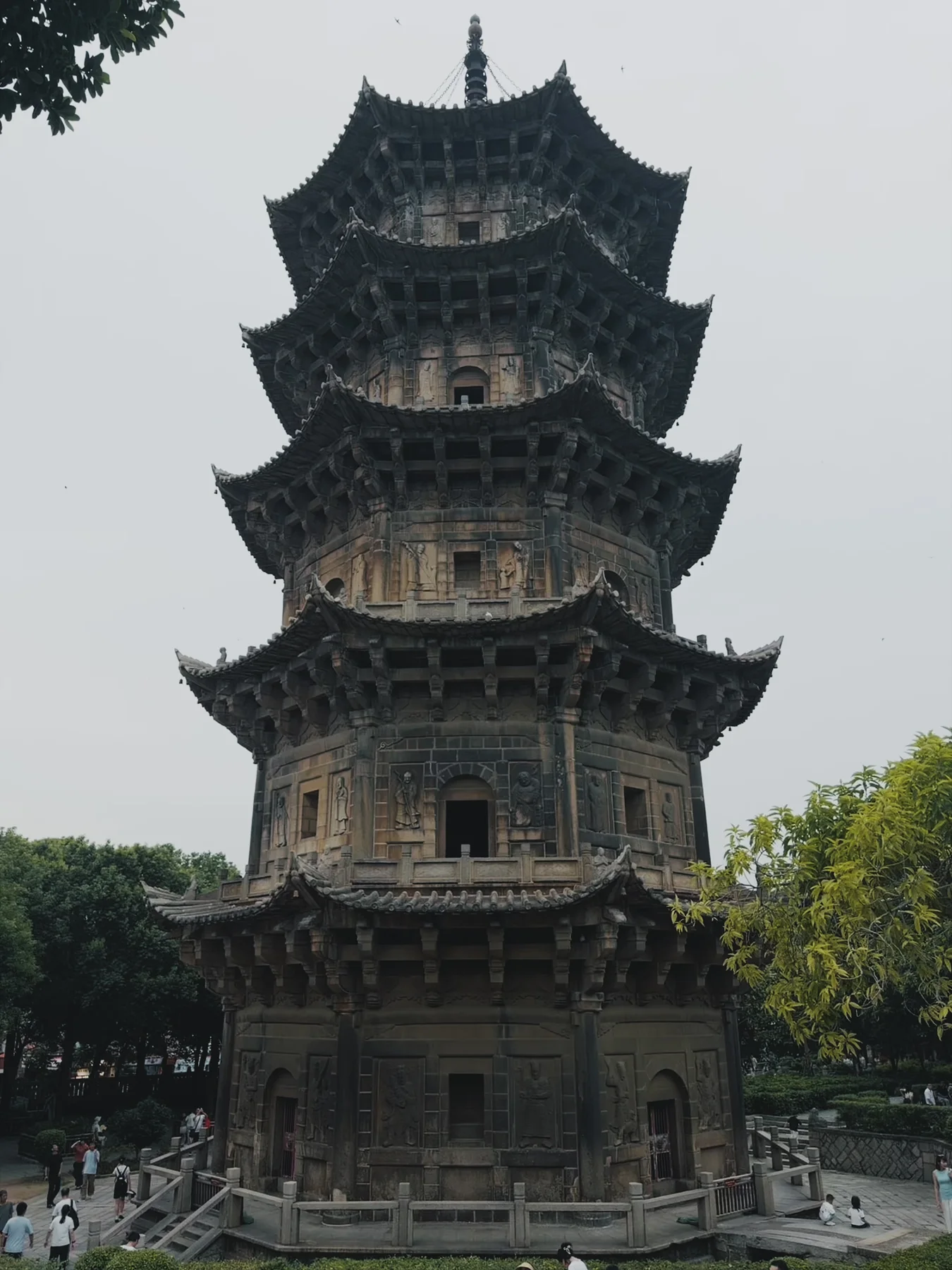
In one day, I watched desire enter public view; I watched a pause lower the noise for only a few minutes; I saw one man’s renunciation become concrete through discipline and leave consequences no one else could answer away. The pillars at Kaiyuan removed the last layer of romance: once something enters a new structure, its old weight does not disappear.
So I choose to keep building. That choice does not need Hongyi’s approval, and it does not decorate suffering as a medal. I still want to bring certain products into reality and discover how far my judgment, courage, creativity, organisational ability, and capacity to bear responsibility can travel under real resistance.
When I lose a round, I will revise the strategy without revising the value of the whole person. When I accept a commitment, I also accept its constraints and keep other people’s costs inside the decision.
The twin pagodas remained in the distance. I put the cup back on the table and returned to the round.
References
- UNESCO World Heritage Centre: Quanzhou, Emporium of the World in Song–Yuan China
- Quanzhou Maritime Silk Road World Heritage Centre: Qingjing Mosque
- Quanzhou Municipal Bureau of Ethnic and Religious Affairs: Kaiyuan Temple
- Xiamen University Research Centre for Folk Historical Documents: Hindu Stone Carvings in Quanzhou
- Hangzhou Integrity Culture Resource Library: Li Shutong
- Quanzhou Municipal Bureau of Ethnic and Religious Affairs: Commemorating the 78th Anniversary of Master Hongyi’s Death
- Lingyin Temple: A Biographical Sketch of Master Hongyi
- Digital Library and Museum of Buddhist Studies: A Study of Master Hongyi’s Vinaya
- Collected Writings of Master Hongyi: Vinaya
- China Writers Association: Uncertainties Around Li Shutong’s Farewell to His Wife
Responses