
This piece is a thought experiment in the form of a simulated interview. Its two fictional voices combine perspectives from behavioral decision research and high-risk outdoor practice; they do not represent the words of any real person. Nothing here constitutes investment, medical, or outdoor safety advice.
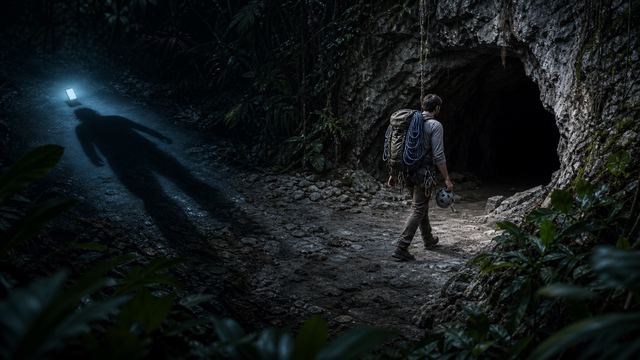
In May 2026, I injured my leg in Vang Vieng and still walked into the cave. Over the past two years, I’ve also been able to leave traditional systems, live long-term abroad, and place both income and identity within greater uncertainty.
For this reason, I have described myself as someone with a high tolerance for risk.
But June produced another set of evidence. I would leave finished work undistributed and study marketing before facing possible indifference from the market. When a relationship truly drew close, I might suddenly start assembling reasons why it was wrong for me.
Why does someone who can enter pitch-black caves fear pressing the publish button?
If tolerance for risk were a stable personality trait, this contradiction would make no sense. Perhaps mine has always had clear boundaries and appears only in front of certain kinds of risk.
Beyond Probability: The Power of Explanation
Me: Why does the same person show such different risk attitudes across domains?
Behavioral Decision Researcher: Because the word “risk” compresses several variables.
At a minimum, we need to distinguish loss magnitude, probability, reversibility, controllability, feedback speed, and self-exposure. The physical risk in caves may be higher, but the rules are clear: assess terrain, carry light, move with a partner, and evaluate injuries. The physical risk of publishing work is nearly zero, yet it exposes you to social judgments you cannot control—and silence offers no clear explanation.
People don’t just fear loss; they also fear unexplainable outcomes.
Outdoor Leader: In the mountains, skilled adventurers often handle boundaries with the utmost care. They know the weather, retreat routes, equipment, and team status. They dare to proceed because they’ve thoroughly understood what they can control. Those who simply “don’t fear” often cause concern for the group.
Behavioral Decision Researcher: I disagree that you so quickly classify this cave experience as “mature adventure.” With a leg injury, you still entered; now you remember your confidence but have no record of checking light sources, route conditions, communication, infection risks, or retreat capabilities at that moment. Without these details, “I calculated this” might be a post-hoc justification for impulsive behavior.
This rebuttal unsettled me. My May reflection framed this experience as the key to self-understanding, yet it barely asked: if a companion had urged me to stop, would I have interpreted their caution as cowardice? While I might be right about preferring calculable risks, this story alone doesn’t prove it.
Calling prepared entry “courage” easily overlooks the full risk engineering process. Impulsive people chase thrills; mature adventurers preserve action capacity within uncertainty.
Active Choice Alters Risk Experience
In my May notes, I wrote: “I survive by making active bets, not by schedule.” Vang Vieng and Vientiane later both involved play, drinking, and meeting people—Vang Vieng made me shine, while Vientiane left me empty. Freshness explains only part of the story; the more critical variable is whether I remained in the driver’s seat.
Behavioral Decision Researcher: Active choice significantly alters risk perception. The same uncertainty, when chosen by oneself, becomes exhilarating; when passively endured, it feels threatening.
But this also creates blind spots. Active choice leads people to overestimate control—especially in entrepreneurship and investing. The more you research, the more likely you’ll mistake “I can explain this system” for “I can control the outcome.”
Me: How do I distinguish confidence from the illusion of control?
Behavioral Decision Researcher: Check whether you’ve honestly written down variables you cannot control and whether you’re willing to exit the plan when failure occurs.
The illusion of control favors detailed success paths but dislikes stopping conditions. True confidence allows failure: I know what I’ll lose, when I’ll leave, and that failure brings the next opportunity.
Some “Small Risks” Directly Attack Identity
Public expression, sales, and intimate relationships differ in that outcomes easily translate to “who I am.”
When a product goes unsold, it is not experienced as just one failed hypothesis; it can feel like proof that I create no value. When someone does not respond, it is not experienced as just one mismatch; it can feel like proof that I do not deserve love. Physical adventures threaten the body. Social risks threaten the story of the self.
Me: Should I build confidence first before exposing myself?
Behavioral Decision Researcher: That often creates a loop: low confidence prevents action, and without evidence produced by action, confidence never gets a chance to update.
A more effective approach is to reduce the explanatory power of a single exposure on identity. “Does the market accept me?” can be narrowed to “Do five users have this issue?” “Am I compatible?” can first become “Can I voice the urge to step back this time?”
Rewriting personality questions as localized experiments makes risk truly learnable.
Reversibility Matters More Than Courage
Outdoor Leader: One core principle in the mountains is preserving as many escape routes as possible when information is minimal. The further you go, the more information you gain and the fewer escape routes you have. Poor decisions often happen early by handing over all choices.
Life’s bets work similarly. Quitting all income, investing all savings, and publicly binding a new identity seems sincere but places excessive survival pressure on a single experiment. The greater the pressure, the harder it is to honestly read feedback—admitting the wrong direction is too costly.
Me: Does preserving escape routes lead to insufficient commitment?
Outdoor Leader: Yes, so escape routes need usage rules. A safety rope enables serious climbing—it doesn’t keep you stuck at the starting point.
You can set time limits, budgets, and exit conditions. Commit fully to one task within ninety days while maintaining basic cash flow; adjust when you hit a predefined failure threshold, rather than withdrawing daily due to emotional shifts. Reversibility isn’t arbitrary—it places commitments within bearable boundaries.
The Real Pain Comes After the Message Is Sent
The risks I face while building products are rarely dramatic. No cliffs, no darkness, no one reminding me to wear a headlamp. It’s simply sharing a link with a potential user and watching the chat box go silent.
This silence has no clear meaning. Maybe they’re busy, the product is useless, the opening is poor, or they simply aren’t the target user. It can’t be clarified like a wall with a flashlight, and no single action instantly proves I handled it correctly.
Behavioral Decision Researcher: The most punishing part of this risk is ambiguous feedback. A refusal at least draws a boundary; silence leaves every explanation open. People with a high need for cognition automatically fill that gap, often with identity-level explanations: the product has no value, I am bad at distribution, or no one sees me.
Outdoor Leader: Outdoor experiences have similar moments too. In thick fog where you can’t see the route, the most dangerous impulse is to speed ahead to end uncertainty. Stopping to confirm your position is psychologically harder—it looks like doing nothing.
These two scenarios finally connected. My strength lies in handling visible risks: boundaries can be assessed, and actions quickly return results. My weakness is staying in ambiguous risks without rushing to end them with a personality conclusion.
Do One “Silent Exposure” Exercise—Not a Courage Performance
Next time I publish, I won’t test whether “I’m brave enough.” Instead, I’ll send ten specific invitations in a row. Each time, I’ll record just three things: who I sent it to, what I asked them to do, and how long it took to receive a response. For seven days, I won’t let a single silence alter my self-evaluation or use more research to ease discomfort.
After ten invitations, I’ll assess: Is the problem with the audience, the message, the product, or is the sample still insufficient? If there’s still no answer, the conclusion will be “I don’t know yet”—not a painful explanation pulled from ambiguity.
This exercise differs fundamentally from cave exploration. It has no photos and doesn’t make me feel particularly brave. It simply requires me to deliver the work and stay in that afternoon when there’s no immediate answer.
As for the cave, I’m willing to downgrade it from a personality proof to a single experience with gaps. Continuing forward might have been judgment or stubbornness. Without risk checks, later narratives shouldn’t fill in what happened then.
This might be the risk ability I need most now: facing the unclear without treating stillness as cowardice or using forward motion to prove myself.


Responses