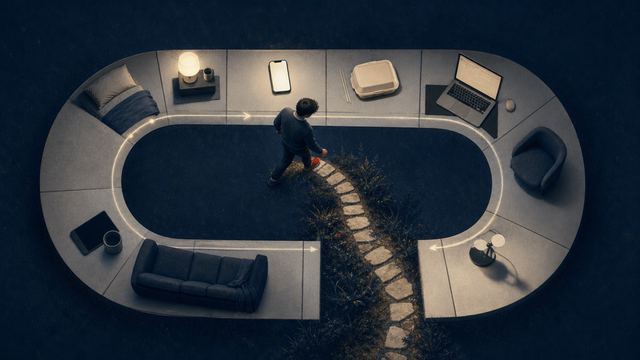

This piece is a thought experiment in simulated interviews. The respondents are synthesized from existential philosophy and behavior design perspectives—this is not verbatim dialogue from any real person.
One June day, perhaps like this.
I woke around noon. My phone lay on the pillow. First I checked the time, then the messages. Nothing was urgent, so I opened a short video. The algorithm did not require me to decide what came next. By the time I looked up, more than forty minutes had passed.
I ordered takeout. Address, flavor preferences, payment method—all saved. Completed in three minutes. While waiting, I opened my computer. Originally meant to work on a product, I instead checked the latest AI news. A new framework led to a review, which then triggered a GitHub repository. Every page was work-related, yet it was hard to admit I was avoiding work.
By four in the afternoon, the takeout box still sat on the table. I told myself I’d feel better at night.
After dark, I did feel slightly more energized. I checked my API bill and bank balance—my stomach “clenched.” That discomfort didn’t turn into a specific action. I started researching distribution again, as if reading a few more methods would naturally give me the courage to launch my product.
At two a.m., I needed to get myself to sleep. A new episode began automatically.
This day had no boss, commutes, or fixed schedules. Almost every hour, I could do something else. If you only look at the options, it felt incredibly free.
No Clear Decision Before 2 P.M.
I handed this day over to a behavior designer. He didn’t start with self-discipline—he drew arrows on paper:
- Phone placed by the pillow
- The first action after waking is managed by notifications
- High-stimulus content raises the threshold for starting low-feedback work
- Takeout removes the necessity of leaving home and meeting people
- “Research counts as work” protects me from admitting avoidance
- No external delivery deadlines mean I can always make up for it at night
- Bills trigger discomfort; short videos provide rapid pain relief
“There is no single bad choice that ruins the day,” the behavior designer said. “Only a sequence of locally sensible actions. By the time you realize what the day has become, it is almost over.”
The existential philosopher, however, didn’t like this diagram.
“If you reduce yourself entirely to an environmental product, you’ve escaped once more. The phone is indeed there, but the thirteenth video is still what you watch. Acknowledging this isn’t meant to shame you. Only by acknowledging it can tomorrow’s change be yours.”
Their disagreement matters. The behavior designer wants to reduce resistance; the philosopher insists on responsibility. If the former goes too far, people will blame every loss of control on the interface. If the latter goes too far, they’ll collapse all tendencies from platforms, spaces, and body states into a single phrase: “You should choose better.”
I need to keep both statements in view: precise defaults steered the day, and they acquired their power through my repeated consent.
“I Feel Better at Night”—Truth or Passkey?
Night does suit part of my work. Quiet, fewer messages, thoughts can stretch further. The problem is this phrase has gained passkey status: as long as I didn’t start in the day, I can explain it as waiting for night.
This kind of explanation is hard to falsify. If night succeeds, the judgment is correct; if it fails, I can say the day already drained too much. It no longer describes a rhythm—it just makes every day’s delay seem reasonable.
The behavior designer advises against arguing “early mornings vs. late nights.” Instead, track for seven days. Every two hours, write: what you were doing, what action preceded it, and how your energy felt afterward. Don’t fill in ideal plans or assign moral scores.
If the data shows higher output at night, protect that time. If most nights remain dominated by “preparation” and recovery, that phrase loses its privilege.
Here, freedom is simple: any explanation about yourself must pass your own life’s test.
Day Two: Only Three Points Changed
I don’t want to attack with a rigid schedule. That would turn the schedule into a new autopilot. On day two, I changed only three points.
Placed the phone by the door before bed. This doesn’t guarantee early rising—it just adds a step between waking and the information stream.
Scheduled a meeting with someone at 3 p.m. to review the product. Regardless of progress, open the current version. Research can continue, but it can’t replace this meeting.
At 10 p.m., explicitly choose rest. Watch short dramas if you want—no longer pretending you’ll work later. When the time ends, observe whether you still have the ability to exit.
The existential philosopher asked: “What if day two still fails?”
The behavior designer replied: “Then you get a more specific message than self-blame. Maybe the phone isn’t the issue, maybe the 3 p.m. commitment was too late, maybe sleep needs to be addressed first. Design doesn’t guarantee success—it exposes the structure of failure.”
This time, they finally spoke of the same place.
The Traces of Freedom
I used to define freedom in grand terms. When it actually lands in a single day, it’s far less dramatic. It might simply be walking to the door before touching your phone in the morning, letting a specific person wait in the afternoon, and acknowledging you’re resting at night.
More importantly, by the end of day two, you can see a few clear decision points. They don’t all have to be right—but they no longer vanish into “just doing it,” “later,” or “I’m naturally suited for night.”
I don’t yet know how long these three changes will last. Maybe by day four, the phone returns to the pillow, the product demo gets canceled, and short videos resume playing automatically. At that point, the question isn’t whether I’m capable of freedom—but which default values have reacquired permission, and whether I’m willing to change once more.


Responses