
The seed of this piece was a conversation that ran for several rounds — starting from small talk about the weather and sliding, almost by accident, into “what is life even made of?” It won’t hand you an answer, because the thing actually worth having grows precisely where there is no answer.
Opening: A question that sounds gentle and is actually dangerous
Let me start with a question a friend threw out.
She said she kept turning it over: how much can you take away from her before she stops being herself?
It sounds gentle — like counting the luggage on a person. But take two honest steps into it and you find it has teeth. Because it forces you to remove things one by one. Take away the job — still you? Yes. The memories? The body? Those experiences, that accent, the people you’ve loved — the very things that make you you? Keep going, and at some point, does “you” simply vanish? If so, where’s the threshold? And if not — then what, exactly, was holding “you” up all along?
The real origin of that conversation was suffering — the older question of why we suffer at all. Trace it back and you arrive at a suspect nearly every tradition points to: the self. Suffering comes from clinging to a self, from there being an “I” that’s afraid to lose, that can’t get what it wants, that won’t let go. So the question flips into: what is this “I” actually made of? Can it survive being taken apart?
This piece walks that road — the road of taking-apart — all the way to the end, to see what’s still in your hands when you get there.
Let me say this up front: this is not an essay meant to help you “let go.” Quite the opposite. It wants to pull you back, right at the spot where you think you’ve already let go.
Layer One: A shaft of light, and an eye that can’t see clearly
Start with an image — the most beautiful thing in that whole conversation.
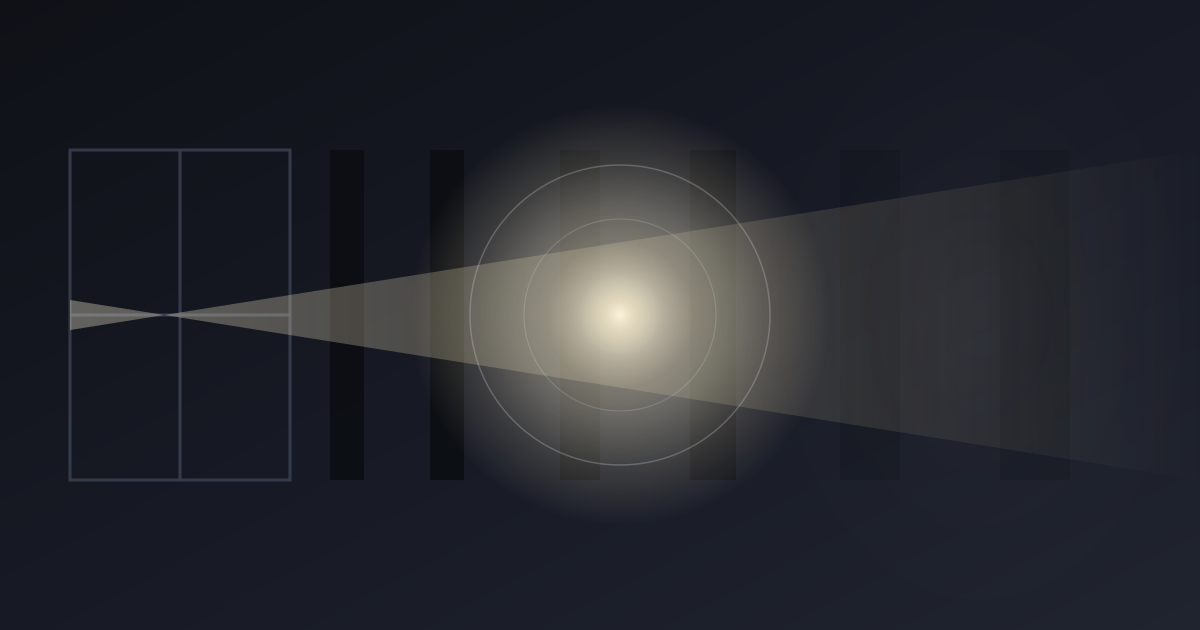
A shaft of sunlight, plus the eye of someone with cataracts, can see the shadow cast through a window.
Optically, the sentence holds, and it’s lovely. Cataracts cloud the lens, so light passing through no longer refracts cleanly — it scatters. To such an eye, a shaft of sunlight isn’t a sharp column of light; it blooms, pales, wears a halo, its edges fraying into mist. And the shadow thrown by the window frame, which should be a crisp geometric line, goes soft, grey, bleeding into itself under the scatter.
There’s something here worth stopping for.
A clear eye sees “the boundary between light and shadow” — as if “light” were one thing and “shadow” another, with a real, objective line between them. The clouded eye erases that line. What it sees is almost a reconciliation of light and shadow: the boundary gone, everything steeped in the same soft glow.
It’s far too easy to call the clouded eye “defective.” But turn it around: that erased boundary line was never in the world to begin with. In the world there’s only a continuous gradient of light intensity, a smooth slope from brightest to darkest. It’s the clear eye (and the brain behind it) that takes a knife to that slope and cuts, declaring “light on this side, shadow on that.” The boundary isn’t given by the world. It’s added by the one who looks.
So the clouded eye, in a sense, sees something closer to how things actually are — the place where distinctions dissolve.
Remember this move: we habitually mistake the lines we cut into the world for lines the world already had. What comes next — taking apart the “self” — uses the same knife. Only this time, it’s cutting into us.
Layer Two: Taking it apart — a chariot, and an “I” you can’t find
Now turn the knife on “I.”
There’s a very old Buddhist text, The Questions of King Milinda, that records a dialogue. The monk Nāgasena asks King Milinda: you came by chariot — so tell me, what is a “chariot”?
Are the wheels the chariot? No, wheels are just wheels. Is the axle the chariot? No. The frame, the pole, the reins — are they the chariot? None of them. So take it all apart, lay each piece on the ground — where is “the chariot”?
You can’t find it. There’s only a heap of parts on the ground. And yet you can’t say the chariot doesn’t exist — you plainly rode in on it.
The conclusion: “chariot” is not any single part, nor the mere pile of parts, but the name we give to the whole when these parts are assembled in a certain relationship and functioning. Pull out the relationship and you’re left with parts; pull out the parts and the relationship has nothing to hang on. The chariot is dependently originated — it holds together provisionally, on conditions. It’s not a ready-made thing sitting there in its own right.
The same is true of “I.”
Walk it down that road: without elements, without organs, there’s no bodily self; without experiences, consciousness, thought, there’s no self of the soul. Take both sides apart, and the “I” in the middle has no separate place to hide.
Buddhism systematizes this dismantling into the five aggregates — form, feeling, perception, mental formations, and consciousness. Form is matter and body; feeling is sensation (pleasant, unpleasant, neutral); perception is recognition and conceptualizing; mental formations are volition, habit, the impulse to construct; consciousness is knowing, awareness. What we call “I” is these five flowing processes momentarily gathered and named a person. Search each aggregate and you won’t find a core called “me.” This is no-self.
And here is a spot that’s extremely easy to slide past, and must not be slid past:
No-self is not “I don’t exist.”
Buddhism has a specific term of abuse for “nothing exists at all” — annihilationism — and it explicitly rejects it. That shadow on the window really is there — you can see it, it moves with the sun — but you can’t find an entity called “shadow.” It’s just the appearance of a condition: light being blocked. So is “I.” I don’t fail to exist; I exist in a way different from what intuition assumes: not a thing, but a process underway.
A better image is a candle flame. The flame is right there — you can name it, it gives light, it burns your hand. But the gas molecules that make up the flame are new each instant, burning off and gone. You can’t find the flame’s “substance”; you only find a combustion in progress. Life isn’t “a thing made of parts.” It’s a river, not the water in the river.
The interesting part: science, taken to its end, gives the same answer. The atoms that make up you are the same batch that make up a stone, a breath of air. And they keep flowing in and out — most of the atoms in your body today weren’t in you a few years ago and will have left in a few more. Materially too, you’re not “a lump of special stuff” but a pattern that has held for a while.
Whichever road you take in — the five aggregates or the atoms — when you reach the end, you never dismantle out a thing called “the self itself” or “life itself.”
At this point many people feel clarified, light, even a little euphoric. “So I’m illusory.” “So everything is dependently arisen.” “So there’s nothing worth grasping.”
Don’t get light just yet. Because what comes immediately after is the most dangerous cliff in this whole inquiry.
Layer Three: You see through the concepts — and then you get dizzy
Once you’ve taken “I” apart into dependent origination, into five aggregates, into a combustion — something happens: words start to fail.
You notice that the same thing can be said either way.
A mother’s heart aches for her child — you can call it “attachment,” or you can call it “love.” Someone grieves the loss of a beloved — you can call it “suffering born of clinging,” or “the weight one life carries for another.” Loss — you can call it “impermanence functioning normally,” or you can call it “harm.”
Every word cuts both ways. Praise flips to blame, devotion to delusion, steadfastness to an inability to let go. And you can’t find an objective referee to rule which reading is “right.”
Which produces the real sore point:
“It seems like you can say it any way you like. Is that really okay? So many words can mean something or mean nothing. I don’t know what to reach for anymore.”
This is a very specific dizziness. It isn’t an abstract philosophical puzzle; it can genuinely hollow you out at 3 a.m. If right and wrong are only words that appear relative to some situation, if things have no inherent right or wrong at all — then what am I even moving toward? On what grounds do I get up early, work hard, ache over anything? If it all “could go either way,” then none of it is necessary.
The cliff is real. Plenty of sharp people, taking the self apart, arrive here and fall off — they don’t become free, they become nihilistic. Having seen through everything, nothing holds them up anymore.
If the essay ended here, it would be harmful. So the real point starts in the next section.
The turn: “you could say it either way” is a property of the map, not of the road
Let me push back with one line: “you could say it either way” may not be a property of the world, but a property that only appears when you stand outside the world and look.
Distinguish two positions.
When you’re in the discussion, in the chat window, weighing it over and over in your head, you are standing outside your life, pointing at it. From there, everything is reversible: the ache can be called clinging or love, the loss impermanence or harm. Words here are tools, not mirrors — they’re built to cut both ways. That’s not a defect; that’s just how words work. Language is a map, and on a map every road can be relabeled, renamed, at will.
But look at that mother.
In the moment her heart aches, she doesn’t feel “you could say it either way.” She isn’t weighing “perhaps this is clinging, perhaps love, both readings hold.” She simply hurts. Same with the grieving person — he isn’t choosing among interpretations; he’s pinned there, unable to move.
“Either way” is a property of the map, not of walking the road.
That 3 a.m. dizziness comes from standing at the map too long — long enough to forget that while every road on the map can be relabeled, the moment you actually walk in, there’s only one under your feet. You can’t go left and right at once. You can’t genuinely love someone while also “just as validly not.” In a real step, the possibilities that sat side by side on paper collapse into a single present.
Relativity is real — but it only holds while you’ve stepped back and spread your life out on paper. You can’t stand at the paper forever. Sooner or later you walk back into the road. And in the road there’s no “either way”; there’s only the step you’re taking.
Layer Four: When you’ve taken it all apart, what still has weight
So where does direction come from?
My answer: not from “thinking the concepts through.” Concepts can never be thought through; they’re slippery by design. Think for another ten years and they’ll still cut both ways. You can’t earn direction by getting words clear, because words are engineered to go both ways.
Direction comes from somewhere else.
After you’ve dismantled everything dismantlable and reversed everything reversible — see what’s left that hasn’t gotten lighter.
You and your friend have already taken a lot apart: the self of organs, the self of consciousness, all the way to no-self, to dependent origination, to “you could say it either way.” So ask one more question: at this point, is there anything that, no matter how much “impermanence,” “emptiness,” or “clinging” you throw at it, still has weight?
If there is — that thing is your ground.
It wasn’t argued into being; it’s what’s left after the taking-apart. Everything that could be waved off with “well, this too is dependently arisen,” “this too is empty” has been filtered out, lightened, floated away. And yet some things — even after you’ve fully granted they have no self-nature, granted they’re a coupling, granted they’ll dissolve — still have weight. The thought of losing them still hurts, and that hurt doesn’t drop a gram because you “thought it through.”
That un-siftable residue is what you actually care about. And — this matters — it’s yours alone. What’s left over for someone else needn’t match yours. It’s not a truth you can derive universally; it’s your ground. It resists dismantling not because you’re not yet clever enough, not because you haven’t cut deep enough, but because it was never in the “dismantlable” category to begin with.
Which is why I don’t agree with pinning all suffering on “clinging to self.”
“Suffering comes from ego” is one account — a powerful one, but not the whole truth. Some suffering really does come from clinging: wanting what you can’t have, fearing loss, refusing to release a shadow that was always going to move. For that kind, seeing through it as dependent origination really can loosen the grip.
But some suffering holds together precisely because there is a self, a love, a tie. A mother’s heart aching for her child, a person grieving a beloved’s death — sure, you can call it clinging and set about dismantling it. But you can also say: this is exactly what makes this one life itself. Treat all suffering as an illusion to be dissolved, and you may, without meaning to, dismantle the heaviest part of life along with it.
Back to that gentle, dangerous opening question: how much can you take away before she’s no longer her?
Maybe the answer isn’t “until you reach no-self.” Maybe the answer is: there are some things that, the moment you take them away, that “she” is gone. And “the capacity to be tied to something, to be hurt” is very likely one of the things you can’t take away. Pain isn’t a malfunction to be cleared. Here, the pain is the proof it still has weight — proof that the thing is still there, still heavy, still yours.
Layer Five: On wanting an answer
One last piece to handle honestly.
You want a clear answer. Of course you do; people do. Facing the void of “you could say it either way,” a person instinctively wants somewhere to stand, wants someone — the universe, a scripture, a smarter person, an AI — to hand them a “this is how it is” they can then just follow.
I don’t want to do what some traditions do and flip it on you: “that wanting is clinging too, let it go.” The wanting is legitimate. It’s a person at the edge of an abyss reaching for a rope; there’s nothing shameful in it.
But here’s something worth pointing out, and it may be the most counterintuitive line in this whole essay:
If a clear answer really were handed to you by the universe or a scripture or anyone, then all you’d be doing next is executing a set of instructions.
A given, definite, universally applicable answer cancels one thing out: you. Because anything someone else can think through for you, spell out completely for you, grows into something that isn’t yours. That answerless void is the only place where “your own thing” can grow.
The blank you fear — “I don’t know what to reach for” — and the freedom you want are the same thing. Freedom was never “someone tells me where to go.” Freedom is “no one tells me, and I still have to walk.” Of course it’s uncomfortable; blankness always is. But you can’t have both “complete freedom” and “someone to nail the direction down for me” — those are two faces of one coin, and you don’t get to keep only the one you like.
So the blank isn’t a pit to be filled. It’s ground to be claimed.
Closing: Standing between taking-apart and claiming
This inquiry began in suffering. Having come this far, here’s what I want to say: the turn is not “find the answer and the pain stops.”
The real turn is learning to hold two hands at once.
One hand is taking-apart: dismantling to no-self, to dependent origination, to loosening the grip and easing suffering. This hand keeps you from being lashed to things you could have released, suffering over them on repeat — from being destroyed each time a shadow that was always going to move, moves. This is what Buddhism gives, and it’s the real thing.
The other hand is claiming: granting that some couplings, once formed, become an irreducible “this one.” Granting that some things can’t be dismantled, and shouldn’t be. Granting that pain is the proof a thing has weight, not a fault to be repaired. This hand keeps you, after seeing through everything, from falling into the nihilism of “it could go either way, so nothing is necessary.”
Most people learn only one hand. Either they dismantle all the way to nihilism — clever and hollow, nothing holds them up — or they clench, afraid to release anything, ground down again and again by the very things they care about.
And growth — the kind with a genuinely high ceiling — probably happens the moment you learn to open both hands and put weight into both at once: knowing, clear-eyed, that everything is dependently arisen, dispersible, sayable either way; and, just as clear-eyed, claiming those few un-dismantlable, hurt-inducing things that are yours alone, and not throwing them out just because they “can’t survive philosophical scrutiny.”
Seeing through is so you no longer suffer pointlessly. Claiming is so you’re still worthy of loving.
An eye that can’t see clearly erases the never-real line between light and shadow, and lets you see they were one all along. A mature heart does the opposite, and yet the same: it sees through the fact that every boundary was self-drawn — and then still chooses, in that continuous soft glow, to draw a line again for a few particular things. A line it knows full well it drew itself, and is willing to answer for.
That line is you.
When you’ve taken it all apart, what’s left isn’t an answer. What’s left is a small patch — something you can’t dismantle no matter how you try, and wouldn’t want to. That’s not your limitation. That’s your ground.
Responses