Creation Is the Outward Half
We’ve reached the final layer. Information has been denoised, records have been sedimented, knowledge has been structured into repeatedly callable capability — but up to this point, every stage has been solving your own problem. Knowledge makes you stronger, but it doesn’t automatically turn into something others want to read.
Creation is the layer that reverses the direction of this pipeline.
Knowledge faces inward; creation faces outward. Knowledge asks “can I reuse this”; creation asks “can others receive this.” Creation corresponds to a platform’s recommendation logic, a particular group of users’ reading habits, and the substantial research you did to support this specific piece of expression. It has exactly one goal: have the audience receive it, understand it, and want to connect with you.
This is exactly why I insisted, in the overview, on splitting knowledge and creation into two separate layers. They run on two completely different judgment systems. A lot of people get stuck here: either they create the way they build knowledge, producing rigorously structured but entirely self-indulgent writing only they can understand; or they take notes the way they create, pouring all their energy into formatting and quotable lines without sedimenting any real capability. Telling inward and outward apart is where creation begins.
The boundary becomes useful only when it produces a handoff. Mine now has eight gates:
- Choose a knowledge card. Start with one scoped claim, not the whole vault.
- Name the audience task. Write what a specific reader should understand, decide, or try.
- Select one governing claim. If the piece cannot be reduced to one defensible sentence, it is not ready.
- Attach evidence. Separate firsthand evidence, external sources, and interpretation.
- Choose the container. A blog post, short video, and social post do different jobs; they are not length variants of the same text.
- Run human acceptance. Check facts, voice, omissions, and whether the promised reader task was actually completed.
- Publish deliberately. The author, not the model, approves the final claim and platform action.
- Filter feedback back into the system. Corrections and repeatable questions may become knowledge; applause and raw engagement do not automatically qualify.
That is my AI content creation workflow. AI can assist at every gate. It owns none of them.
Creation Isn’t the Endpoint — It’s a Flywheel
The second intuition to break is: creation isn’t the end of the pipeline.
If you understand “creation” as “publish it and you’re done,” you’ll be stuck in one-off consumption forever. Real, sustained creation is a flywheel. After several rounds of publishing, I reduced my working loop to this:
Inspiration → Knowledge processing → Article → Video → Publish → User feedback → New insight → Knowledge card → Recombine again → New content → (back to inspiration)
The most elegant part of this loop: its endpoint connects back to its starting point. User feedback isn’t the end of creation — it’s a new round of information input. It flows back in, sediments into new knowledge cards, and gets recombined into the next piece of content. So creation stops being “emptying out your knowledge,” and becomes “letting your knowledge keep breathing.” Every piece you publish accumulates raw material for the next one.
This is also what truly closes the loop across the whole four-layer series: the feedback produced at the creation layer becomes input for the information layer again. This isn’t a straight line — it’s a self-feeding cycle. A single piece of creation is often a large amount of newly captured information recombined with a small amount of knowledge you’ve already sedimented — information supplies timeliness and flesh, knowledge supplies judgment and skeleton.
One card, three containers
Here is a sanitized example from this series. The source knowledge card said:
A personal knowledge base needs an elimination mechanism, because retrieval quality falls when unsupported and obsolete methods remain equally visible.
The card contained one firsthand observation, a list of retired notes, and a boundary: this was my repository experience, not a universal retention rule.
| Container | What stayed | What changed | What I removed |
|---|---|---|---|
| Blog section | claim, mechanism, evidence boundary | added the directory design and counterargument | platform hooks and urgency |
| Short-video script | one problem, one visual metaphor, one action | opened on the “bookmarks graveyard” and showed the lint loop | implementation detail and caveats that needed links |
| Social post | claim plus one diagnostic question | compressed it into a test readers could answer | the conclusion that one workflow fits everyone |
The knowledge did not become three copies. It became three different promises. The blog earned depth, the video earned attention through demonstration, and the social post earned a question worth answering. The source card remained unchanged; the creation records stored each transformation and its results.
Present Yourself Manually First, Then AI Can Help
At the creation layer, the place you’ll most want to take a shortcut is letting AI write it directly for you. It’s also the place most likely to backfire.
An early version of my own workflow made this mistake. I gave the model a topic and asked for a strong essay. The result was fluent, orderly, and unpublishable: it had no evidence boundary, no target reader decision, and no reason to sound like me rather than any competent newsletter.
The lesson is narrower and more useful: AI can propose candidate standards, rubrics, and counterexamples, but it cannot choose my objective function for me. I still have to decide what good means for this reader and this claim. A manual first pass is one reliable way to expose that standard; another is to give the model contrasting examples and then reject the rule it infers until the boundary becomes explicit.
Present yourself manually first, then use AI to discover your own boundaries. This is not a ban on AI-first exploration. It is a ban on publishing before the author can explain the standard being applied. Voice can be modeled and assisted; lived experience, accountability, and final judgment still need an owner.
Give AI Tasks, Not Directions
The distinction between direction and task remains useful, but it is a workflow distinction, not a division of species. AI can help explore direction; people still need to execute verification and editing tasks.
“Help me think through how to approach this topic” is a direction. It can be useful during discovery, but it has no completion state. “Cut this draft in half while preserving these three claims and their citations” is a task. It has an observable result and can be accepted or rejected.
An enjoyable conversation is not evidence of failure, just as friction is not evidence of growth. My practical test is simpler: did the session leave behind a decision, an artifact, a rejected hypothesis, or a sharper question? If not, the conversation was recreation. That can be fine, but I should not book it as production.
So the discipline for using AI at the creation layer is: turn direction into a task contract before asking for production. This is the compact version I use:
input:
  knowledge_card: "elimination-mechanism"
  audience: "builders with a folder full of unused notes"
  reader_task: "decide which notes should be retired"
non_goals:
  - "do not present my retention window as a universal rule"
evidence:
  firsthand: ["retro/knowledge-lint-2026-07.md"]
  external: ["sources supplied with the task"]
required_output:
  - "one 1,200-word article draft"
  - "one evidence table"
  - "one counterargument"
acceptance:
  - "every factual claim points to supplied evidence"
  - "first-person claims come only from the firsthand file"
  - "uncertainty and scope survive editing"
human_approval:
  - facts
  - voice
  - final title
  - publish action
Anthropic’s current prompt engineering guidance starts from the same practical premise: define success criteria and a way to test them before refining a prompt. The contract does not make the model reliable by decree. It makes failure easier to see.
| Work | AI may assist | Human remains accountable |
|---|---|---|
| Direction | topic alternatives, audience questions, counterpositions | objective, reader promise, ethical boundary |
| Evidence | extraction, comparison, missing-source flags | source quality, factual verification, firsthand truth |
| Drafting | outlines, compression, variants, format adaptation | omissions, voice, argument, final wording |
| Evaluation | rubric checks, contradiction scans, candidate scores | rubric validity, edge cases, acceptance |
| Publishing | metadata checks and previews | consent, timing, final publish decision |
Reduce Your Own Costs First, Then Talk About Empowering Others
Creation has another commonly overlooked starting question: who are you writing for, and where do you start?
One pattern I have repeatedly seen in conversations with builders is worth treating as a hypothesis, not a law: solve a concrete cost in your own work before promising to empower everyone else. The strongest material often starts with a problem the author can document, a solution they actually tried, and a boundary they learned the expensive way.
Behind this is a useful selection rule: a problem you have genuinely solved is usually a stronger starting candidate than a guess about what an audience might want. It gives you inspectable decisions, failed attempts, and details that a generic synthesis will not contain unless you supply them. Firsthand practice is not automatically good content, but it is evidence you can be held accountable for.
This path works because of what accumulated in the layers before it. Notes cannot replace preparation, but records of real decisions make preparation faster: they give the creator examples, failure cases, and language already earned in practice.
Creative power was never something you scramble together on the spot. It’s what naturally overflows after information, records, and knowledge have been processed for a long time.
Feedback Needs a Customs Gate
The flywheel fails when every comment is admitted as knowledge. Feedback is information first. It must pass customs:
| Feedback type | Default action | Promotion test |
|---|---|---|
| Factual correction | verify immediately | source or reproduction confirms it |
| Repeated question | add to the research queue | appears across target readers or reveals a real omission |
| Reasoned disagreement | preserve beside the claim | challenges an assumption with evidence or a coherent countermodel |
| Preference | keep in the creation record | relevant to the intended audience and repeated |
| Praise, outrage, raw engagement | log, do not promote | no promotion without a claim that can be tested |
This matters because AI can summarize feedback beautifully while laundering noise into certainty. It can also overfit to the loudest replies, erase a useful edge from the voice, or optimize for a vanity metric that never served the reader task.
My publication review therefore separates content quality from distribution:
- claim support: sampled factual claims that remain supported after publication;
- completion: completion or reading depth against comparable pieces;
- saves and qualified replies: normalized by impressions;
- reader outcome: evidence that the intended reader could decide or act;
- downstream action: relevant subscriptions, profile visits, or conversations;
- corrections: valid corrections received and resolved.
I compare each signal with the rolling median of similar work on the same channel. A spike does not prove the method. It creates a candidate explanation for the next comparable run.
The Failure Modes Belong in the Workflow
AI assistance does not merely fail by producing bad prose. The more dangerous failures look finished:
- it invents a first-person experience because the draft needs a story;
- it smooths away the strange sentence that carried the author’s actual voice;
- it moves a format convention from one platform to another without checking whether it belongs;
- it cites a source that supports the topic but not the claim;
- it turns uncertain evidence into a confident transition;
- it chases clicks, likes, or completion while weakening the reader’s real outcome.
Anthropic’s official guidance on reducing hallucinations recommends grounding factual work in supplied sources, permitting uncertainty, and verifying claims with citations. It also states the boundary plainly: these techniques reduce hallucinations; they do not eliminate them. That is why my acceptance gate includes a source pass and human approval instead of treating fluent output as finished work.
Tools Exist to Drive Nails
At this point, a bucket of cold water is necessary, because this is exactly the trap this series most wants to guard against.
The ballast of this methodology is an old, plain engineering instinct: a tool is not the goal. You buy a hammer to drive nails, not to admire the hammer.
This series has walked through four stages, talked about Obsidian, Flomo, knowledge cards, PARA, AI pipelines — but if you pursue them as “building a very cool system,” you’ve put the cart before the horse. My preferred entry point is narrower: use AI on one annoying, observable problem in your actual work, such as shortening an email without losing its three commitments, then decide from the result whether the tool earned a larger role.
So don’t be scared off by “systems,” and don’t get seduced by them either. The right way to use this pipeline is: cut in from the one thing you most want to express or solve right now, and let information, records, knowledge, and creation serve only that one real output. Run through it once, and you build muscle memory; run through it again, and it becomes instinct. The system grows out of repeated, real acts of creation — it isn’t something you pre-build.
Closing: Getting the Chain Actually Turning
Across five essays, we’ve fully taken apart “the ability to process information”:
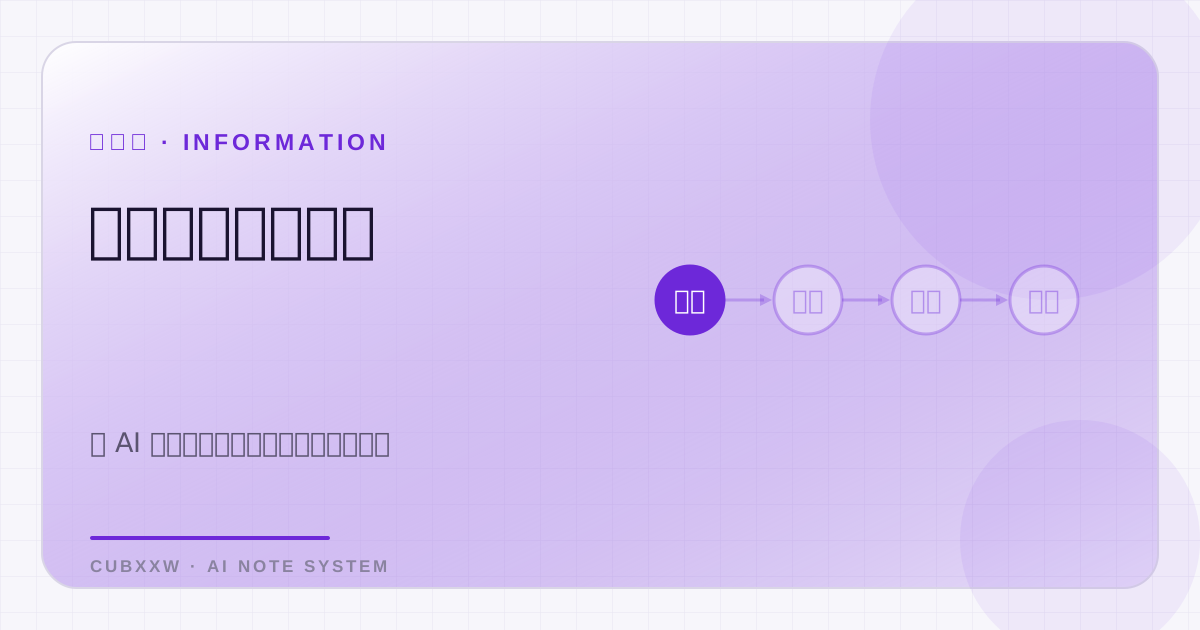
- Information — capture and reduce noise, keep most of it out at the door, and hunt for firsthand or source-grounded signals that generic generation does not supply on its own;
- Records — let the semi-finished product settle with the lowest friction, using “write something every day” and next-day polish to push it toward knowledge;
- Knowledge — structure validated output into repeatedly callable capability sediment, which doubles as a context map fed to AI;
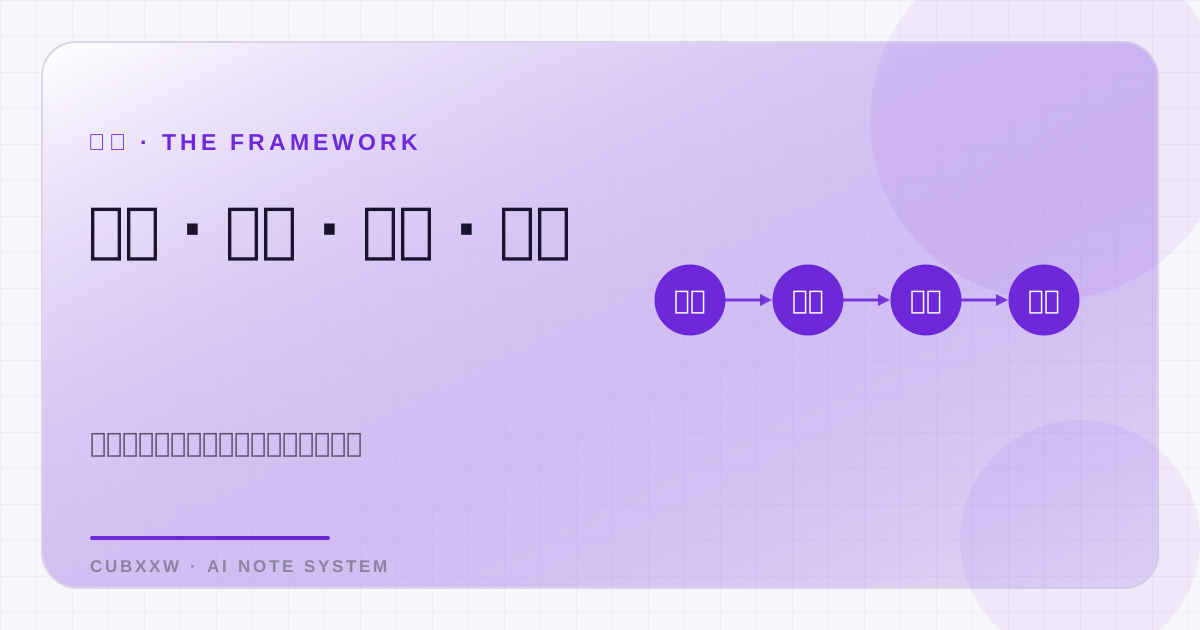
- Creation — recombine knowledge for an audience into a finished product, and let feedback flow back in, turning it into a self-feeding flywheel.
The operating principle I carry out of this chain is not a fixed allocation by layer. It is a risk test: the less reversible a claim is, the more firsthand it sounds, and the more it affects another person, the stronger the evidence and human review must become. AI can search broadly at the information layer, propose structure at the knowledge layer, and help draft at the creation layer. At every layer it can also omit, distort, or invent. Friction is not automatically growth, but the work of making a vague claim testable is friction I do not want the system to remove.
The plainest test standard for this entire series is still the one I trust most: judging whether your system is good doesn’t come from how much you’ve stored or how much you’ve published — it comes from whether your decisions and work have changed.
Information is cheap. What’s valuable is processing information, layer by layer, into capability, and then into finished work — and, in that process, genuinely becoming a different person.
This is the finale of the “From Information to Creation” column. Previous: Layer Three · Knowledge . Back to the overview for a full view of this pipeline.
Responses