A Year Later, Why Does AI Still Feel Like Extra Work?
AI now writes copy, translates documents, summarizes meetings, and inspects spreadsheets. Yet one honest question cuts through the excitement: has it taken over a business step, or do you still explain the background, judge the answer, and decide what happens next every time?
The model may be smarter. The person carrying the context and the responsibility often has not changed.
For this essay, I use a simple operating framework:
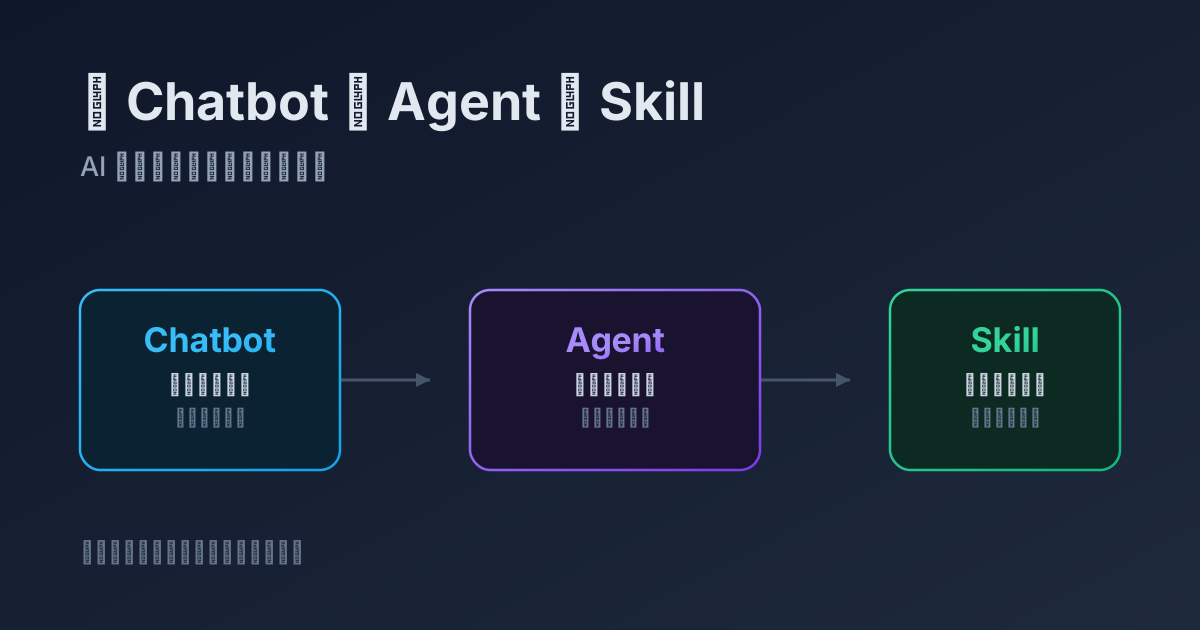
A Chatbot answers one question. An Agent completes a task. A Skill makes a recurring task reusable and testable.
These are not universal industry definitions, nor a strict ladder of technical sophistication. Real products blur the boundaries. I use the three terms as practical tests: where does context come from, what actions may the system take, and who decides whether the result is good enough?
Three Levels, Three Different Transfers of Work
A Chatbot answers a question. You ask it to improve a product title or interpret a negative review. It responds, but you provide the context and choose the next move.
An Agent completes a task. It can read files, query data, call tools, and check its own output. Instead of asking a question, you assign work: read the reviews for an ASIN, classify the complaints, cite the evidence, and flag listing risks.
A Skill is a reusable operating procedure. If the same task returns every week or for every new product, repeatedly writing a prompt is waste. A Skill defines the inputs, tools, decision rules, output, quality checks, and—just as importantly—the actions it must never execute on its own.
The deeper change is where context and judgment live:
- With a Chatbot, you feed in the context each time.
- With an Agent, the system retrieves some context itself.
- With a Skill, retrieval, judgment rules, and acceptance criteria become part of the workflow.
Collecting a hundred prompts improves the wording of manual input. The larger leverage comes from reliable retrieval, explicit judgment, and repeatable verification. This extends the principle in Give AI Tasks, Not Directions : keep direction and accountability with people, give bounded tasks to an Agent, and turn recurring work into a Skill.
The Asset Is Not Judgment Alone, but a Feedback-Bearing Process
This is the turning point.
The cross-border example here comes from my personal reading of discussions in a paid AI community of roughly 400 members. It is an anonymized observation, not a survey, and it cannot represent all sellers. One pattern appeared often enough to become a useful hypothesis: many people buy tools; far fewer keep improving a process.
The difference may not be who has the most expensive model. It may be who can turn private business judgment into a workflow that another person can run, inspect, and challenge.
Tools are widely available. A competitor can use the same model and upgrade on the same day. Domain judgment is harder to copy. An experienced Amazon operator reads a keyword through category economics, sample size, returns, inventory, and margin. The conclusion is not magic; it is compressed experience.
The useful move is to unpack that experience:
- What evidence led to the decision?
- Which threshold mattered?
- What exception would reverse it?
- What is the cost of being wrong?
- What happened after the decision?
Only then can intuition become a team asset. A written rule without real data grows stale. A workflow without feedback repeats yesterday’s mistake faster. The durable asset is therefore not “the prompt” or even “the judgment.” It is a process with domain data, decision rules, feedback loops, and responsibility boundaries.
Two Opportunities on the Same Boundary
For Industry Practitioners: Move Experience from Memory into a System
In commerce, manufacturing, trade, and services, critical decisions often live in a few experienced heads. AI does not automatically copy that experience, but it lowers the cost of recording it, replaying it, and comparing it with outcomes.
Do not begin by documenting everything. Start with decisions that are frequent, expensive, and replayable. Write down the input, evidence, threshold, exception, and final outcome. The model is only the engine; the workflow corrected by real feedback is the steering wheel.
For AI-Native Builders: Take a Narrow Slice, Not the Whole Industry
If you can build Agents and Skills but lack years in a traditional industry, the opportunity is to remove one small pocket of repetitive judgment—not to announce that the industry is about to be replaced.
AI is strong in the soft layer: analysis, content, coordination, and workflow. Supply chains, distribution, offline trust, licenses, and capital belong to the hard layer. They are not compressed into a three-month learning curve.
The dangerous mistake is to confuse knowing how to build a workflow with knowing how the business works. A steadier path is to solve one narrow soft-layer problem, earn trust and data through delivery, and partner for the hard-layer knowledge you do not possess.
Amazon Ads: Separate Official Capability from Product Hypothesis
First, the documented facts.
Amazon describes Ads Agent as a conversational AI assistant inside the Amazon Ads console. Its official product page says it can create campaign structures from media plans, adjust pacing, budgets, and delivery across campaigns, recommend Amazon DSP audiences, and help generate SQL queries and audience segments in Amazon Marketing Cloud (AMC).
That does not mean every Amazon seller receives a free, fully autonomous bidding system. Amazon says initial web access is for advertisers with access to AMC and Multimedia Solutions with Amazon DSP, and availability varies by locale. Ads Agent itself is available at no cost; media spend and other Amazon Ads charges are separate.
The control boundary matters just as much. Amazon states that Ads Agent summarizes proposed changes before taking action. The advertiser can review and approve them, and the Agent then makes the specified changes. In other words, the documented workflow keeps a human decision point; “it spends for every seller on its own” would be an inaccurate description.
The current boundaries are documented on the Amazon Ads Agent product page and in Amazon’s Ads Agent launch announcement .
Now the hypothesis.
Amazon has deep first-party advertising data and sells advertising inventory. A seller may care about net profit after product cost, fulfillment, returns, and working-capital pressure. Those objectives are not necessarily in conflict, but they are not automatically identical either. That leaves a possible role for third-party decision support around cross-source profit calculations, evidence trails, and independent review.
Possible product principles include:
- Traceable evidence: every recommendation cites its source rows, calculation, scope, and confidence.
- Profit-aware decisions: evaluate net contribution after costs and returns, not ACoS in isolation.
- Cross-source review: put ads, orders, returns, inventory, and margin in one decision record.
- A human gate: changes to bids, budgets, and campaign status remain pending until an accountable person approves them.
These are product hypotheses, not proof of a market. Some operators I have spoken with ask why a tool recommends a change, but that is an anonymized personal observation—not the industry’s “number-one complaint.” Rule-based systems can also be explainable. The real test is whether an explanation changes a decision, reduces error cost, and earns repeated use.
A Skill You Can Start Building Today
Do not start with “build an advertising Agent.” Start with one task that can be replayed against historical cases.
name: ad-anomaly-review
goal: identify ad groups that need human review; never change campaigns
inputs:
  - ad report: spend, sales, clicks, conversions, search terms
  - product data: margin, return rate, days of inventory
rules:
  - if the sample is too small, flag it without drawing a conclusion
  - every recommendation must cite source rows and its calculation
  - budget, bid, or pause changes must be emitted as pending actions
output:
  - observed anomaly
  - possible causes with confidence
  - proposed action, expected upside, and worst-case loss
  - review / approve / reject
checks:
  - required fields exist; currency and time windows match
  - no future data is used
  - correlation is not presented as causation
Before using it on live work, replay at least 20 historical cases and compare the output with decisions made by an experienced operator. Track four kinds of evidence:
- Evidence accuracy: Are cited rows and calculations correct?
- Recommendation acceptance: What share is approved, and why are others rejected?
- Business outcome: After approved actions, did net profit, wasted spend, or stockout risk improve?
- Risk: How often did the Skill propose a harmful action, exceed its authority, or produce something that could not be rolled back?
Counting generated recommendations rewards noise. A useful Skill reduces repeated work and costly mistakes without crossing its responsibility boundary.
Do Not Outsource Accountability
AI can perform work; accountability remains human. Price changes, budget adjustments, replenishment orders, core listing edits, and high-risk disputes should follow a visible path:
AI recommends → a person reviews → high-risk actions receive a second confirmation → important actions are logged.
Sensitive data should be minimized or redacted before it enters an external tool. Maturity is not the percentage of clicks automated. It is the ability to gain speed while preserving judgment, auditability, and recovery.
Closing: Build One Process That Can Survive a Review
Tools, platforms, and models will change. The question worth keeping is smaller and harder: can I turn one recurring judgment into a process with evidence, boundaries, and feedback?
Do not begin with a grand “digital employee.” Choose one frequent task. Replay 20 historical cases. Let an experienced person challenge every recommendation. The first worthwhile Skill is not the one that sounds intelligent; it is the one that survives review and improves after reality answers back.



Responses