
Doneas adds a constraint to a personal weekly plan: it locks at noon on Monday, and on every workday after that, you report progress to the same small group. You still decide what to work on, but someone remembers today what you said yesterday.
That design is worth taking apart. Independent developers can already build a task list quite easily, or even a complete project management interface. The difficulty often arrives in the second week: whether the original commitments survive, whether incoming work has displaced them, and whether anyone will show up on time tomorrow.
The Doneas website connects these questions through a working week: plan on Sunday, lock at noon on Monday, execute during the week, and reflect on Friday, with a fifteen-minute group call each workday connecting the days. This article examines that mechanism using public pages and official published material available as of October 23, 2026. The research did not include registration, payment, or participation in a real call, and there is no user data sufficient to judge retention or productivity gains. Official rules, public-page observations, and suggested implementations are distinguished below.
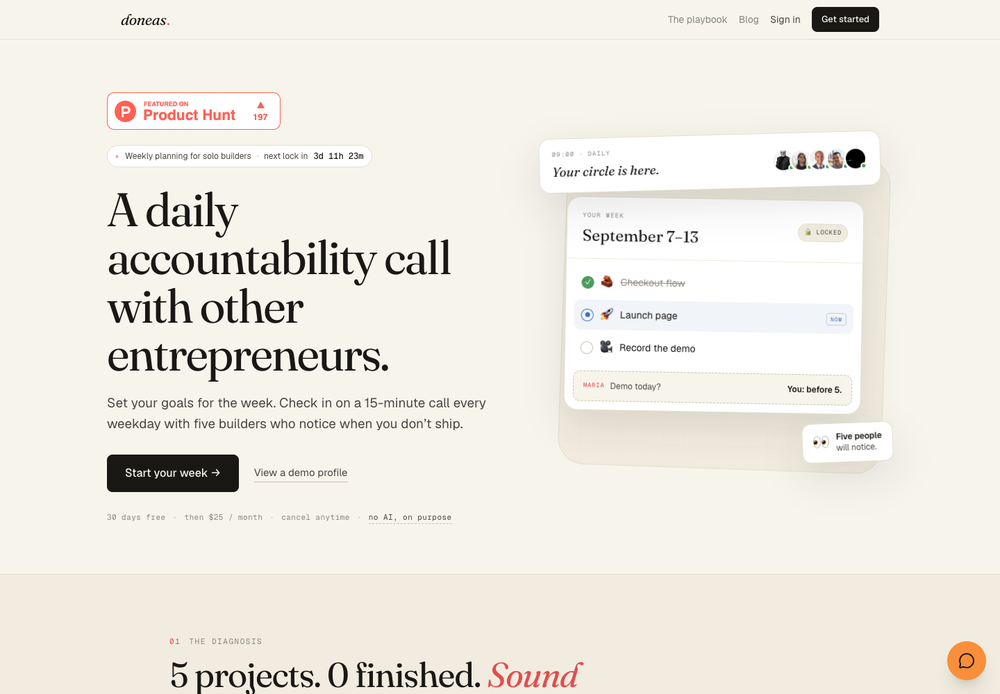
Official marketing illustration showing how a weekly plan connects to daily meetings; this is not an account record from this research. Source: Doneas homepage , captured on 2026-10-23.
Sunday: decide what to leave out of the week
Doneas targets independent entrepreneurs, and also names freelancers and consultants as intended users. It is currently a Web product, and the official FAQ specifically notes that calling it an accountability app does not imply a native iOS or Android application. Accountability page
It places projects and roadmaps before the weekly plan: establish the longer-term direction, then choose how much work to take on this week. Its project page explicitly separates having a project from prioritizing that project now. The weekly plan follows the latter decision. Both the product overview and the project and roadmap page describe this sequence.
That is a practical distinction for someone building independently. Imagine a person with two products and some consulting work. There is far more they could do this week than they can finish. Moving every item into a weekly view merely gives those wishes another place to live. A plan has to make choices before it can become a shared reference for the calls that follow.
The official planning guidance asks users to estimate effort, assign work to particular days, and consider the week’s actual capacity. Unfinished items require another personal decision: keep them, break them down, or remove them. The product does not make last week’s list next week’s obligation on the user’s behalf. The weekly planning page and product overview explain these two parts.
Consider a hypothetical builder trying to get a first user through payment. A weekly commitment could be “connect the payment callback and complete a test order.” “Improve the whole purchase experience” is still too broad. The first version gives the builder something concrete to report on Friday, and a way to identify a blocker on Wednesday. This is an example for the article; it does not establish that Doneas provides acceptance criteria or automatic task decomposition.
The boundary of a week temporarily moves “someday” out of view. New ideas can still exist, while the current week has only so much room. The software needs to preserve the choices the user has already made, together with the period those choices apply to. Otherwise, rearranging priorities every day can still change the initial decision beyond recognition.
An official post by Bengeekly explains the thinking behind this schedule. In the article dated August 5, 2026, he describes setting aside thirty minutes on Sunday evening to plan the week, then following that plan during the workdays. This helps explain the product’s emphasis on a weekly rhythm. Whether that arrangement reduces procrastination for a particular user still requires actual use. Separate planning from execution
Monday noon: the plan starts leaving a record
The homepage identifies the lock-in point as Monday noon. The broader product page also says work can be added after the plan locks, but late additions should remain visible. Taken together, these statements explain the intended lock: preserve what was promised at the start of the week while allowing new work to enter. The homepage’s weekly cycle , product overview
That detail carries more weight than a padlock icon. Suppose the builder commits to the payment callback on Monday, deals with an incident on Wednesday, and finishes only the incident response. Friday’s task list alone cannot show the tradeoff. Keeping the original plan and the later addition makes it possible to review the deviation.
The public material leaves one question unanswered: which time zone defines Monday noon? The homepage does not specify one in this part of the process, while the circle directory explicitly lists call times in UTC. Those two facts do not establish that every user’s plan locks at noon in their local time. Someone working across regions needs a direct answer about how many hours remain to change a plan.
The scope of the lock also calls for care. The published description supports preserving the initial commitment and identifying later additions, but this research did not test whether a locked task’s name, date, or cancellation state can be changed. An ideal version history cannot be described as an implemented feature without evidence.
For a similar product, I would first save a snapshot when the plan locks, then record subsequent changes separately. Users need to understand both what they originally promised and what happened later. The change log can be simple, but an ordinary edit should not erase the weekly plan’s history. Sensitive work also needs a clear visibility boundary: a commitment shared with peers can contain less detail than the private working record.
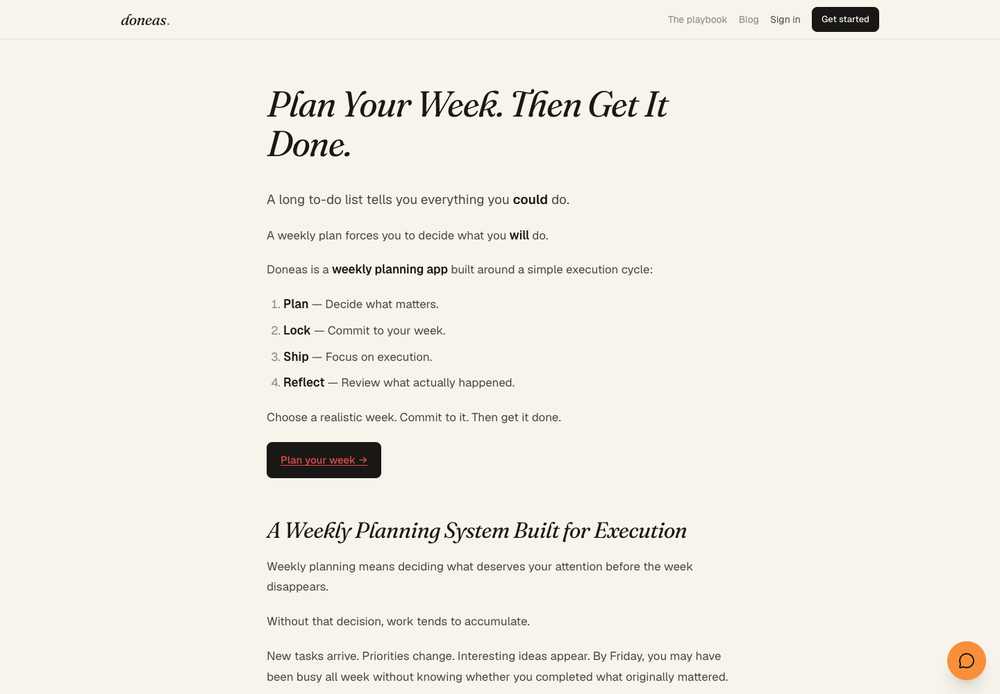
The official page divides the week into planning, locking, execution, and reflection. It illustrates the product’s stated approach; it does not prove that these steps were verified in a real account. Source: Doneas weekly planning page , captured on 2026-10-23.
Workdays: someone expects you to show up
The Doneas homepage describes a standard circle as the same five builders meeting for fifteen minutes every workday over a month. The circle also has a defined role: witnessing commitments and execution, without assigning tasks, managing projects, or setting priorities for members. Personal decisions remain with the individual; peers provide awareness of what was promised. Homepage circle rules , accountability page
There are two official descriptions of the call agenda. The accountability page asks what you did yesterday and what you will do today. The broader product page uses three questions: what you completed, what comes next, and what is blocking you. These can be described as brief progress reports, next steps, and blockers where relevant, but neither wording establishes a single agenda strictly followed by every circle. Accountability page , product overview
Fifteen minutes with five members requires concise contributions. It gives the meeting a memorable place in the day while limiting how much discussion it can support. A member can report a problem with a payment callback so the group understands the situation. That does not make anyone in the call responsible for fixing it. A deeper conversation still needs its own time.
Stable membership and a fixed meeting time reinforce one another. The same people are more likely to remember yesterday’s commitment, and a recurring slot avoids arranging the meeting again each day. The cost is equally concrete: members need to keep that slot available. At five workdays per week, the calls alone amount to seventy-five minutes, excluding waiting and switching between activities. This is arithmetic based on the official frequency, not measured user behavior.
The public entry point gives this constraint priority, too. The circle directory lets visitors choose a fixed UTC slot first, showing a monthly name and available places. Visitors can also switch to the builders directory and start with people. Following one Join calls link anonymously ultimately led to registration. That establishes only that joining begins with registration; allocation and seat confirmation after registration were not verified.
Choosing a time one can sustain can make the decision more concrete than browsing many member profiles. It also exposes operating questions. Whether a circle starts before it fills, what happens when someone leaves mid-month, and whether persistent lateness consumes other members’ time all affect the value of those fifteen minutes. Public information does not yet establish how Doneas handles these situations, so professional facilitation or matching guarantees cannot be supplied on its behalf.
Absence is visible, and leaving needs to be possible
The homepage publishes fairly specific attendance rules: declared leave does not count as absence, absences are visible, and three absences lead to removal. It says users can reactivate themselves twice a year; after that, a peer must vouch for them. These are the official claims. This research did not join a circle or verify removal and reactivation. Doneas homepage
These rules help explain how the service intends to maintain its quality. Someone who repeatedly fails to attend can turn an allocated place into an empty seat that the others encounter every day. A product promising that someone notices whether you show up needs a way to address persistent absence, or those who do attend may gradually lose their reason to wait.
But people miss calls for different reasons. Declared leave, a dropped connection, and disappearing without notice do not affect the group in quite the same way. The page separates leave from absence, but the public evidence does not fully answer how long someone must attend to count as present, how connection failures can be disputed, or whether annual limits use a calendar or rolling year. A clear penalty does not establish that every execution detail is clear.
In another official post, Bengeekly describes using a KitKat as the cost of being late. He emphasizes that the cost is certain, immediate, and known to someone else. This helps explain the product’s interest in a cost for missed commitments, but it does not mean Doneas charges a monetary fine for absence. Mixing a designer’s personal experience with product terms could mislead readers about what they are buying. Make slipping cost something
A service like this also needs room for a reasonable departure. Some people have unpredictable working hours, some do not want to report daily, and others cannot discuss their work with a group. They may value weekly planning without being suited to a fixed daily circle. The product can choose to serve people willing to accept these constraints, without treating departure as a failure of self-discipline.
Friday: revisit what was originally promised
Doneas places reflection at the end of the working week and asks users to decide whether unfinished work should be carried forward. This gives the next week a fresh round of choices. Automatically carrying everything forward would make it easy for an accumulating list to overwhelm the week’s capacity. Homepage weekly cycle , weekly planning page
Its progress page brings completed work together with consistency in peer accountability. The official explanation says these records come from actions already taken in the normal workflow, with users controlling which parts are public. That supports an interpretation of progress being recorded along the way. The actual default visibility settings were not checked inside an account. Progress tracking page
Completing work and showing up on time deserve separate attention. Someone can attend every call without finishing the week’s important work; someone else might deliver something while taking two days of leave. Compressing both into one score would make it hard to understand what that score rewards. For a small implementation, keeping the two records side by side is usually easier to explain than immediately designing a points system.
Progress records also have an evidentiary limit. The public material does not establish that Doneas checks the external output associated with a task. An item marked shipped can indicate a recorded completion claim. It does not automatically prove that a website is live, a customer received the work, or an independent reviewer accepted the result. A work sample link could provide another way to check a public track record, but self-reporting and external confirmation would still need to be distinguished.
Returning to the payment callback example, a useful Friday review could be quite plain: what was originally meant to happen with the test order, how far it actually got, what interrupted it, and whether it is worth continuing next week. A group that has heard several days of updates has context for that review. Whether the process helps members make better decisions still needs observation in a real group.
At twenty-five dollars a month, what must the service deliver?
As of October 23, 2026, the homepage advertised thirty days free, followed by twenty-five dollars per month, with cancellation available at any time. It also said the personal page remains after cancellation. This research did not enter checkout, so card requirements for the trial, taxes, and refund details remain unverified. Doneas homepage
The homepage also promotes “no AI, on purpose.” This describes how the vendor presents its product; that phrase alone cannot establish that the entire technology stack contains no models or automation services. At least in its public positioning, Doneas asks users to choose their own work and meet real people who remember those choices. Doneas homepage
That price broadens the evaluation to an ongoing service. The task list matters, but meeting a stable group at the chosen time may also influence renewal. If five people are happy to write goals but only two appear on time, even a complete interface cannot fulfill the original promise by itself.
From an operating perspective, software scale and group quality may pull in different directions. More time slots make selection easier, but each slot needs enough people. Faster admission makes handling vacancies and absences more important. These are costs implied by the mechanism; the public directory counts are insufficient to estimate Doneas revenue or operating efficiency.
The directory also contained a discrepancy on the research date: one circle showed 6 of 5, while its detail page showed 5 of 5. Some circle names were duplicated as well. The displays might have been updated at different times, or there could be another explanation; the available evidence cannot decide. It establishes only that the public displays did not fully agree, so a strict five-person system limit cannot be guaranteed from them. Circle directory
, corresponding circle detail
More information is needed before buying. This research did not find directly readable official terms, privacy, or refund pages through the public entry points and sitemap; several common paths checked returned 404. That means they were not found in this investigation, rather than proving they do not exist. Renewal and cancellation effective times, whether meetings are recorded, and how data can be deleted or exported still require an explanation from the vendor or evidence from a later purchase flow. Sitemap
“Cancel anytime” and “your personal page stays” answer different questions. The former still needs an explanation of when billing stops. The latter leaves questions about what remains, whether it stays public, and whether it can be deleted. With personal goals and attendance records involved, those answers directly affect how much someone is willing to share.
Building your own: run one group through one week first
To borrow from Doneas, I would start with one fixed time slot and a group willing to accept the same rules, then run a week from planning through reflection. It could be organized manually at first, without replicating the whole public directory. The behaviors to examine are concrete: whether members make commitments that fit their capacity, whether changes remain understandable after lock-in, whether calls repeatedly run over, and whether anyone wants to deal seriously with unfinished items on Friday.
The following is a proposed implementation, not Doneas’s actual data structure. Distinguishing a few things early can reduce confusion when the rules change later.
| What to keep | The first question it should answer |
|---|---|
A weekly plan, WeeklyPlan | Which time zone defines the week, when does it lock, and which version was saved at lock-in? |
A specific commitment, Commitment | What was originally promised, what was added or changed later, and how was it handled at the end of the week? |
A group and daily meeting, Circle / Session | Which monthly group does a member belong to, and when does a particular call take place? |
An attendance record, Attendance | Was the member present, on declared leave, or absent, and was that determination later corrected? |
Separating the monthly group from each daily meeting is particularly useful. A month-long circle has stable membership, but each call has its own date and may encounter a holiday or cancellation. Attendance should belong to a particular meeting, so changing a circle’s schedule does not change historical absence records.
Time rules should be written in language people can understand in the first version, then enforced by the system. The weekly plan’s time zone, whether a recurring call shifts with daylight saving time, and how local times appear after travel all need definite explanations. Saving a UTC timestamp handles only part of this. Members also need to know whether they are committing to the same local clock time or to the same moment worldwide.
Late data needs a place, too. Suppose attendance confirmation arrives after a scheduled job has already marked someone absent: the system needs to correct the record according to its rules. Receiving the confirmation again should not create a second attendance record. Clicking lock twice should not create conflicting weekly commitments either. This requirement for a repeated action to retain a single result is the idempotency problem worth addressing early here.
Billing can wait until the week-long service works, but once added, billing and group status need separate explanations. Does canceling renewal remove the seat immediately? What happens to a call on the day the trial ends? Does a personal page remain after payment failure? The product has to make those choices. Repeated or delayed payment notifications should neither cause duplicate charges nor keep moving a member between states. These are rules a prospective product should define; this article has no evidence of which approach Doneas uses.
The initial acceptance record can be simple as well. Check whether the original plan can be compared with Friday’s outcome, whether any leave was incorrectly counted as absence, and why calls were canceled or ran over. Then ask whether members want to continue next week. For a very small group, actual counts and reasons are more useful than an attractive retention percentage: they give the next change a specific problem to address.
Doneas makes a product question concrete: how many reliable small agreements must a plan written on Sunday pass through before it is still recognizable on Friday? When building a task interface, start by making that single working week dependable. Once the same people still want to show up on time next week, decide whether to open more time slots.
References
All sources below were reviewed on 2026-10-23. Rules and prices can change. Marketing descriptions, public-page observations, and this article’s proposals establish different things.
- Doneas homepage: weekly cycle, circle rules, and current pricing
- Productivity App for Entrepreneurs: planning capacity, late additions, and call content
- Weekly Planning App for Solo Builders: weekly plans and unfinished tasks
- Project Roadmap & Planning for Solo Builders: project selection and execution order
- Accountability App for Solo Builders: the role and scope of peer calls
- Progress Tracking for Solo Builders: completion records, consistency, and visibility controls
- The circles meeting on Doneas: public time slots and seat directory
- The builders shipping on Doneas: the public people-first entry point
- Circle 2 · Oct 2026: the display discrepancy between directory and detail
- Separate planning from execution: Bengeekly’s account of his planning habit
- Make slipping cost something: Bengeekly’s personal explanation of missed-commitment costs
- Doneas sitemap: the public discovery scope of this investigation


Responses